
Session Information
Session Type: Poster Session (Monday)
Session Time: 9:00AM-11:00AM
Background/Purpose: Familial Mediterranean Fever (FMF) is a monogenic autoinflammatory disorder with innate immune activation with an onset before age 20 in approximately 90% of the patients. There is scarce data on the effect of aging on FMF patients over 40 years of age. This study aims to collect data on FMF patients who have survived over 40 years of age. Here we report our preliminary data on disease course and treatment status and comorbidities of our patients with FMF.
Methods: Among the FMF patients who have been followed in our FMF outpatient clinic with a pool of approximately 5000 patients, those who have aged 40 and over are being included to the study. As by today 180 patients are considered for evaluation. The files of patients were reviewed and a standard questionnaire was used to interview the patients. Here we report the results of 100 of these patients (56%) who were contacted for this purpose. These patients were questioned on their demographic characteristics, comorbid conditions, colchicine treatment details, and attack information. In order to see the trend of the change in the parameters assessed, the patients were divided into two groups based on their present age (Group 1: 40-50 years, Group 2: ≥50 years).
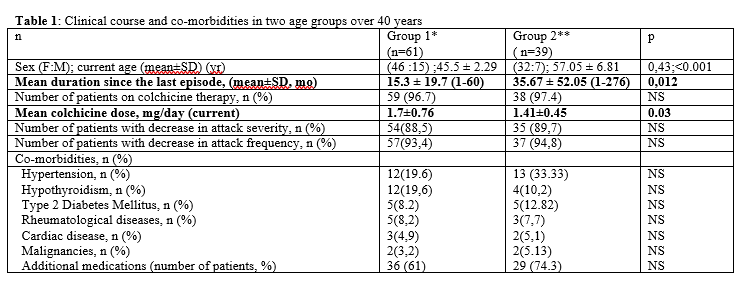
Results: A total of 100 (78 F, 22M) patients were evaluated. There were 61(46F, 15M) patients aged between 40-50 years and 39 (32F, 7M) over 50. The demographic characteristics and clinical features of these patients are given in Table 1. Besides 3, all patients were still on colchicine regularly. Ninety-six percent of the patients declared overall benefit from colchicine therapy; however 38% experienced a side effect related to this treatment. Over 88% of the patients reported decrease in severity and frequency of FMF attacks. The mean daily colchicine dose was lower in the age 50 and over group (1.7±0,77 mg versus 1,35 ±0,38 mg). There were no patients with AA amyloidosis in neither age group. The mean duration from the last attack increased from 15.3 ±19.7 months to 35.6± 52 months in the older patients. One or more additional disease was present in 75% of this patient group.
Conclusion: According to our preliminary data the majority of the patients continue to take colchicine after age of 40. However, the frequency of FMF attacks as well as daily colchicine dose decrease as the patients get older. With well-designed trials stopping colchicine treatment may be considered in a subgroup of patients after 50 years of age. Approximately ¾ of the FMF population over 40 years of age has a comorbidity that necessitates additional medications which underlines the need for special attention.
To cite this abstract in AMA style:
Ugurlu S, Aydin O, Egeli B, Soykut A, Demir D, Ozdogan H. The Impact of Aging on Familial Mediterranean Fever Patients [abstract]. Arthritis Rheumatol. 2019; 71 (suppl 10). https://acrabstracts.org/abstract/the-impact-of-aging-on-familial-mediterranean-fever-patients/. Accessed .« Back to 2019 ACR/ARP Annual Meeting
ACR Meeting Abstracts - https://acrabstracts.org/abstract/the-impact-of-aging-on-familial-mediterranean-fever-patients/