
Session Information
Session Type: ACR Concurrent Abstract Session
Session Time: 11:00AM-12:30PM
Background/Purpose : The goal of the IMI PRECISESADS project is to reclassify individuals affected by systemic autoimmune diseases (SADs) into clusters of molecular, instead of clinical entities. In this project, we investigated 40 individuals with primary Sjögren’s syndrome (pSS), as diagnosed by the revised American-European classification criteria (3 men and 37 women, mean age: 56.3±12.3 years). and 53 healthy controls (HCs) (11 men and 42 women, mean age: 44.1±12.1 years) to determine whether a fine flow cytometry analysis of T and B cell distribution in whole blood could cluster individuals according to disease activity.
Methods: Two flow cytometry panels were designed. The first panel was dedicated to T cells and combined FITC-CD57, PE-CD45RA, PC7-CD62L, PC5.5-CD27, APC-CD38, AAF750-CD3, PB-CD4,KO-CD8 mAbs. The second panel was dedicated to B cells and combined FITC-IgD, PE-TACI, KO-CD5, PC7-CD24, PC5.5-CD27, PB-CD38, APC-CD19, AAF750-CD11b mAbs. Disease activity was determined according to ESSDAI. A Luminex-based system was used to analyze up to 88 cytokines, chemokines and soluble factors in serum of pSS patients and HCs.
Results: A combined analysis of T and B cell distribution highlighted two groups of individuals with a strong cluster of pSS patients in one of them. Indeed, the first cluster (group A) gathers together 24 pSS patients and 5 HCs while group B consists in 16 pSS patients and 49 HCs. Group A was characterized by the association of an increase of activated naïve B cells (IgD+ CD24+ CD38+ CD27–), a decrease of memory B cells (IgD– CD38– CD27+), an increase of central memory CD4+ T cells (CD45RA– CD62L+ CD27+), an increase of effector memory CD8+ T cells (CD45RA– CD62L– CD27–) and a decrease of central memory CD8+ T cells (CD45RA– CD62L+ CD27+) compared to group B and 91% of HCs. Interestingly, group A patients have a higher disease activity score when compared to group B (Mean ESSDAI score 5.0±1.9 versus 3.2±0.9 respectively). Finally, serum pro-inflammatory molecules (interleukin (IL)-6, C-reactive protein (CRP), Chemokine (C-C motif) ligand 20 (CCL20), CCL3, matrix metalloproteinase-7 (MMP-7), IL-18) were markedly up-regulated in group A patients compared to HCs and group B patients (See heat-map below).
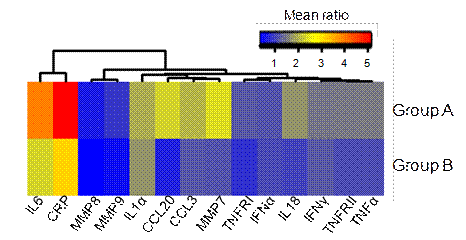
Heat-map shows mean-ratio of pro-inflammatory molecule concentrations relative to HCs in each group of pSS patients.
Conclusion: A fine flow cytometry analysis of T and B cell subsets characterizes pSS patients with a higher disease activity score and a pro-inflammatory signature. Similar approaches are ongoing in the context of the PRECISESADS project for other SADs.
This work has received support from the EU/EFPIA Innovative Medicines Initiative Joint Undertaking PRECISESADS grant n° 115565.www.precisesads.eu
To cite this abstract in AMA style:
Le Lann L, Simon Q, Jamin C, Borghi MO, Beretta L, Cervera R, Saraux A, Cornec D, Lories R, Chizzolini C, Alarcon Riquelme ME, Pers JO. Specific T Cell and B Cell Distributions Characterize Subgroups of Patients with Primary Sjögren’s Syndrome and Are Associated with Disease Activity and Pro-Inflammatory Cytokine Expression [abstract]. Arthritis Rheumatol. 2016; 68 (suppl 10). https://acrabstracts.org/abstract/specific-t-cell-and-b-cell-distributions-characterize-subgroups-of-patients-with-primary-sjogrens-syndrome-and-are-associated-with-disease-activity-and-pro-inflammatory-cytokine-expression/. Accessed .« Back to 2016 ACR/ARHP Annual Meeting
ACR Meeting Abstracts - https://acrabstracts.org/abstract/specific-t-cell-and-b-cell-distributions-characterize-subgroups-of-patients-with-primary-sjogrens-syndrome-and-are-associated-with-disease-activity-and-pro-inflammatory-cytokine-expression/