ACR Meeting Abstracts

ACR Meeting Abstracts

  • Meeting Abstracts
    • All Meetings
    • ACR Convergence 2026
    • PRSYM 2026
    • ACR Convergence 2025
    • Download Abstract Supplements
  • Keyword Index
  • My Favorites
    • View & print my favorites
  • Search

Home » Meeting Abstracts » ACR Convergence 2021

Abstract Number: 0380

Sick Leave and Its Predictors in Early Axial Spondyloarthritis: The Role of Clinical and Socioeconomic Factors. Five-year Data from the DESIR Cohort

Elena Nikiphorou1, Annelies Boonen2, PEDRO CARVALHO3, Bruno Fautrel4, Pascal Richette5, Pedro Machado6, Désirée van der Heijde7, Robert Landewé8 and Sofia Ramiro1, 1Leiden University Medical Center, Leiden, Netherlands, 2Department of Internal Medicine, Division of Rheumatology, Maastricht University Medical Centre+ (MUMC+), Maastricht, Limburg, Netherlands, 3hospital de Faro, LISBON, Portugal, 4Pitié Salpêtrière Hospital, APHP, Sorbonne Université, Paris, France, 5Lariboisiere Hospital, Paris, France, 6Centre for Rheumatology & Department of Neuromuscular Diseases, University College London, London, United Kingdom, 7Department of Rheumatology, Leiden University Medical Center, Meerssen, Netherlands, 8Amsterdam Rheumatology & Clinical Immunology Center, Amsterdam, Netherlands; Zuyderland MC, Heerlen, Netherlands

Share on X (Twitter) Share on Facebook Share on LinkedIn Share on Email
Print

Meeting: ACR Convergence 2021

Keywords: spondyloarthritis, Spondyloarthropathies

Session Information

Date: Saturday, November 6, 2021

Title: Spondyloarthritis Including PsA – Diagnosis, Manifestations, & Outcomes Poster I: Clinical Aspects of Axial Spondyloarthritis (0357–0386)

Session Type: Poster Session A

Session Time: 8:30AM-10:30AM

Background/Purpose: Sick leave (SL) represents an often poorly studied adverse work outcome especially in early axSpA, with speculation around the potential role of clinical and socioeconomic (SE) factors.

Methods: Patients with a clinical diagnosis of axSpA from the DESIR cohort with work-related data and up to five-year follow-up were studied. Incidence, time to first SL and potential baseline and time-varying predictors were analysed, with a focus on socioeconomic variables (age, gender, ethnicity, education, job-type, marital and parental status). Univariable analyses, followed by collinearity and interaction tests, guided subsequent multivariable time-varying Cox survival model building.

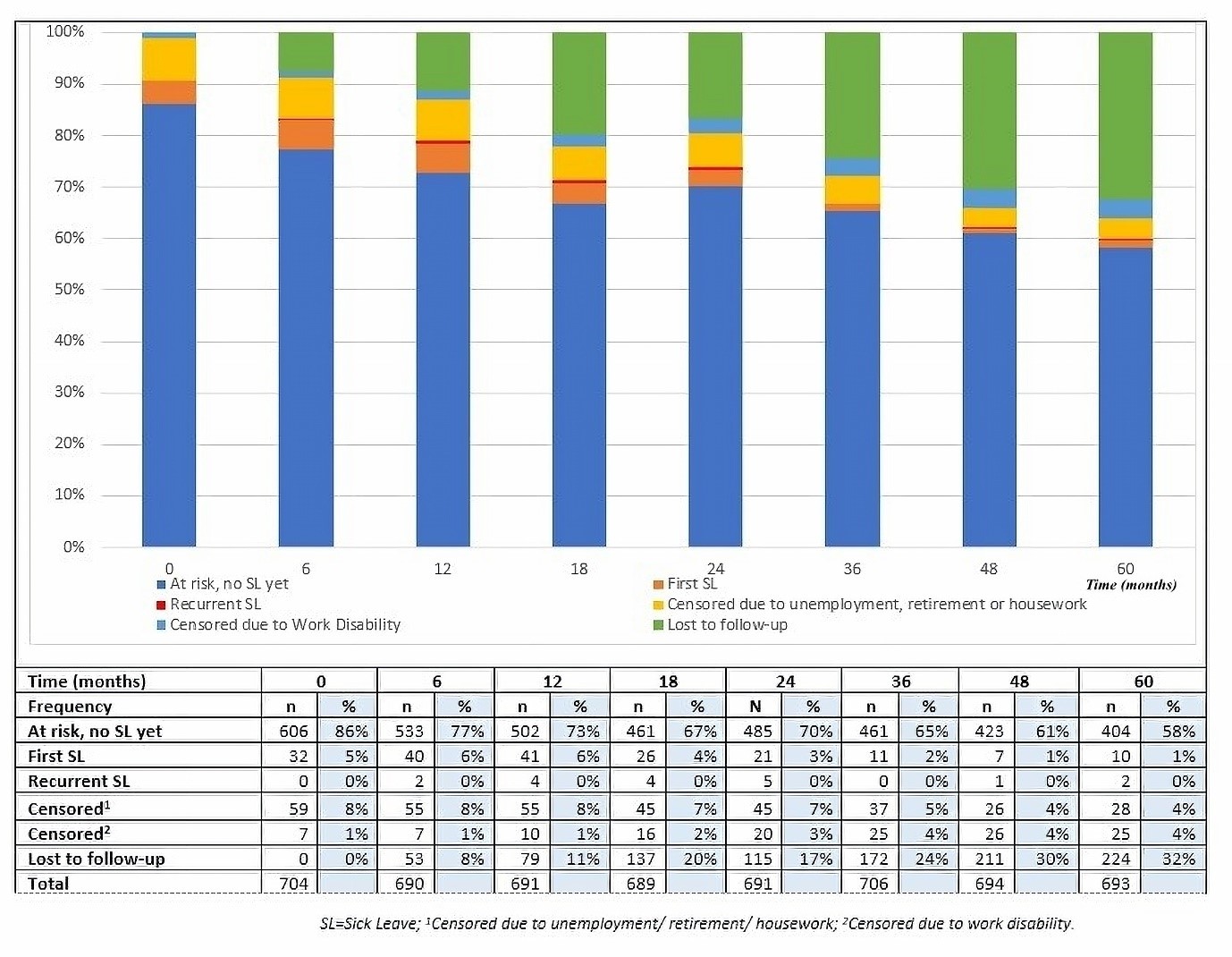
Results: In total, 704 axSpA patients were included (mean (SD) age 33.8 (8.6); 46% male). At baseline, 80% of patients were employed; of these, 5.7% reported being on SL. The distribution of first and recurrent SL episodes over time is shown in Figure 1. The incidence of SL amongst those at risk during the study-period (n=620, 88%) was 0.05 (95% CI 0.03-0.06) per 1000 days of follow-up. Mean (SD) time to first SL was 806 (595) days (range:175-2021 days). In multivariable models, male gender (HR 0.41 (95%CI 0.20-0.86)) and higher education (HR 0.48 (95%CI 0.24-0.95)) were associated with lower hazard of SL, while higher disease activity (HR 1.49 (95%CI 1.04-2.13)), older age, smoking and use of TNFi were associated with higher hazard of SL.

Conclusion: In this early axSpA cohort of young, working-age individuals, male gender and higher education were independently associated with a lower hazard of SL, whereas older age and higher disease activity were associated with higher hazard of SL. The findings suggest a role of socioeconomic factors in adverse work outcomes, alongside active disease.

Disclosures: E. Nikiphorou, Celltrion, 1, Pfizer, 1, 6, Sanofi, 1, Gilead, 1, AbbVie, 1, 6, Lilly, 1, 6, Galapagos, 6; A. Boonen, None; P. CARVALHO, None; B. Fautrel, AbbVie, 5, Pfizer, 5, Janssen, 2, Medac, 2, Novartis, 2, Sanofi-Genzyme, 2, Roche, 2, UCB, 2, Abbvie, 2, Amgen, 2, Biogen, 2, BMS, 2, Celltrion, 2, Fresenius Kabi, 2, Galapagos, 2, Gilead, 2, Lilly, 2, 5, MSD, 2, MSD, 5, Mylan, 2, Nordic Pharma, 2, Pfizer, 2, Sandoz, 2, SOBI, 2; P. Richette, AbbVie, 1, 6, Amgen, 1, 6, Celgene, 1, 6, Janssen, 1, 6, Eli Lilly, 1, 6, MSD, 1, 6, Novartis, 1, 6, Pfizer, 1, 6, UCB, 1, 6; P. Machado, Abbvie, 6, BMS, 6, Celgene, 6, Eli Lilly, 2, Janssen, 2, MSD, 6, Galapagos, 6, Novartis, 2, 6, Pfizer, 6, Roche, 6, UCB, 2, 6, Orphazyme, 5, 6; D. van der Heijde, AbbVie, 2, Amgen, 2, Astellas, 2, AstraZeneca, 2, Bayer, 2, BMS, 2, Boehringer Ingelheim, 2, Celgene, 2, Cyxone, 2, Daiichi, 2, Eisai, 2, Eli Lilly, 2, Galapagos, 2, Gilead, 2, GlaxoSmithKline, 2, Janssen, 2, Merck, 2, Novartis, 2, Pfizer, 2, Regeneron, 2, Roche, 2, Sanofi, 2, Takeda, 2, UCB Pharma, 2, Imaging and Rheumatology BV, 4; R. Landewé, AbbVie, 5, 6, Novartis, 5, 6, Pfizer, 5, 6, UCB, 5, 6, Astra-Zeneca, 6, Bristol Myers Squibb, 6, Celgene, 6, Eli-Lilly, 6, Janssen, 6, Gilead, 6, Galapagos, 6, Glaxo-Smith-Kline, 6; S. Ramiro, AbbVie, 2, Eli Lilly, 2, MSD, 2, Novartis, 2, Sanofi, 2, UCB, 2, MSD, 5.

To cite this abstract in AMA style:

Nikiphorou E, Boonen A, CARVALHO P, Fautrel B, Richette P, Machado P, van der Heijde D, Landewé R, Ramiro S. Sick Leave and Its Predictors in Early Axial Spondyloarthritis: The Role of Clinical and Socioeconomic Factors. Five-year Data from the DESIR Cohort [abstract]. Arthritis Rheumatol. 2021; 73 (suppl 9). https://acrabstracts.org/abstract/sick-leave-and-its-predictors-in-early-axial-spondyloarthritis-the-role-of-clinical-and-socioeconomic-factors-five-year-data-from-the-desir-cohort/. Accessed .

ACR Meeting Abstracts - https://acrabstracts.org/abstract/sick-leave-and-its-predictors-in-early-axial-spondyloarthritis-the-role-of-clinical-and-socioeconomic-factors-five-year-data-from-the-desir-cohort/

My Favorites

Save and print abstracts during your browser session by clicking the “Favorite” button at the bottom of any abstract (must have cookies enabled in browser). See saved favorites.

Abstract Policies

  • ACR Convergence Abstract Embargo Policies
  • ACR Convergence Abstract Permissions & Reprints
  • PRSYM Abstract Policies

ACR Convergence. Where Rheumatology Meets

ACR Convergence 2026

Join us November 6-11 in Orlando, Florida.
See Registration Information

  • Contact ACR
  • Privacy Policy
  • ACR Policies
  • Cookie Preferences

© Copyright 2026 American College of Rheumatology