ACR Meeting Abstracts

ACR Meeting Abstracts

  • Meeting Abstracts
    • All Meetings
    • PRSYM 2026
    • ACR Convergence 2025
    • Download Abstract Supplements
  • Keyword Index
  • My Favorites
    • View & print my favorites
  • Search

Home » Meeting Abstracts » ACR/ARHP Annual Meeting 2018

Abstract Number: 962

Safety Profile of Baricitinib for the Treatment of Rheumatoid Arthritis up to 6 Years: An Updated Integrated Safety Analysis

Mark C. Genovese1, Josef S. Smolen2, Tsutomu Takeuchi3, Terence P. Rooney4, Christina L. Dickson4, Xiao-Yan Yang4, Chadi Saifan4, Anabela Cardoso4, Maher Issa4, Taeko Ishii5 and Kevin Winthrop6, 1Stanford University Medical Center, Palo Alto, CA, 2Division of Rheumatology, Department of Medicine 3, Medical University of Vienna, Vienna, Austria, 3Division of Rheumatology, Department of Internal Medicine, Keio University School of Medicine, Tokyo, Japan, 4Eli Lilly and Company, Indianapolis, IN, 5Eli Lilly and Company, Kobe, Japan, 6Oregon Health and Science University, Portland, OR

Share on X (Twitter) Share on Facebook Share on LinkedIn Share on Email
Print

Meeting: ACR/ARHP Annual Meeting 2018

Keywords: Janus kinase (JAK), rheumatoid arthritis (RA) and safety

Session Information

Date: Sunday, October 21, 2018

Title: 3S108 ACR Abstract: RA–Treatments II: Safety (958–963)

Session Type: ACR Concurrent Abstract Session

Session Time: 4:30PM-6:00PM

Background/Purpose:  Baricitinib (bari), an oral, selective inhibitor of Janus kinase (JAK) 1 and JAK 2, is approved for the treatment of moderately to severely active RA in adults in over 40 countries including European countries, US and Japan. We further describe the drug’s safety profile with updated data from an ongoing long-term extension (LTE) study. 


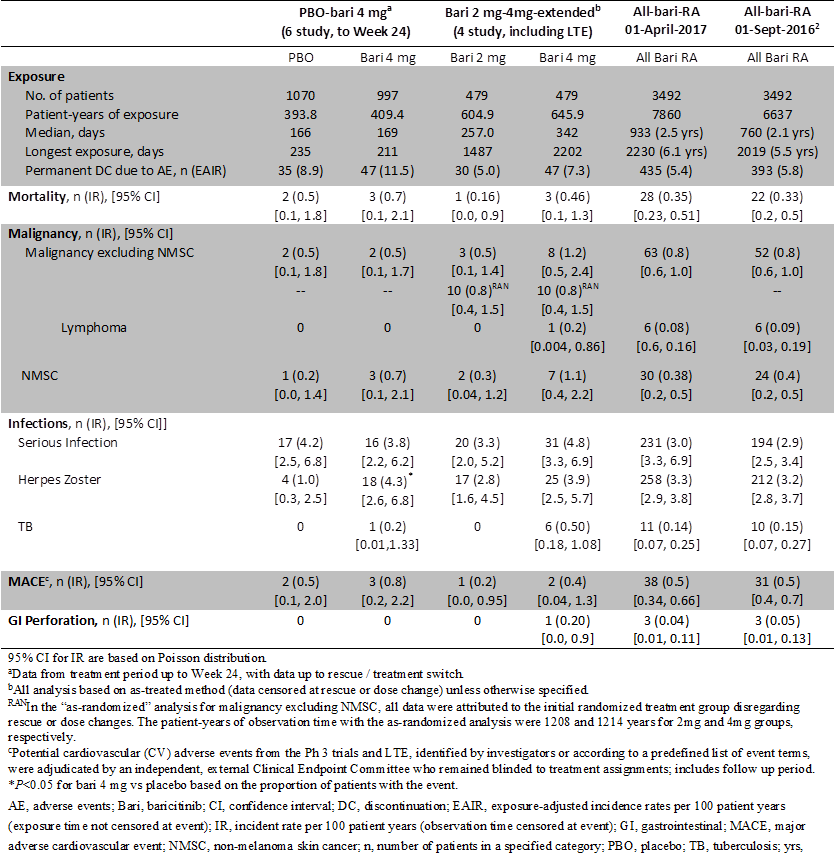
Methods:  Long-term safety of once-daily bari was evaluated in the “all-bari-RA” dataset, which includes all patients (pts) with active RA exposed to any bari dose from 8 randomized trials (4 Phase 3, 3 Phase 2, 1 Phase 1b) and 1 LTE study (data up to 01-April-2017). Previous all-bari-RA analyses1 are provided for comparison (data up to 10-Aug-2015 and 01-Sept-2016).2 Dose responses were evaluated based on the 4 Phase 2/3 trials in which pts were randomized to 2 or 4mg including data from the LTE (the “2mg-4mg-extended” dataset). Data were censored at rescue or dose change (as-treated analysis). Because of the latent period for malignancy, 2mg-4mg-extended was also analyzed without censoring for rescue or dose change (as-randomized analysis). Incidence rates (IR) per 100 patient-years (PY) were calculated.


Results:  In the current analysis, 3492 pts received bari for 7860 total PY of exposure (an increase in over 1200 PY; 18% from 01-Sept-2016) for up to 6 years (Table 1). Of these, 2723 (78.0%) were treated for at least 52 weeks and 1788 (51.2%) were treated for at least 130 weeks. Adverse events (AEs) IRs did not increase with prolonged exposure (Table 1). Malignancy (excluding non-melanoma skin cancer (NMSC)) IR were 0.5 and 1.2 for 2mg and 4mg, respectively, with as-treated analysis and 0.8 and 0.8 with as-randomized analysis. For the above events, the current IRs in all-bari-RA are similar to those previously reported (Table 1). The following IRs were observed in the current all-bari-RA: gastrointestinal (GI) perforation (0.04), and tuberculosis (TB) (0.14). Fewer than 1% of pts discontinued due to abnormal lab results.


Conclusion:   In this updated integrated analysis of patients with moderately to severely active RA, including patients exposed for up to 6 years, baricitinib maintained a safety profile that was similar to that previously reported1,2 acceptable in the context of demonstrated efficacy.3,4


Disclosure: M. C. Genovese, AbbVie, Eli Lilly and Company, Galapagos, Gilead, Pfizer, 5; J. S. Smolen, AbbVie, Janssen, Eli Lilly and Company, MSD, Pfizer, Roche, 2,AbbVie, Amgen, Astra-Zeneca, Astro, BMS, Celgene, Celltrion, Chugai, Gilead, Glaxo, ILTOO, Janssen, Eli Lilly and Company, Medimmune, MSD, Novartis-Sandoz, Pfizer, Roche, Samsung, Sanofi-Aventis, UCB, 5; T. Takeuchi, Astra Zeneca K.K., Eli Lilly Japan K.K., Novartis Pharma K.K., Mitsubishi Tanabe Pharma Co., Abbivie GK, Nipponkayaku Co.Ltd, Janssen Pharmaceutical K.K., Astellas Pharma Inc,. Taiho Pharmaceutical Co., Ltd., Chugai Pharmaceutical Co, Ltd., Taisho Toyama , 5,AbbVie GK., Bristol–Myers K.K., Chugai Pharmaceutical Co,. Ltd., Mitsubishi Tanabe Pharma Co., Pfizer Japan Inc., Astellas Pharma Inc, Diaichi Sankyo Co.,Ltd., Eisai Co., Ltd., Sanofi K.K., Teijin Pharma Ltd., Takeda Pharmaceutical Co., Ltd., Novartis Pha, 8; T. P. Rooney, Eli Lilly and Company, 1, 3; C. L. Dickson, Eli Lilly and Company, 1, 3; X. Y. Yang, Eli Lilly and Company, 1, 3; C. Saifan, Eli Lilly and Company, 1, 3; A. Cardoso, Eli Lilly and Company, 1, 3; M. Issa, Eli Lilly and Company, 1, 3; T. Ishii, Eli Lilly and Company, 1, 3; K. Winthrop, Pfizer, BMS, 2,Pfizer, UCB, Abbvie, Eli Lilly and Company, Amgen, BMS, 5.

To cite this abstract in AMA style:

Genovese MC, Smolen JS, Takeuchi T, Rooney TP, Dickson CL, Yang XY, Saifan C, Cardoso A, Issa M, Ishii T, Winthrop K. Safety Profile of Baricitinib for the Treatment of Rheumatoid Arthritis up to 6 Years: An Updated Integrated Safety Analysis [abstract]. Arthritis Rheumatol. 2018; 70 (suppl 9). https://acrabstracts.org/abstract/safety-profile-of-baricitinib-for-the-treatment-of-rheumatoid-arthritis-up-to-6-years-an-updated-integrated-safety-analysis/. Accessed .

ACR Meeting Abstracts - https://acrabstracts.org/abstract/safety-profile-of-baricitinib-for-the-treatment-of-rheumatoid-arthritis-up-to-6-years-an-updated-integrated-safety-analysis/

My Favorites

Save and print abstracts during your browser session by clicking the “Favorite” button at the bottom of any abstract (must have cookies enabled in browser). See saved favorites.

Abstract Policies

  • ACR Convergence Abstract Embargo Policies
  • ACR Convergence Abstract Permissions & Reprints
  • PRSYM Abstract Policies

ACR Convergence. Where Rheumatology Meets

ACR Convergence 2026

Join us November 6-11 in Orlando, Florida.
See Registration Information

  • Contact ACR
  • Privacy Policy
  • ACR Policies
  • Cookie Preferences

© Copyright 2026 American College of Rheumatology