ACR Meeting Abstracts

ACR Meeting Abstracts

  • Meeting Abstracts
    • All Meetings
    • PRSYM 2026
    • ACR Convergence 2025
    • Download Abstract Supplements
  • Keyword Index
  • My Favorites
    • View & print my favorites
  • Search

Home » Meeting Abstracts » ACR Convergence 2024

Abstract Number: 2580

Safety and Efficacy of Subcutaneous Ianalumab (VAY736) for up to 68 Weeks in Patients with Systemic Lupus Erythematosus: Results from Phase 2 Study

Eduardo Mysler1, Stanislav Ignatenko2, Alexander Gordienko3, Josefina Cortés-Hernández4, Nancy Agmon-Levin5, Pongthorn Narongroeknawin6, Katarzyna Romanowska-Prochnicka7, Nan Shen8, Hana Ciferská9, Masanari Kodera10, James Cheng-Chung Wei11, Piotr Leszczynski12, Joung Liang Lan13, Rafał Wojciechowski14, Tunde Tarr15, Elena Vishneva16, Yi-Hsing Chen17, Yuko Kaneko18, Stephanie Finzel19, Alberta Hoi20, Masato Okada21, Ajchara Koolvisoot22, Shin-Seok Lee23, Lie Dai24, Hiroshi Kaneko25, Bernadette Rojkovich26, Lingyun Sun27, Eugeny Zotkin28, Jean-François Viallard29, Berta Paula Magallares30, Tirtha Sengupta31, Carole Sips32, Carole Lau33, Alexandre Avrameas32 and Stephen J Oliver34, 1Organizacion Medica de Investigacion, Buenos Aires, AR, Buenos Aires, Argentina, 2Charité Research Organisation, GmbH, Berlin, DE, Berlin, Germany, 3SM Kirov Military Medical Academy, St Petersburg, RU, St Petersburg, Russia, 4Hospital Universitario Vall d´Hebrón Hospitals, Barcelona, ES, Barcelona, Spain, 5Center for Autoimmune Disease, Sheba Medical Center, Tel Aviv University, Tel Aviv, IL, Tel Aviv, Israel, 6Rheumatic Disease Unit, Department of Internal Medicine, Phramongkutklao Hospital and College of Medicine, Bangkok, TH, Bankok, Thailand, 7Department of Systemic Connective Tissue Diseases, National Institute of Geriatrics, Rheumatology and Rehabilitation, Warsaw, PL, Warsaw, Poland, 8Shanghai Institute of Rheumatology, Renji Hospital, Shanghai Jaiotong University School of Medicine, Shanghai, CN, Shanghai, China (People's Republic), 9Institute of Rheumatology and Department of Rheumatology, First Faculty of Medicine, Charles University, Prague, CZ, Prague, Czech Republic, 10Department of Dermatology, Japan Community Healthcare Organization, Chukyo Hospital, Nagoya, JP, Nagoya, Japan, 11Department of Rheumatology, Chung Shan Medical University Hospital, Taichung, TW, Taichung, Taiwan (Republic of China), 12Department of Internal Medicine, Poznan University of Medicine Sciences, Poznan, PL, Poznan, Poland, 13Rheumatology and Immunology Center, China Medical University Hospital, Taichung, TW, Taichung, Taiwan (Republic of China), 14Department of Rheumatology and Systemic Connective Tissue Diseases, University Hospital No. 2, Bydgoszcz, PL, Bydgoszcz, Poland, 15Division of Clinical Immunology, Faculty of Medicine, University of Debrecen, Debrecen, HU, Debrecen, Hungary, 16LLC Family Clinic, Yekaterinburg, RU, Yekaterinburg, Russia, 17Taichung Veterans General Hospital, Taichung, TW, Taichung, Taiwan (Republic of China), 18Division of Rheumatology, Department of Internal Medicine, Keio University School of Medicine, Tokyo, JP, Shinjuku-ku, Tokyo, Japan, 19Department of Rheumatology and Clinical Immunology, University Medical Center Freiburg, Freiburg, DE, Freiburg im Breisgau, Germany, 20Monash Health, Monash University, Melbourne, AU, Melbourne, Victoria, Australia, 21Immuno-Rheumatology Center, St. Luke’s International Hospital, Tokyo, JP, Tokyo, Japan, 22Division of Rheumatology, Department of Medicine, Faculty of Medicine Siriraj Hospital, Mahidol University, Bangkok, TH, Bangkok, Thailand, 23Division of Rheumatology, Department of Internal Medicine, Chonnam National University Medical School and Hospital, Gwangju, KR, Gwangju, Republic of Korea, 24Department of Rheumatology, Sun Yat-Sen Memorial Hospital, Sun Yat-Sen University, Guangzhou, CN, Guangzhou, China (People's Republic), 25Division of Rheumatic Disease, National Center for Global Health and Medicine, Tokyo, JP, Tokyo, Japan, 26Department of Rheumatology and Physiotherapy, Polyclinic of the Hospitaller Brothers of St. John of God, Semmelweis University, Budapest, HU, Budapest, Hungary, 27Dept of Rheumatology and Immunology, The Affiliated Drum Tower Hospital of Nanjing Univ Medical School, Nanjing, CN, Nanjing, China (People's Republic), 28V A Nasonova Research Institute of Rheumatology, Moscow, RU, Moscow, Russia, 29CHU de Bordeaux, Hôpital Haut-Lévêque, Pessac, FR, Bordeaux, France, 30Dept of Rheumatology, Hospital de la Santa Creu I Sant Pau, Barcelona, ES, Barcelona, Spain, 31Novartis Pharma India, Hyderabad, IN, Hyderabad, India, 32Novartis Pharma AG, Basel, CH, Basel, Switzerland, 33Novartis Pharma, East Hanover, NJ, USA, East Hanover, 34Novartis Pharma AG, Basel, Switzerland

Share on X (Twitter) Share on Facebook Share on LinkedIn Share on Email
Print

Meeting: ACR Convergence 2024

Keywords: Systemic lupus erythematosus (SLE)

Session Information

Date: Monday, November 18, 2024

Title: Abstracts: SLE – Treatment II: Non-Cellular Lupus Therapeutics

Session Type: Abstract Session

Session Time: 1:00PM-2:30PM

Background/Purpose: Ianalumab (VAY736) is an afucosylated, fully human IgG1 monoclonal antibody with a dual mechanism of action of enhanced B-cell depletion through antibody-dependent cellular cytotoxicity and B cell–activating factor receptor blockade. Our purpose is to expand upon previously published results from the phase 2 study with longer term (68-week [W]) results from open-label (OL) ianalumab treatment.

Methods: This multi-center, randomized, parallel-group trial included 3 study periods: 1) 28W blinded, placebo-controlled, 2) 24W OL, and 3) post-treatment follow up. We report here 68W results. Patients were randomized (1:1) to either subcutaneous ianalumab 300 mg or placebo every 4 weeks (q4w) and switched at W28 to OL ianalumab through W48. Patients with anti-nuclear antibodies ≥1:80, ≥4 of 11 ACR 1997 SLE classification criteria, SLEDAI-2K score ≥6, and BILAG -2004 ≥1 A or ≥2 B were included. Outcomes were measured at baseline, q4w to W52, and then W60 and W68. The primary W28 outcome was the composite endpoint of patients who achieved both SLE Responder Index (SRI-4) and met corticosteroid (CS) responder criteria (tapering prednisone ≤5 mg/d or ≤baseline dose, whichever was lower, by W16 and kept within that range to W28). W52 composite responders met CS responder criteria from W40 to W52. Other outcomes included SRI-4, SRI-6, SRI-8, incidence BILAG-2004 flares (BILAG-2004 ≥1 A or ≥2 B scores), proportion of patients achieving Lupus Low Disease Activity State (LLDAS) and Definition of Remission in SLE (DORIS), safety/tolerability, and laboratory markers for B cell counts and immune activation.

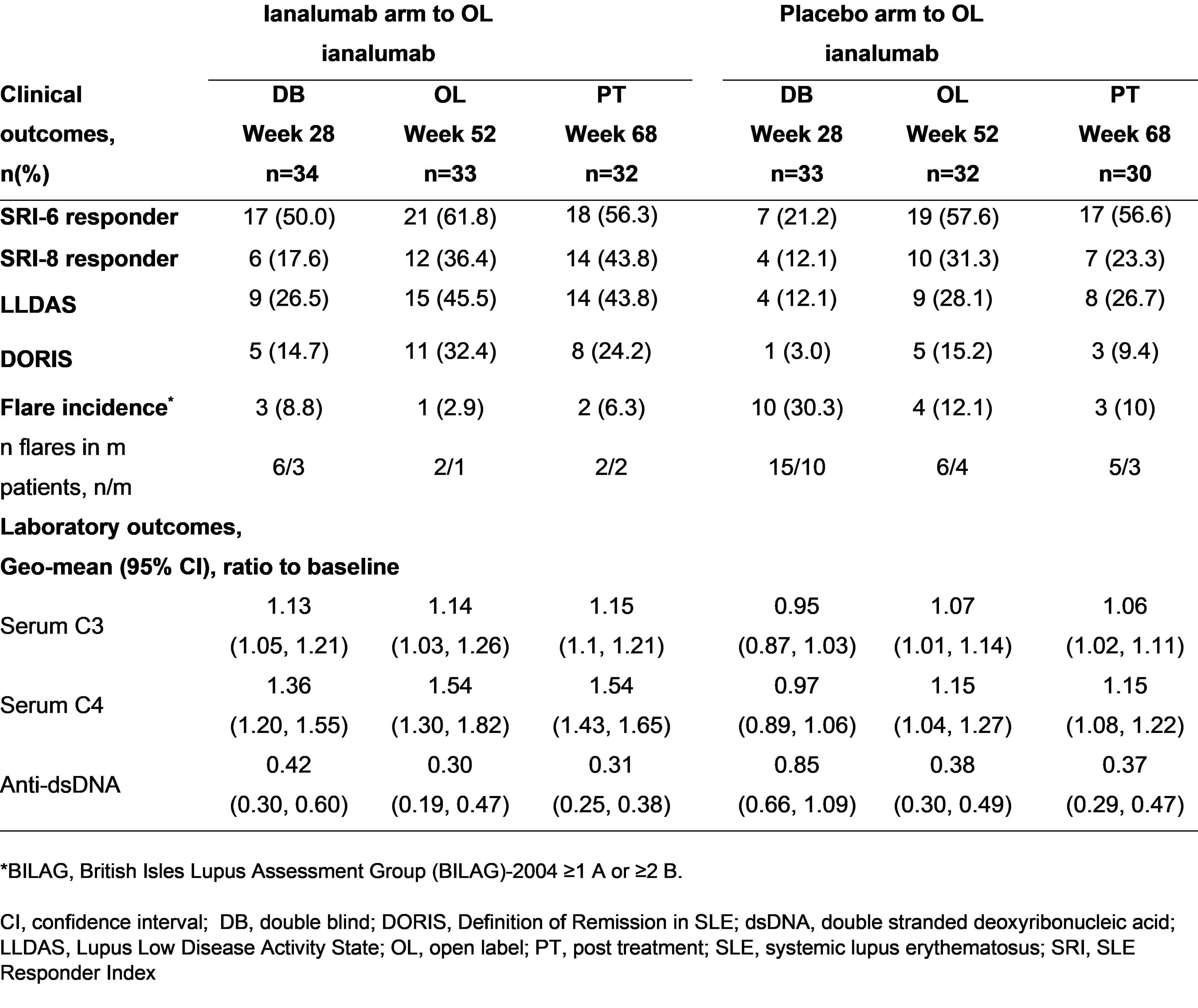
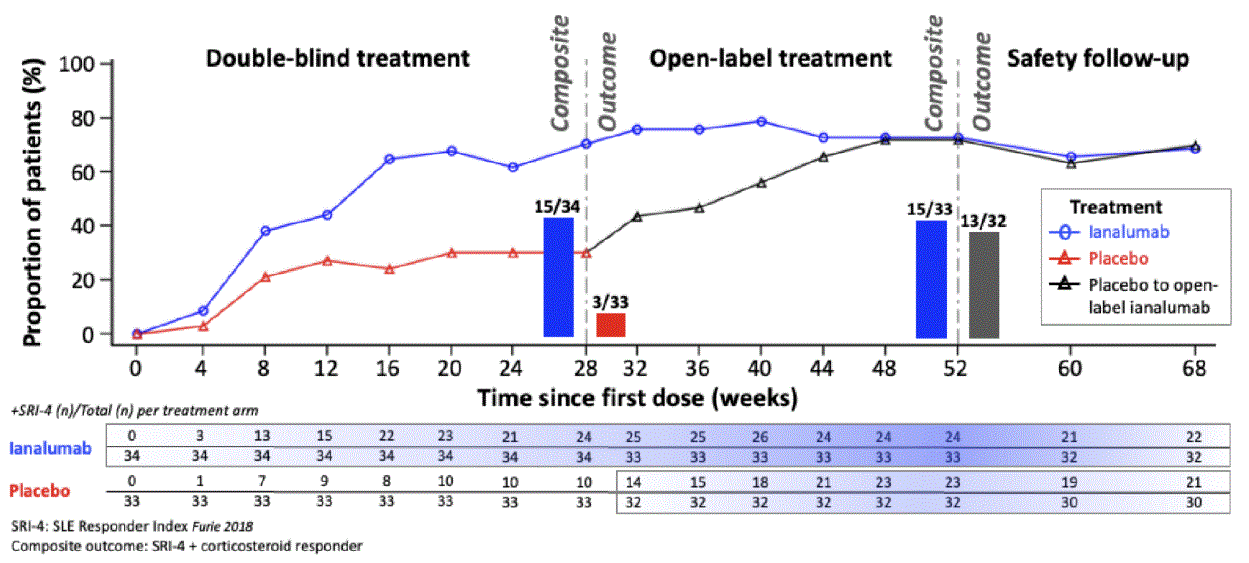
Results: Overall, 67 patients enrolled from December 19, 2018 to January 31, 2022 with median age 42 years and 39 years for ianalumab and placebo arms, respectively. Baseline median (range) values for ianalumab and placebo arms, respectively, were: SLEDAI-2K scores 11 (6-32) and 10 (4-21), and prednisone dose/day 10.0 mg (0-30.0) and 10.0 mg (0-27.5). The proportion of patients treated with ianalumab or placebo achieving composite endpoint criteria for SRI-4 + CS responder at W28 was 44.1% (n/N=15/34) vs 9.1% (n/N=3/33), respectively, and at W52 for patients switching from active treatment to OL ianalumab or switching from placebo to ianalumab was 45.5% (n/N=15/33) vs 40.6% (n/N=13/32; Figure 1). Longer duration of q4w ianalumab exposure at W52 vs W28, or for placebo+24W, resulted in further improvement in outcomes (Table 1) for incidence BILAG flare, status of SRI-6, SRI-8, DORIS and LLDAS, and serum levels of complement and autoantibodies. IgG reduction from baseline (geometric mean, 95% CI) at W52 was 0.78 (0.73-0.84). Treatment responses were maintained during the safety follow up period at W68 without unexpected or new safety findings.

Conclusion: Treatment with ianalumab was well-tolerated, and data suggests longer exposure up to 1 year provides further clinical and laboratory benefits in patients with active SLE. These positive results were maintained up to W68 during the safety follow up. Ianalumab is currently being investigated in large randomized controlled phase 3 studies (NCT05639114; NCT05624749; NCT05126277) in patients with active SLE, and in those with lupus nephritis.
Supporting image 1

Figure 1. SRI-4 responders over time and composite SRI-4+CS responders (bar graphs)

Supporting image 2

Table 1. Clinical and laboratory outcomes at weeks 28, 52, and 68


Disclosures: E. Mysler: AbbVie, 2, 5, Alpine Immunology, 2, 5, Amgen, 2, 5, Astra Zeneca, 2, 5, BMS, 2, 5, GSK, 2, 5, HiBio, 2, 5, Janssen, 2, 2, 5, 5, Lilly, 2, 5, Novartis, 2, 5, Pfizer, 2, 5, Roche, 2, 5, Sandoz, 2, 5, Sanofi, 2, 5; S. Ignatenko: None; A. Gordienko: None; J. Cortés-Hernández: None; N. Agmon-Levin: None; P. Narongroeknawin: None; K. Romanowska-Prochnicka: None; N. Shen: None; H. Ciferská: None; M. Kodera: None; J. Cheng-Chung Wei: AbbVie/Abbott, 2, 5, Amgen, 2, AstraZeneca, 2, Bristol-Myers Squibb(BMS), 2, 2, 5, Chugai, 2, Eisai, 2, Eli Lilly, 2, 5, Gilead, 2, GlaxoSmithKlein(GSK), 2, Janssen, 2, Novartis, 2, Pfizer, 2, Sanofi-Aventis, 2, SUN Pharma, 2, TSH Taiwan, 2, UCB pharma, 2; P. Leszczynski: AbbVie/Abbott, 2, AstraZeneca, 2, Merck/MSD, 2, Novartis, 2, UCB, 2; J. Liang Lan: None; R. Wojciechowski: AbbVie/Abbott, 6, Eli Lilly, 6, Novartis, 5, 6, UCB, 6; T. Tarr: None; E. Vishneva: None; Y. Chen: None; Y. Kaneko: None; S. Finzel: AbbVie/Abbott, 2, AstraZeneca, 2, Chugai, 2, Galapagos, 2, Novartis, 2, UCB, 2; A. Hoi: AbbVie/Abbott, 6, AstraZeneca, 5, Australian Rheumatology- Association, 4, 12, Treasurer, Eli Lilly, 6, EUSA Pharma, 2, Limbic, 6, Moose Republic, 6, Novartis, 6; M. Okada: AbbVie, 2, Amgen, 2, Asahi Kasei Pharma, 2, Astellas, 2, AstraZeneca, 2, Ayumi Pharma, 2, Bristol-Myers Squibb(BMS), 2, Chugai, 2, Daiichi Sankyo, 2, Eisai, 2, Eli Lilly, 2, Gilead, 2, GlaxoSmithKlein(GSK), 2, Janssen, 2, Mitsubishi Tanabe Pharma, 2, Novartis, 2, Ono Pharma, 2, Pfizer, 2, UCB Pharma, 2; A. Koolvisoot: None; S. Lee: None; L. Dai: None; H. Kaneko: None; B. Rojkovich: None; L. Sun: None; E. Zotkin: None; J. Viallard: None; B. Paula Magallares: None; T. Sengupta: Novartis, 3; C. Sips: Novartis, 3; C. Lau: Novartis, 3; A. Avrameas: Novartis, 3; S. J Oliver: Novartis, 3, 11.

To cite this abstract in AMA style:

Mysler E, Ignatenko S, Gordienko A, Cortés-Hernández J, Agmon-Levin N, Narongroeknawin P, Romanowska-Prochnicka K, Shen N, Ciferská H, Kodera M, Cheng-Chung Wei J, Leszczynski P, Liang Lan J, Wojciechowski R, Tarr T, Vishneva E, Chen Y, Kaneko Y, Finzel S, Hoi A, Okada M, Koolvisoot A, Lee S, Dai L, Kaneko H, Rojkovich B, Sun L, Zotkin E, Viallard J, Paula Magallares B, Sengupta T, Sips C, Lau C, Avrameas A, J Oliver S. Safety and Efficacy of Subcutaneous Ianalumab (VAY736) for up to 68 Weeks in Patients with Systemic Lupus Erythematosus: Results from Phase 2 Study [abstract]. Arthritis Rheumatol. 2024; 76 (suppl 9). https://acrabstracts.org/abstract/safety-and-efficacy-of-subcutaneous-ianalumab-vay736-for-up-to-68-weeks-in-patients-with-systemic-lupus-erythematosus-results-from-phase-2-study/. Accessed .

ACR Meeting Abstracts - https://acrabstracts.org/abstract/safety-and-efficacy-of-subcutaneous-ianalumab-vay736-for-up-to-68-weeks-in-patients-with-systemic-lupus-erythematosus-results-from-phase-2-study/

My Favorites

Save and print abstracts during your browser session by clicking the “Favorite” button at the bottom of any abstract (must have cookies enabled in browser). See saved favorites.

Abstract Policies

  • ACR Convergence Abstract Embargo Policies
  • ACR Convergence Abstract Permissions & Reprints
  • PRSYM Abstract Policies

ACR Convergence. Where Rheumatology Meets

ACR Convergence 2026

Join us November 6-11 in Orlando, Florida.
See Registration Information

  • Contact ACR
  • Privacy Policy
  • ACR Policies
  • Cookie Preferences

© Copyright 2026 American College of Rheumatology