
Session Information
Session Type: Poster Session (Sunday)
Session Time: 9:00AM-11:00AM
Background/Purpose: The SLEDAI-2K, a widely-used measure for disease activity, does not incorporate symptoms such as weight loss, lymphadenopathy (LAD) or fatigue which may limit accurate assessment of disease activity. Another instrument, the Physician Global Assessment (PGA), derives from physician perception of overall disease activity. Our primary objective was to determine whether the addition of weight loss, LAD, and fatigue to the SLEDAI-2K improves the accuracy of disease activity assessment as measured by the PGA.
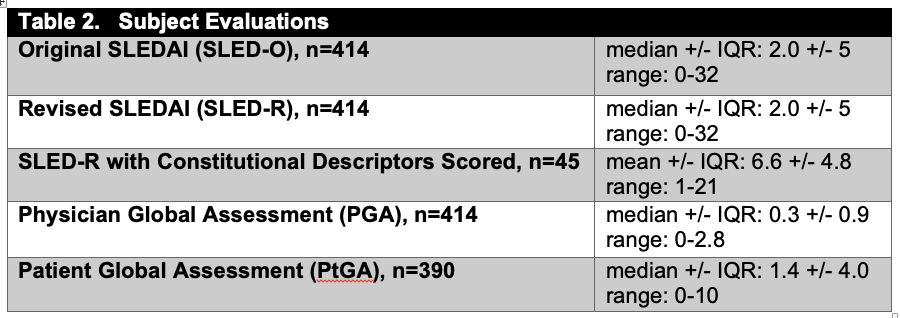
Methods: A revised SLEDAI (SLED-R) was created that substituted the “Fever” descriptor with a new “Constitutional” descriptor that included the original fever > 38 °C plus weight loss of more than 5%, lymphadenopathy ≥ 0.5 cm (categorized 0.5cm-1cm or >1cm), and/or fatigue (defined as fatigue limiting activities of daily living ≥ 50% of the time) in the preceding 28 days (excluding Fibromyalgia or other known causes). In order to preserve integrity of the original SLEDAI (SLED-O) scoring, total points for the new descriptor remained 1. A total of 414 SLED-O and SLED-R scores were prospectively collected from 163 SLE subjects in the Rheumatology clinics at Northwell Health. Concomitant PGA and Patient Global Assessment (PtGA) scores were also collected (Table 2). The primary analysis was a Steiger’s test to compare correlation coefficients obtained using a Spearman’s Rank correlations test between SLED-O vs. PGA and SLED-R vs. PGA. Similar analyses were performed comparing SLED-O and SLED-R to the PtGA.
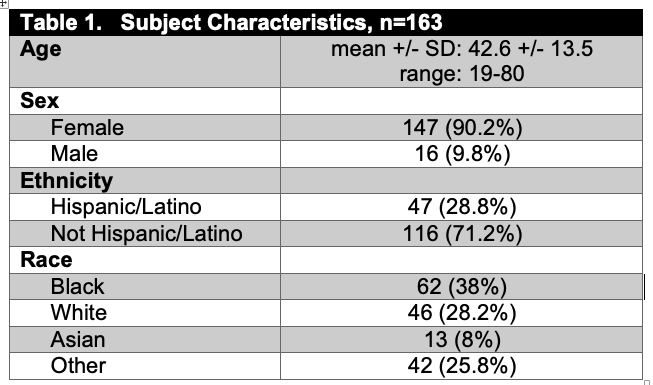
Results: Demographic data is presented descriptively (Table 1); PGA, SLED-O and SLED-R were collected on all subjects, PtGA were collected on 390. The new Constitutional descriptor was scored in 45 of the 414 SLEDAIs collected; among these, fatigue scored in 20, LAD scored in 23 ( > 1 cm in 9, 0.5 -1 cm in 14), weight loss in 1 and fever in 5. The original descriptor, Fever alone, was scored in 3 in contrast to an additional 42 that scored with the new Constitutional descriptor. The correlation between PGA and SLED-R (R 0.790, p< 0.00) is significantly greater than the correlation between SLED-O and PGA (R 0.784, p< 0.00), (p=0.048, Steiger’s test). Significance was lost if either fatigue or LAD was removed from the new descriptor (Table 3). The correlation between PtGA and SLED-R (R 0.436, p< 0.00) is significantly greater than the correlation between SLED-O and PtGA (R 0.417, p< 0.00), (p< 0.00, Steiger’s test).
Conclusion:
Expansion of the Fever descriptor to include other constitutional symptoms, both subjective (fatigue) and objective (LAD, fever, weight loss), resulted in higher SLEDAI scores in 10.86% of this cohort. This was driven by both fatigue and LAD and removal of either negated the significance, suggesting that both measures contribute. Importantly, the addition of more constitutional signs/symptoms improved the SLEDAI correlations with PGA, suggesting increased accuracy of the revised SLEDAI. Further clinical studies would be needed to assess the applicability of the SLED-R as a tool in guiding therapeutic changes and long-term outcomes in SLE patients.

To cite this abstract in AMA style:
Shah B, Anderson E, Mackay M, Aranow C, Sansone M, Hong J. Revising the SLEDAI-2K to Include Additional Constitutional Symptoms to More Accurately Assess Lupus Disease Activity [abstract]. Arthritis Rheumatol. 2019; 71 (suppl 10). https://acrabstracts.org/abstract/revising-the-sledai-2k-to-include-additional-constitutional-symptoms-to-more-accurately-assess-lupus-disease-activity/. Accessed .« Back to 2019 ACR/ARP Annual Meeting
ACR Meeting Abstracts - https://acrabstracts.org/abstract/revising-the-sledai-2k-to-include-additional-constitutional-symptoms-to-more-accurately-assess-lupus-disease-activity/