
Session Information
Session Type: Poster Session (Sunday)
Session Time: 9:00AM-11:00AM
Background/Purpose: Spondyloarthritis (SpA) generally affects patients at a working age. Despite therapeutic improvements, SpA remains responsible for a significant burden for patients and society in terms of sick leave and work disability. This study aims to assess the determinants of work participation in a Belgian SpA cohort.
Methods: Between May 1st 2018 and April 1st 2019, a cross-sectional survey was conducted amongst patients included in a Belgian SpA cohort ((Be-)Giant), all fulfilling ASAS classification criteria for axial or peripheral SpA. Information on work participation was collected using the Work Productivity and Activity Impairment (WPAI) questionnaire. Physicians’ assessment included standardized clinical and laboratory evaluations. Outcomes of interest were employment status (being employed yes/no), absenteeism (percentage of time absence from the workplace), presenteeism (percentage of productivity loss while at work) and percentage of overall work impairment. Continuous outcomes were categorized because of skewed (zero inflated) distributions. The associations between the four outcomes of interest and patient characteristics were modelled using univariate and multivariate logistic regression. The sample was restricted to SpA patients of working age (≤65 years old).
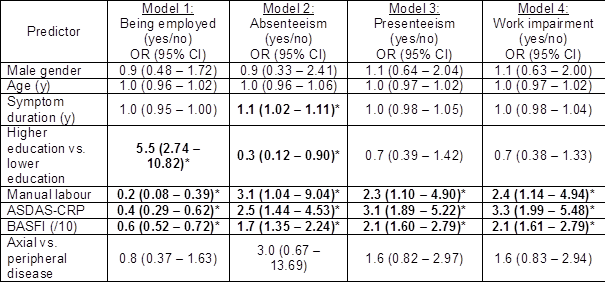
Results: Data were collected on 262 patients: 214 (81.7%) were employed, 26 (9.9%) work disabled, 8 (3.1%) unemployed, 8 (3.1%) student, 5 (1.9%) early retired and 1 (0.4%) housekeeper. Table 1 summarizes demographic and clinical characteristics. Table 2 shows univariate associations between patient characteristics and the outcomes of interest. Gender, age, symptom duration and SpA subtype are not significantly associated with any of the four outcomes. Higher education increases the odds of being employed and reduces the odds of absenteeism. Manual labour, high ASDAS-CRP and high BASFI show a negative association with employment and significantly increase the odds of absenteeism, presenteeism and overall work impairment. After multivariate adjustment, only ASDAS-CRP and BASFI showed a significant association with employment status (OR 0.39 and 0.69), absenteeism (OR 2.54 and 1.71), presenteeism (OR 2.58 and 1.81) and work impairment (OR 2.67 and 1.82) (all p < 0,05).
Conclusion: High disease activity and functional impairment are significantly associated with work participation and overall work impairment in a Belgian SpA cohort. Of interest, neither gender, age, symptom duration, type of work nor SpA subtype significantly affect any of the work-related outcomes. Given the important health economic impact of employment rate in our society, this underscores the need for tight disease control in patients with SpA.

To cite this abstract in AMA style:
De Craemer A, Renson T, Deroo L, Carron P, Boonen A, Janssens X, Elewaut D, Van den Bosch F. Restricted Work Participation Relates to High Disease Activity in Spondyloarthritis Patients [abstract]. Arthritis Rheumatol. 2019; 71 (suppl 10). https://acrabstracts.org/abstract/restricted-work-participation-relates-to-high-disease-activity-in-spondyloarthritis-patients/. Accessed .« Back to 2019 ACR/ARP Annual Meeting
ACR Meeting Abstracts - https://acrabstracts.org/abstract/restricted-work-participation-relates-to-high-disease-activity-in-spondyloarthritis-patients/