
Session Information
Date: Tuesday, November 15, 2016
Title: Spondylarthropathies and Psoriatic Arthritis – Clinical Aspects and Treatment - Poster III
Session Type: ACR Poster Session C
Session Time: 9:00AM-11:00AM
Background/Purpose: This study investigated the impact of psoriatic arthritis (PsA) disease severity on patients’ (pts) ability to perform normal daily activities and their reported happiness.
Methods: Data from cross-sectional research with specialists treating pts with PsA in 16 countries were analyzed. Physicians completed a detailed form for consecutive consulting PsA pts recording Physician Assessed severity (PA severity) (choice of mild, moderate or severe), change in severity (choice of improving, stable, unstable, deteriorating), general health (1- 100 VAS), perceived pain (1 – 10 scale), swollen (/ 66) and tender (/ 68) joint counts and severity of skin symptoms (PASI). Pts completed a form rating severity of their PsA (mild, moderate, severe), current pain (1- 10 scale), and their health related quality of life (SF-36). Question 3 (Q3; physical function domain) of SF-36 asks if their health limits pts’ performance of 10 daily activities. SF‑36 question 9h (Q9h; mental health domain) asks “How much of the time during the past week have you been happy?”; pts answering “All” or “Most” were defined as Happy (Group 1), pts answering “A little” or “None” as Not Happy (Group 2); “Some” were excluded from the analysis. Bivariate analysis described differences between the Groups.
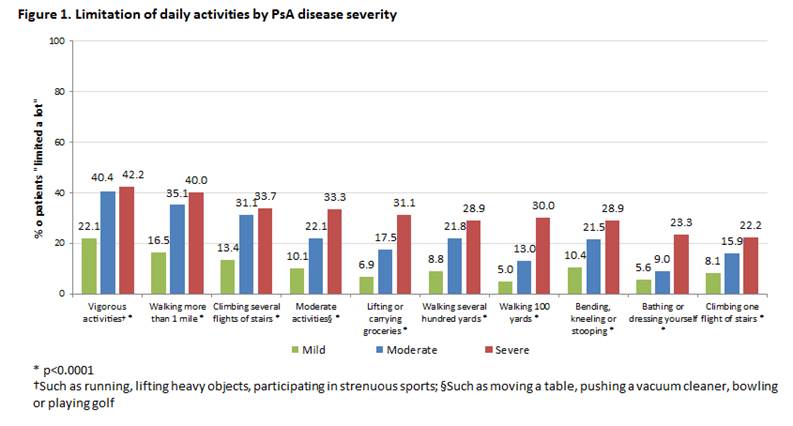
Results: 1,722 pts completed Q3; 61%, 34% and 5% with mild, moderate and severe PsA, respectively. 1,698 pts answered Q9h – 44.6% in Group 1 and 20% in Group 2. The proportion who reported “a lot” of limitation in the Q3 activities increased with disease severity (Figure 1). Of pts with severe PsA, 33–42% were limited in undertaking normal physical activities, such as climbing several flights of stairs (moderate PsA, 22–40%), and 22–31% could not perform limited physical activities, such as dressing themselves (moderate PsA, 9–30%). Unhappy pts were associated with worse health outcomes when physicians’ and pts’ perceptions of health status, as well as clinical characteristics, were compared between Group 1 and 2 (Figure 2). A lower level of satisfaction with the control their current treatment provided was also observed among Group 2 (“satisfied”: Group 1, 83%; Group 2, 56.9%; P<0.001).
Conclusion: Many PsA pts cannot undertake everyday activities that would allow them to lead a normal life. Impairment increases with disease severity and unhappiness is also associated with more severe disease status. Thus strategies to proactively treat PsA to reduce severity should improve important components of health related quality of life.

To cite this abstract in AMA style:
Alten R, Strand V, Conaghan PG, Huneault L, Sullivan E, Blackburn S, Tian H, Gandhi K, Jugl S. Psoriatic Arthritis Limits Patients’ Abilities to Undertake Activities Crucial for Normal Daily Life and Impacts Happiness, Results from a Multinational Real-World Sample [abstract]. Arthritis Rheumatol. 2016; 68 (suppl 10). https://acrabstracts.org/abstract/psoriatic-arthritis-limits-patients-abilities-to-undertake-activities-crucial-for-normal-daily-life-and-impacts-happiness-results-from-a-multinational-real-world-sample/. Accessed .« Back to 2016 ACR/ARHP Annual Meeting
ACR Meeting Abstracts - https://acrabstracts.org/abstract/psoriatic-arthritis-limits-patients-abilities-to-undertake-activities-crucial-for-normal-daily-life-and-impacts-happiness-results-from-a-multinational-real-world-sample/