
Session Information
Session Type: Abstract Submissions (ACR)
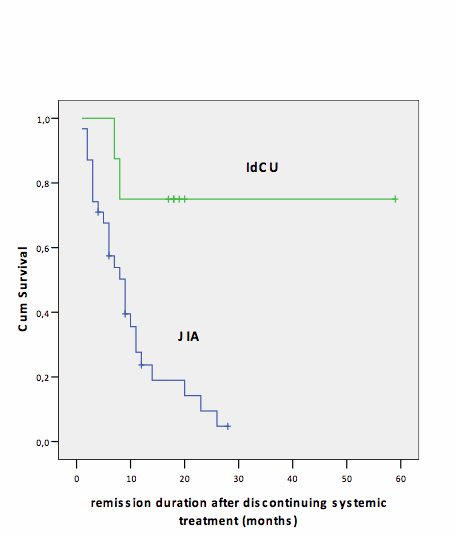
Background/Purpose Information regarding the natural clinical history of a child on systemic treatment due to auto-immune chronic uveitis would be helpful in driving duration therapy. Aim of our study was to assess the time on remission after discontinuing systemic therapy in a retrospective, comparative, multi-centre, cohort study of childhood non-infectious chronic uveitis. Methods 40 patients (30 F, 10 M; median age: 11.6 years, 31 JIA, 9 Idiopathic Chronic Uveitis [IdCU]) from 4 different paediatric rheumatology centres, with previously refractory, vision threatening, non-infectious inactive uveitis, which discontinued all related treatments for at least 3 months were enrolled. 23 children previously received Methotrexate, 17 TNF inhibitors. Primary outcome was to assess, once remission was achieved, the time on remission up to the first relapse after discontinuing treatment. Time to remission once systemic not-steroid treatment was started, time to steroid discontinuation, number of relapses before achieving remission and time on remission on therapy before discontinuing all treatments were also considered. Statistical Analysis. Mann–Whitney U-test, Wilcoxon signed-rank test for paired samples, c-square tests, and Fisher’s exact test, when appropriate, were used to compare data. Pearson and Spearman correlation tests were used to determine correlation coefficients for different variables. In order to identify predictors of outcome Cox regression model and Kaplan–Meier curves were constructed, each one at mean of enter ed covariates. Results Median follow-up time on remission without treatment was 9 months (range 1–59 months). At last available follow-up after 1 year from discontinuation of treatment [49 months, range 15-168], 11/39 (28.2%) children maintained a complete remission over a median period of 18 months. At 49 months of follow-up, 6/8 children with IdCU (75%) compared to 5/31 children with JIA (16.1%) were still on remission without treatment (p<0.003). A higher probability of maintaining uveitis remission after discontinuing treatment was shown in IdCU compared to JIA group (Mantel-Cox c2 7.62, p<0.006) (Figure). ANA positivity was associated with a higher probability of flare in overall population (Mantel-Cox c2 6.68, p<0.01), but not in sub-analysis limited to JIA (Mantel-Cox c2 0.78, p=0.37) and IdCU (Mantel-Cox c2 1.18, p=0.27). None clinical variable, including time on remission on therapy, total length of treatment, and type of treatment, resulted significant predictors of long-lasting remission without therapy. Conclusion Even if limited to a relatively small group in retrospectively study design, our results suggest that type of disease, rather than the type or the length of treatment, can predict different duration of uveitis remission without systemic therapy.
Disclosure:
G. Simonini,
None;
C. Bracaglia,
None;
M. Cattalini,
None;
A. Taddio,
None;
A. Brambilla,
None;
C. DeLibero,
None;
D. Pires Marafon,
None;
R. Caputo,
None;
R. Cimaz,
None.
« Back to 2014 ACR/ARHP Annual Meeting
ACR Meeting Abstracts - https://acrabstracts.org/abstract/predictors-of-relapse-after-discontinuing-systemic-treatment-in-childhood-autoimmune-chronic-uveitis/