
Session Information
Session Type: ACR Poster Session C
Session Time: 9:00AM-11:00AM
Background/Purpose:
For projects such as the ACR Rheumatology Informatics System for Effectiveness (RISE) to succeed for quality improvement, practice benchmarking, & research, the data included must be high fidelity and represent the majority of patients in participating practices. To prepare a large academic practice for RISE participation, we synergistically harnessed the power of institutional informatics coupled with systems engineering. We focused on two Rheumatoid Arthritis (RA) assessments: Routine Assessment of Patient Index Data (RAPID3) & Clinical Disease Activity Index (CDAI). Baseline data was extremely low (13% & 27% respectively). The aim was to improve compliance for these instruments in the Rheumatology clinics to > 75% by December 2016.
Methods:
High quality data was extracted from our RA registry established in April 2015. Inclusion criteria: RA patients seen by a rheumatology provider twice in the last 24 months & at least once in last 12 months. By Feb 2017, the registry had 543 patients. The project team utilized Six Sigma DMAIC (Define, Measure, Analyze, Improve & Control) data-driven improvement cycle for problem-solving & process improvement. Tools & techniques included brainstorming, project charter, process maps, fishbone diagrams, Pareto chart, & feedback communications. Interventions were aimed towards standardization of clinic work flow, and motivating better EMR documentation practices.
Results:
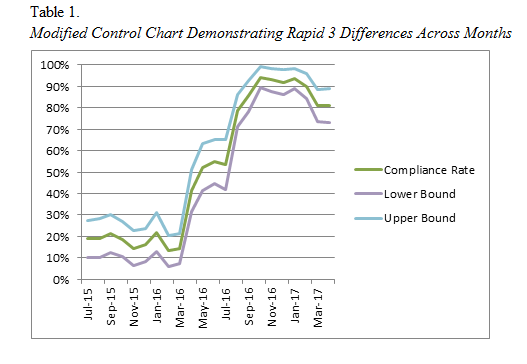
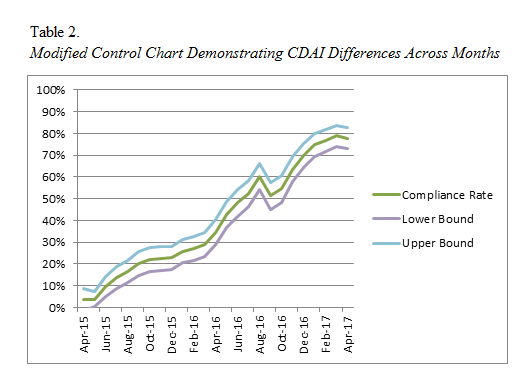
We have created modified control charts (Tables 1 & 2). Given our goal to demonstrate differences over time, the standard error of difference (SED; (σ/N)*√ (2)*1.96) within month was calculated and used to create the bounds around the observed compliance rates. Any month’s proportion rate outside of other months’ SED bounds is statistically different at α = .05.
Conclusion:
Combining the power of informatics & systems engineering led to impressive improvements in provider behaviors. This methodology helped to identify opportunities to overcome barriers & to motivate providers. High quality processes facilitated high quality data, and vice versa. Performance expectations were clear, improvements were sustained, and we have believable long-term RA outcomes data that can be used to improve outcomes at the practice level.
To cite this abstract in AMA style:
Bajaj P, Varghese S, Sunleaf A, Padilla P, Scielzo S, Philip S, Haridas J, Wang C, Kannan V, Lewis J, Bhat D, Mutz J, Willett D, Fish J, Karp D. Practice Improvement Utilizing Six Sigma and Health Informatics in an Academic Setting [abstract]. Arthritis Rheumatol. 2017; 69 (suppl 10). https://acrabstracts.org/abstract/practice-improvement-utilizing-six-sigma-and-health-informatics-in-an-academic-setting/. Accessed .« Back to 2017 ACR/ARHP Annual Meeting
ACR Meeting Abstracts - https://acrabstracts.org/abstract/practice-improvement-utilizing-six-sigma-and-health-informatics-in-an-academic-setting/