ACR Meeting Abstracts

ACR Meeting Abstracts

  • Meeting Abstracts
    • All Meetings
    • PRSYM 2026
    • ACR Convergence 2025
    • Download Abstract Supplements
  • Keyword Index
  • My Favorites
    • View & print my favorites
  • Search

Home » Meeting Abstracts » ACR/ARP Annual Meeting 2019

Abstract Number: 1329

Pooled Safety Analyses from Phase 3 Studies of Filgotinib in Patients with Rheumatoid Arthritis

Kevin Winthrop1, Mark Genovese 2, Bernard Combe 3, Yoshiya Tanaka 4, Alan Kivitz 5, Franziska Matzkies 6, Beatrix Bartok 6, Lei Ye 6, Ying Guo 6, Chantal Tasset 7, John Sundy 6, Edward Keystone 8, Rene Westhovens 9, William F.C. Rigby 10 and Gerd Burmester 11, 1Oregon Health and Science University, Portland, OR, 2Stanford University, Stanford, CA, 3CHU Montpellier, Montpellier University, Montpellier, France, 4University of Occupational and Environmental Health Japan, Kitakyushu, Japan, 5Altoona Center for Clinical Research, Duncansville, PA, 6Gilead Sciences, Inc., Foster City, CA, 7Galapagos NV, Mechelen, Belgium, 8Mount Sinai Hospital and University of Toronto, Toronto, Canada, 9University Hospitals, Leuven, Belgium, 10Dartmouth College, Lebanon, NH, 11Charité—University Medicine Berlin, Berlin, Germany

Share on X (Twitter) Share on Facebook Share on LinkedIn Share on Email
Print

Meeting: ACR/ARP Annual Meeting 2019

Keywords: Adverse events, Clinical research, drug safety, Janus kinase (JAK) and rheumatoid arthritis, treatment

Session Information

Date: Monday, November 11, 2019

Title: RA – Diagnosis, Manifestations, & Outcomes Poster II: Treatments, Outcomes, & Measures

Session Type: Poster Session (Monday)

Session Time: 9:00AM-11:00AM

Background/Purpose: Filgotinib (FIL) is an orally administered, selective inhibitor of Janus Kinase 1 (JAK1) that is under development for the treatment of RA and other inflammatory diseases. The safety and efficacy of FIL has been investigated in the FINCH clinical program that includes three Phase 3, randomized, multicenter studies in patients (pts) with moderate to severely active RA, who had an inadequate response to MTX (FINCH 1; NCT02889796); who were receiving conventional DMARDs and had an inadequate response to biological therapies (FINCH 2; NCT02873936); or who were MTX naïve and initiating MTX alone or in conjunction with FIL or receiving FIL monotherapy (FINCH 3; NCT02886728). Here we present pooled safety data from the double-blind, active and placebo controlled periods of FINCH 1–3 up to 24 weeks.

Methods: The FINCH studies enrolled pts who had a diagnosis of RA (2010 ACR/EULAR criteria) and had ≥ 6 swollen joints and ≥ 6 tender joints at both screening and Day 1. Safety analyses included pts who had received at least one dose of study drug. Pts in FINCH 1 and 2 who did not experience at least a 20% improvement in both swollen joint count and tender joint count by Week 14 discontinued study drug and switched to standard of care. Week 24 safety data from the FINCH 1, 2, and 3 were aggregated and summarized by the number and percentage of pts with events or abnormalities for categorical values. The key safety endpoints reported are treatment-emergent adverse events (AE), treatment-emergent serious AEs, treatment-emergent AEs of interest, all death and treatment-emergent laboratory abnormalities.

Results: This pooled safety analyses assessed 3,452 pts across FINCH 1–3, including 2,088 pts who received FIL. At Week 24, the frequency of treatment-emergent AEs were similar between pts who received FIL and those in the control arms of the FINCH studies (Table 1). Furthermore, the proportions of pts with treatment-emergent AEs of interest were also similar across groups. The most common treatment-emergent AEs were infections, notably upper respiratory tract and nasopharyngitis. Laboratory abnormalities occurred at similar rates with FIL and placebo or active control and were mostly mild to moderate (Grade 1 & 2). Overall, the frequency of major adverse cardiac events (MACE), herpes zoster virus, deep vein thrombosis (DVT) and pulmonary embolism (PE) was low, and similar across groups. The incidences of MACE were 0.2% for FIL, 0.3% for adalimumab (ADA), and 0.5% for placebo/csDMARD. Additionally, the incidences of DVT/PE were < 0.1% for FIL, 0% for ADA, and 0.3% for placebo/csDMARD.

Conclusion: Although gathered over a short duration (24 weeks), pooled data from this large safety database describing a broad population of pts with RA highlights the favorable safety and tolerability profile of FIL in pts with RA both as a monotherapy and in conjunction with MTX/csDMARD.
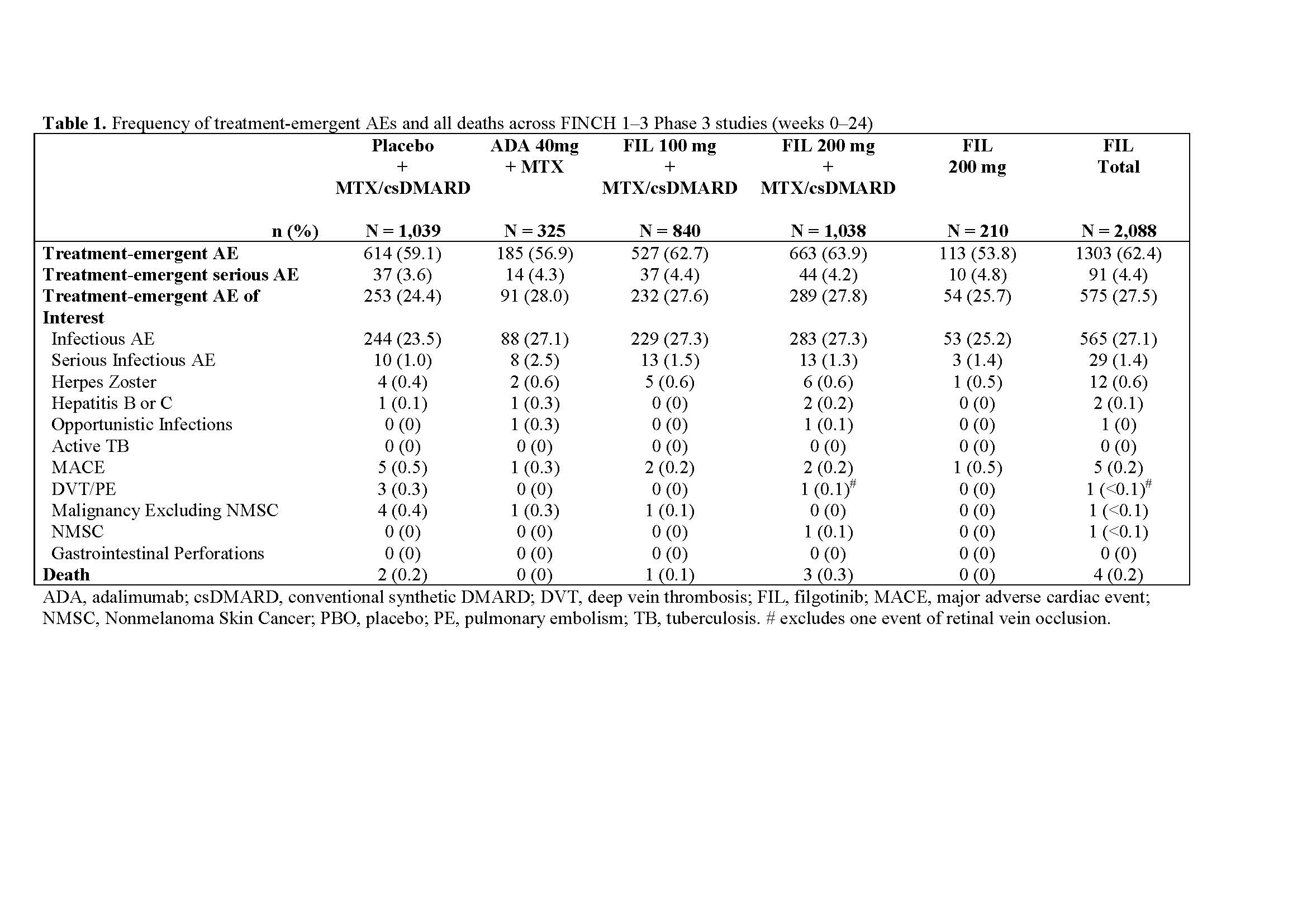

Table 1

Frequency of treatment-emergent AEs and all deaths across FINCH 1–3 Phase 3 studies -weeks 0–24-


Disclosure: K. Winthrop, AbbVie, 5, Abbvie, 5, Bristol-Myers Squibb, 2, 5, Eli Lilly, 5, Galapagos, 5, Galapagos NV, 5, Gilead, 5, Gilead Sciences, Inc., 5, GSK, 5, Lilly, 5, Pfizer, 2, 5, Roche, 5, UCB, 5, UCB Pharma, 5, UCB Pharma, Pfizer, Bristol-Myers Squibb, Eli Lilly, AbbVie, and Roche., 2, 5; M. Genovese, AbbVie, 2, 5, Abbvie, 2, 5, AbbVie, Inc., 9, Astellas, 2, 5, Eli Lilly, 2, 5, Eli Lilly and Company, 2, 5, EMD Merck Serono, 2, 5, Galapagos, 2, 5, Galapagos NV, 2, 5, 9, Genentech/Roche, 2, 5, Gilead, 2, 5, Gilead Science, 9, Gilead Sciences, Inc., 2, 5, 9, GSK, 5, Lilly, 2, 5, 9, Novartis, 2, 5, Pfizer, 2, 5, 9, Pfizer Inc, 2, 5, Pfizer, Inc., 9, Pzier, 9, RPharm, 5, Sanofi Genzyme, 2, 5, Vertex, 2, 5; B. Combe, AbbVie, 5, BMS, 5, 8, Chugai, 5, 8, Eli Lilly, 5, Eli Lilly and Company, 5, 8, Gilead, 5, 8, Gilead Sciences, Inc., 5, 8, Janssen, 5, Lilly, 5, 8, MSD, 2, 5, 8, Novartis, 5, Pfizer, 2, 5, 8, Roche, 2, 5, 8, Roche-Chugai, 5, 8, Sanofi, 5, UCB, 5, USD, 5; Y. Tanaka, Abbvie, 8, AbbVie, 5, 8, Asahi-kasei, 2, Asahi-Kasei, 2, Asahi-kasei, BMS, Chugai, Daiichi-Sankyo, Eisai, Mitsubishi-Tanabe, Ono, Pfizer, Sanofi, Takeda, UCB, 2, Astellas, 8, Astellas Pharma, 9, Astellas Pharma, Inc., 2, 3, 5, 8, 9, Astellas, BMS, Chugai, Daiichi-Sankyo, Eli Lilly, Janssen, Mitsubishi-Tanabe, Pfizer, Sanofic, UCB, YL Biologics, 8, BMS, 2, 5, 8, Bristol-Myers, 2, 8, Bristol-Myers Squibb, 2, 8, Chugai, 2, 8, Daiichi-Sankyo, 2, 8, Daiichi-Sankyo, Astellas, Eli Lilly, Chugai, Sanofi, Abbvie, Pfizer, YL Biologics, Bristol-Myers, 8, Eisai, 2, 8, Eli Lilly, 5, 8, Eli Lilly and Company, 8, Genzyme, 5, Glaxo-Smithkline, UCB, Mitsubishi-Tanabe, Novartis, Eisai, Takeda, Janssen, Asahi-kasei, 8, Janssen, 8, Mitsubishi-Tanabe, 2, 8, Mitsubishi-Tanabe, Bristol-Myers, Eisai, Chugai, Takeda, Abbvie, Astellas, Daiichi-Sankyo, Ono, MSD, Taisho-Toyama., 2, Mitsubishi-Tanabe, Takeda, Daiichi-Sankyo, Chugai, Bristol-Myers, MSD, Astellas, Abbvie, Eisai, 2, Novartis, 8, Ono, 2, Pfizer, 5, 8, Pfizer Inc, 8, Roche, 5, Sanofi, 2, Takeda, 2, 8, Teijin, 8, UCB, 2, YL Biologics, 8; A. Kivitz, AbbVie, 5, Amgen, 1, 4, 5, Boehringer Ingeleheim, 5, Boehringer Ingelheim, 5, Celgene, 8, Flexion, 5, 8, Flexion Therapeutics, 8, Genzyme, 5, 8, Gilead, 1, 4, 5, Gilead Sciences, Inc., 4, Horizon, 8, Janssen, 5, Janssen Research & Development, LLC, 2, Merck, 8, Novartis, 1, 4, 8, Pfizer, 1, 4, 5, 8, Regeneron, 1, 5, 8, Sanofi, 1, 4, 5, 8, Sun Pharma, 5, SUN Pharma Advanced Research, 5, UCB, 5; F. Matzkies, Gilead Sciences, Inc., 1, 3, 4; B. Bartok, Gilead Sciences, Inc., 3, 4; L. Ye, Gilead Sciences, Inc., 3, 4; Y. Guo, Gilead Sciences, Inc., 3, 4; C. Tasset, Galapagos, 1, 3, Galapagos NV, 3, 4; J. Sundy, Gilead Sciences, Inc., 3, 4; E. Keystone, AbbVie, 2, 5, 8, Amgen, 2, 5, 8, Gilead Sciences, Inc., 2, 5, Lilly Pharmaceuticals, 2, 5, Merck, 2, 5, 8, Pfizer Pharmaceuticals, 2, 5, 8, PuraPharm, 2, Sanofi, 2, AstraZeneca, 5, Bristol-Myers Squibb, 5, 8, Celltrion, 5, Crescendo Bioscience, 5, F. Hoffman-La Roche Inc, 5, 8, Genentech Inc, 5, Janssen, 5, 8, Sandoz, 5, Sanofi-Genzyme, 5, 8, Samsung Bioepsis, 5, UCB, 8; R. Westhovens, Celltrion, 5, 8, 9, Celltrion, Inc., 2, 5, Galapagos, 5, 8, Galapagos NV, 5, 9, Galapagos/Gilead, 2, 5, Gilead Sciences, Inc., 5, 8, 9; W. Rigby, Abbvie, 5, AbbVie, 5, BMS, 5, Bristol-Myers Squibb, 5, Gilead Sciences, Inc., 5, Pfizer, 5, Roche, 5; G. Burmester, AbbVie, 5, 8, Abbvie, 5, 8, AbbVie Inc, Eli Lilly, Gilead, Janssen, Merck, Roche, Pfizer, and UCB Pharma., 5, 8, AbbVie Inc., 5, 8, BMS, 5, 8, Eli Lilly, 5, 8, Eli Lilly and Company, 5, Gilead, 5, 8, Gilead Sciences, Inc., 5, 8, Janssen, 5, 8, Lilly, 5, 8, Merck, 5, 8, Merck Shar & Dohme, 5, 8, MSD, 5, 8, Pfizer, 2, 5, 8, Roche, 2, 5, 8, Roche, Sanofi-Genzyme, 5, 8, Sanofi, 5, 8, UCB, 5, 8, Union Chimique Belge, 2, 5, 8.

To cite this abstract in AMA style:

Winthrop K, Genovese M, Combe B, Tanaka Y, Kivitz A, Matzkies F, Bartok B, Ye L, Guo Y, Tasset C, Sundy J, Keystone E, Westhovens R, Rigby W, Burmester G. Pooled Safety Analyses from Phase 3 Studies of Filgotinib in Patients with Rheumatoid Arthritis [abstract]. Arthritis Rheumatol. 2019; 71 (suppl 10). https://acrabstracts.org/abstract/pooled-safety-analyses-from-phase-3-studies-of-filgotinib-in-patients-with-rheumatoid-arthritis/. Accessed .

ACR Meeting Abstracts - https://acrabstracts.org/abstract/pooled-safety-analyses-from-phase-3-studies-of-filgotinib-in-patients-with-rheumatoid-arthritis/

My Favorites

Save and print abstracts during your browser session by clicking the “Favorite” button at the bottom of any abstract (must have cookies enabled in browser). See saved favorites.

Abstract Policies

  • ACR Convergence Abstract Embargo Policies
  • ACR Convergence Abstract Permissions & Reprints
  • PRSYM Abstract Policies

ACR Convergence. Where Rheumatology Meets

ACR Convergence 2026

Join us November 6-11 in Orlando, Florida.
See Registration Information

  • Contact ACR
  • Privacy Policy
  • ACR Policies
  • Cookie Preferences

© Copyright 2026 American College of Rheumatology