
Session Information
Date: Wednesday, November 13, 2019
Title: 6W011: RA – Diagnosis, Manifestations, & Outcomes V: Treatment (2870–2875)
Session Type: ACR Abstract Session
Session Time: 9:00AM-10:30AM
Background/Purpose: Synovial B cell aggregates in patients with early Rheumatoid Arthritis (RA) have been associated with disease severity and radiographic progression. Here, we analysed the presence of B cells and their association with clinical outcomes in matched synovial biopsies pre- and post- treatment with conventional synthetic Disease Modifying anti-Rheumatic Drug (scDMARDs).
Methods: DMARD-naïve patients with early (< 12 months) RA (n=164) fulfilling the 2010 ACR/EULAR criteria were recruited as part of the Pathobiology of Early Arthritis Cohort at Barts Health NHS Trust. Patients underwent ultrasound-guided synovial biopsy at baseline (n=164) and 6 months after standard treatment with synthetic DMARDs (n=104). Sequentially-cut sections were stained by HE for semi-quantitative (SQ) assessment of synovitis and by IHC for SQ assessment of CD20+ B cells (0-4) and classification into B cell-rich (≥2) or poor (< 2). X rays at baseline and 12 months underwent scoring for erosions and joint space narrowing, with radiographic progression defined as an increase in total score ≥ 1.
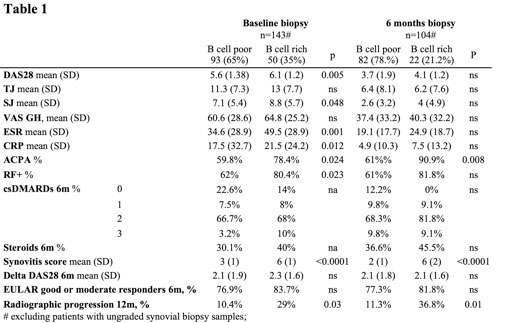
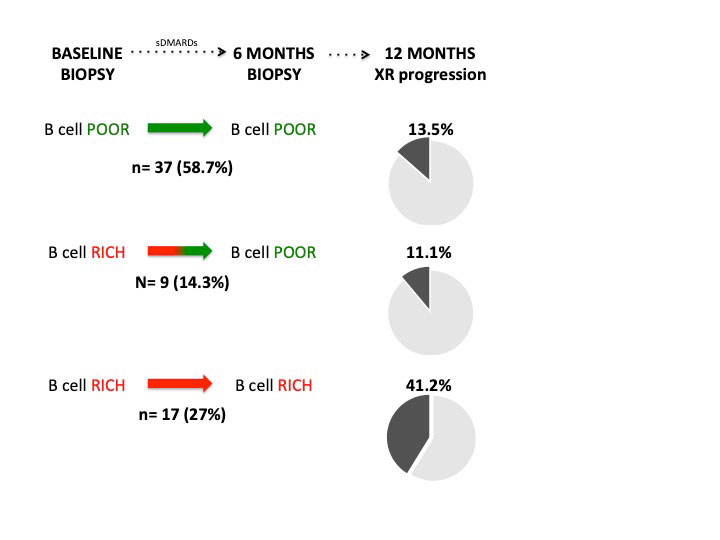
Results: At baseline, patients classified as B cell-rich (35%) had significantly higher disease activity, inflammatory markers, autoantibody positivity and synovitis score when compared to B cell-poor (Table 1). There were no differences between B cell-rich and poor patients in terms of drug exposure and EULAR clinical response at 12 months. However, patients with B cell-rich synovitis had a significantly higher rate of radiographic progression at 12 months. At the 6 months repeated synovial biopsy, 21.2% of the patients had B cell-rich synovitis, which still associated with ACPA positivity and higher synovitis score but not with other clinical features, including the use of csDMARDs and clinical response at 12 months. However, patients with a B cell-rich synovitis at 6 months showed significantly higher rates of radiographic progression at 12 months. Upon assessing the change of B cell infiltrates between 0 and 6 months, patients with a reduction in synovial B cell score (from B cell rich to poor) had a lower rate of radiographic progression compared to patients with persistent B cell-rich infiltrate (Figure 1).
Conclusion: We here confirm that B cell-rich synovitis in early RA patients is associated with disease severity and radiographic progression, particularly when the B cell-rich synovial infiltrate persist after 6 months treatment with csDMARDs, independently of the clinical response. This suggests that the presence of B cell-rich synovitis represents an important prognostic factor in RA.
To cite this abstract in AMA style:
Rivellese F, Lliso-Ribera G, Nerviani A, humby F, Pitzalis C. Persistence of B Cell-rich Synovitis Following Conventional Synthetic Disease Modifying Anti-Rheumatic Drug Treatment in Early Rheumatoid Arthritis Is Associated with Radiographic Progression Independently of Clinical Response [abstract]. Arthritis Rheumatol. 2019; 71 (suppl 10). https://acrabstracts.org/abstract/persistence-of-b-cell-rich-synovitis-following-conventional-synthetic-disease-modifying-anti-rheumatic-drug-treatment-in-early-rheumatoid-arthritis-is-associated-with-radiographic-progression-independ/. Accessed .« Back to 2019 ACR/ARP Annual Meeting
ACR Meeting Abstracts - https://acrabstracts.org/abstract/persistence-of-b-cell-rich-synovitis-following-conventional-synthetic-disease-modifying-anti-rheumatic-drug-treatment-in-early-rheumatoid-arthritis-is-associated-with-radiographic-progression-independ/