
Session Information
Date: Saturday, November 6, 2021
Title: SLE – Diagnosis, Manifestations, & Outcomes Poster I: Diagnosis (0323–0356)
Session Type: Poster Session A
Session Time: 8:30AM-10:30AM
Background/Purpose: Recently developed EULAR/ACR classification criteria for systemic lupus erythematosus (SLE) has important differences compared to the 2012 Systemic Lupus International Collaborating Clinics (SLICC) SLE classification criteria and the revised 1997 American College of Rheumatology (ACR) criteria:The obligatory entry criterion of antinuclear antibody (ANA) positivity is introduced and a “weighted” approach is used.Sensitivity and specificity of these three criteria have been debated and may vary in different populations and clinical settings. We aim to compare the performances of three criteria sets/rules in a large cohort of patients and relevant diseased controls from a reference center with dedicated clinics for SLE and other autoimmune/inflammatory connective tissue diseases from Turkey.
Methods: We reviewed the medical records of SLE patients and diseased controls for clinical and laboratory features relevant to all sets of criteria. Criteria sets/rules were analysed based on sensitivity, positive predictive value, specificity and negative predictive value, using clinical diagnosis with at least 6 months of follow-up as the gold standard. A subgroup analysis was performed in ANA positive patients for both SLE group and control group. SLE patients that did not fulfil 2012 SLICC criteria and 2019 EULAR/ACR criteria and diseased controls that fulfilled these criteria were evaluated.
Results: A total of 392 SLE patients and 294 non-SLE diseased controls (48 undifferentiated connective tissue disease, 51 Sjögren’s syndrome, 43 idiopathic inflammatory myopathy, 50 systemic sclerosis, 52 primary antiphospholipid syndrome (APS), 15 rheumatoid arthritis, 15 psoriatic arthritis and 20 ANCA associated vasculitis) were included in the study. Hundred and fourteen patients (16.6%) were ANA negative.
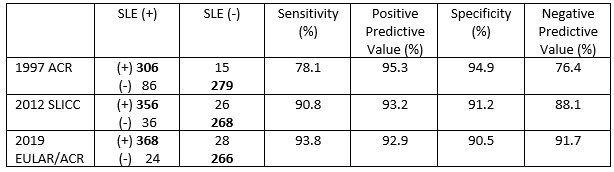
Sensitivity was more than 90% for both 2012 SLICC criteria and 2019 EULAR/ACR criteria and positive predictive value was more than 90% for all three criteria (Table 1). Specificity was the highest for 1997 ACR criteria. Negative predictive value was 76.4% for ACR criteria, 88.1% for SLICC criteria and 91.7% for EULAR/ACR criteria.
In ANA positive patients, sensitivity was 79.1% for 1997 ACR criteria, 91.9% for 2012 SLICC criteria and 96.1% for 2019 EULAR/ACR criteria. Specificity was 92.6% for ACR criteria, 87.8% for SLICC criteria and 85.1% for EULAR/ACR criteria.
Eleven clinically diagnosed SLE patients had insufficient number of items for both 2012 SLICC and 2019 EULAR/ACR criteria. Both criteria were fulfilled by 16 diseased controls: 9 with Sjögren’s syndrome, 5 with APS, one with dermatomyositis and one with systemic sclerosis.
Conclusion: In this cohort, although all three criteria have sufficient specificity, the sensitivity and negative predictive value of 1997 ACR criteria are the lowest. Overall, 2019 EULAR/ACR and 2012 SLICC criteria have a comparable performance, but if only ANA positive cases and controls are analysed, the specificity of both criteria decrease to less than 90%. Some SLE patients with a clinical diagnosis lacked sufficient number of criteria. Mostly, patients with Sjögren’s syndrome or antiphospholipid syndrome are prone to misclassification by both recent criteria.
To cite this abstract in AMA style:
Torun E, Bektaş E, Kemik F, Bektaş M, Cetin C, Yalcinkaya Y, Esen B, Gül A, Inanc M. Performances of Different Classification Criteria for Systemic Lupus Erythematosus in a Single Center Cohort from Turkey [abstract]. Arthritis Rheumatol. 2021; 73 (suppl 9). https://acrabstracts.org/abstract/performances-of-different-classification-criteria-for-systemic-lupus-erythematosus-in-a-single-center-cohort-from-turkey/. Accessed .« Back to ACR Convergence 2021
ACR Meeting Abstracts - https://acrabstracts.org/abstract/performances-of-different-classification-criteria-for-systemic-lupus-erythematosus-in-a-single-center-cohort-from-turkey/