
Session Information
Date: Tuesday, November 12, 2019
Title: Pediatric Rheumatology – ePoster III: Systemic JIA, Fever, & Vasculitis
Session Type: Poster Session (Tuesday)
Session Time: 9:00AM-11:00AM
Background/Purpose: The OMERACT Juvenile Idiopathic Arthritis Core Set Working Group formed in 2015 as an international initiative to revise the existing Core Set with relevant patient and caregiver input. In efforts to develop an updated, patient-centered Core Outcome, multinational virtual focus groups (VFGs) were conducted to identify main patient-valued themes regarding the impact of Juvenile Idiopathic Arthritis (JIA), with special emphasis on patient and parental perception of disease activity states, and to examine the validity of the identified domains across different populations.
Methods: Two sets of paired VFGs were conducted with JIA patients (adolescents and young adults) and parents (split by ages of their children) in two clinics, in the US and in Italy respectively. 86 subjects were included. Caregivers were split by ages of their children (under and over 15 years old in the US sample; under and over 10 years old in the Italian sample). Patients were split in adolescents (15-17 years old in the US sample, 15-18 years old in the Italian sample) and young adults (18-24 years old in the US sample, 19-25 years old in the Italian sample). A 3-day facilitated online board was held per group, focusing on the impact of JIA on physical, mental and social health, and the perceived differences between active and inactive JIA. Qualitative analysis of transcripts was first conducted independently in the two centers and compared. Transcripts were further analyzed using text network analysis, that allows studying the interactions between domains and the impact of specific items, as measured by centrality indexes.
Results: Key domains and group-specific themes were identified, with cross-cultural and age-specific differences between groups, as described in the table. Psychosocial impact and limitations in daily activities emerged as main domains in both samples. Among the main cross-cultural differences, fear of relapses and burden of medications were indicated as concerns by Italian patients and caregivers, while impact on children’s activities and family life were more relevant in US groups. Participants were asked to identify and rank their five top priority features defining inactive disease. Absence of pain, swelling and activity restrictions received top-ranking, mood improvement and reduction of disease-related anxiety were ranked as most important, with no significant differences between the two populations (graph 1). Fatigue was cited among relevant themes only by US subjects. Network analysis of transcripts (graph 2) confirmed pain as the single item with the highest degree, closeness and between centrality, indicating high relevance, together with psychosocial distress and activity restriction.
Conclusion: VFGs revealed pain, participation restriction and emotional function as main patient-relevant domains. Differences in the two populations include the role of relapses, treatments and secondary demands in the impact of disease. These results served as inputs for the development of the updated OMERACT JIA Core Domain Set. Further analysis and cross-cultural validation are planned to inform the development of patient-centered outcomes measures.
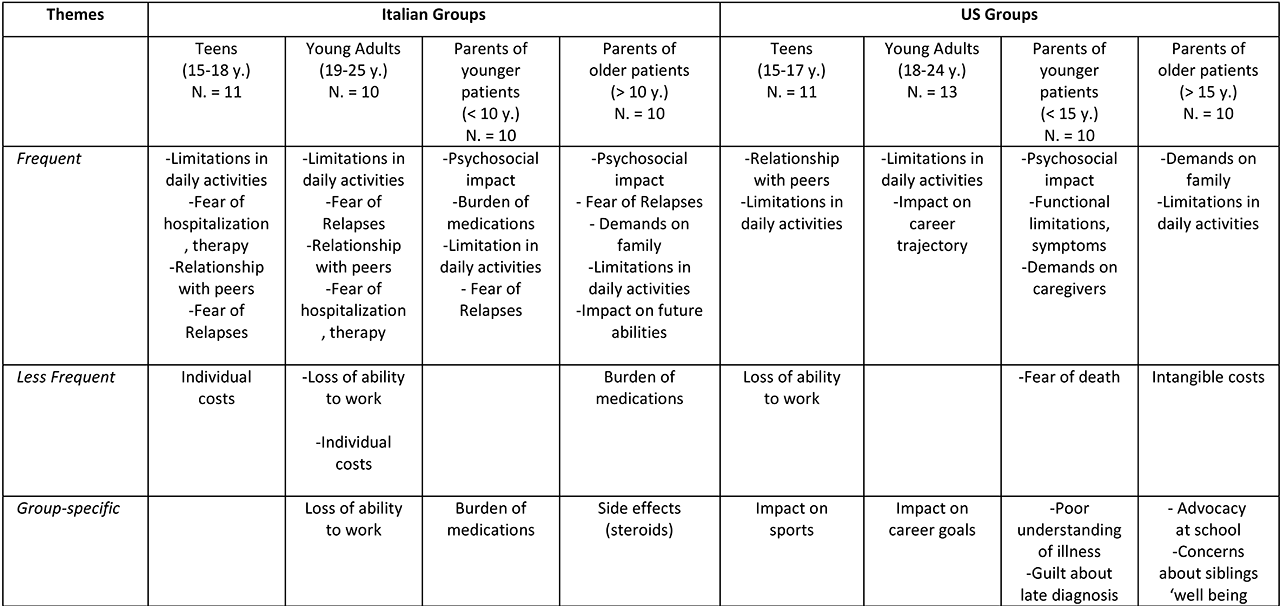
between groups.
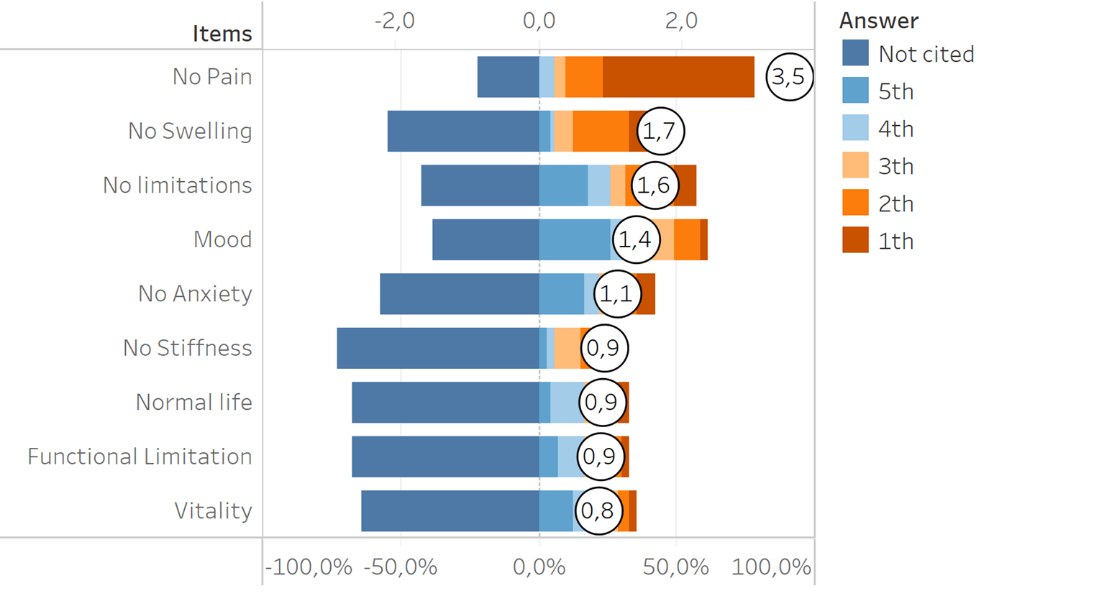
assigning each rank are shown for the domains. The average ranking score for each domain is indicated in the circles.

To cite this abstract in AMA style:
Alongi A, Calandra S, Thornhill S, Stinson J, Horonjeff J, Horton D, Consolaro A, Morgan E. Patients’ and Parents’ Perception of Disease and Its Impact on Life in Juvenile Idiopathic Arthritis: Results from Multinational Virtual Focus Groups by the OMERACT JIA Working Group [abstract]. Arthritis Rheumatol. 2019; 71 (suppl 10). https://acrabstracts.org/abstract/patients-and-parents-perception-of-disease-and-its-impact-on-life-in-juvenile-idiopathic-arthritis-results-from-multinational-virtual-focus-groups-by-the-omeract-jia-working-group/. Accessed .« Back to 2019 ACR/ARP Annual Meeting
ACR Meeting Abstracts - https://acrabstracts.org/abstract/patients-and-parents-perception-of-disease-and-its-impact-on-life-in-juvenile-idiopathic-arthritis-results-from-multinational-virtual-focus-groups-by-the-omeract-jia-working-group/