
Session Information
Date: Monday, November 6, 2017
Session Type: ACR Poster Session B
Session Time: 9:00AM-11:00AM
Background/Purpose: Quantifiable measures of patients’ symptoms such as patient reported outcomes (PROs) provides the physician with quantifiable information of subjective symptoms experienced by patients with rheumatoid arthritis (RA). Electronic tools that include instruments that physicians value to inform their treatment recommendations are limited since collection of this type of data can be time consuming and requires personnel to administer them. To determine which PRO domain, are most commonly used by rheumatologists when treating RA patients and best ways to administered them at the point of care.
Methods: We developed a survey following qualitative data of 4 nominal groups and 25 rheumatologists. Items were aggregated into topic groups and categorized by themes. We used the items/responses generated in the nominal groups to develop the questions and responses of the survey. The survey included multiple choice questions and others included a scale where participants graded specific items into: 1) very important; 2) Important; 3) Somewhat important; 4) Not important; 5) do not assess. Rheumatologists who are a part of the American College of Rheumatology membership were invited to participate. The survey was deployed via Qualtrics. We used proportions to describe the results of this survey.
Results: We invited 600 rheumatologists and 56 responded to the survey (ongoing survey). The majority of the respondents were between 35 and 54 years of age; 64% male. The aspects that physicians graded as very important are shown in figure 1. The majority of them valued medication compliance, aspects related to physical function, and quality of life were. While the Patient-Reported Outcomes Measurement Information System (PROMIS) was known by 16 respondents, only 1 rheumatologist was using it regularly in practice. There were 16 and 25 respondents who collect MDHAQ and RAPID3 on most of all office visits, respectively. The majority of the respondents were interested in having PRO data collected electronically and synchronized with the electronic health record (64%).
Conclusion: Electronic collection of PROs that incorporates medication compliance, patient function and that it has an interface with the electronic health record will make the collection of PROs more feasible for physicians. While PROMIS instruments was known by a small number of respondents only 1 was using it. Educating physicians about these questionnaires can increase its use in clinical practice, which is limited according to these results. 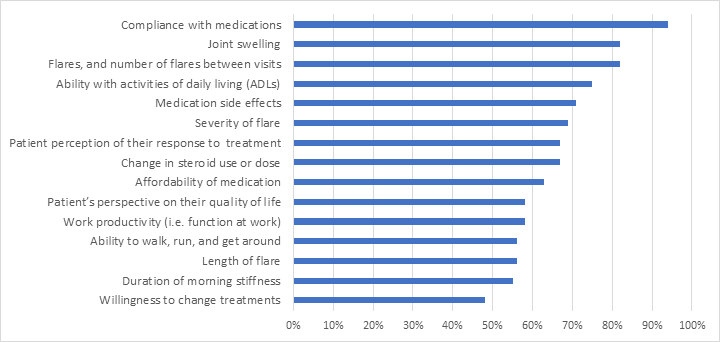
To cite this abstract in AMA style:
Navarro-Millán I, Cornelius-Schecter A, Jagpal A, Johnson B, Fraenkel L, Safford MM, Curtis JR. Patient Reported Outcomes in Rheumatoid Arthritis: Best Domain, Best Interface [abstract]. Arthritis Rheumatol. 2017; 69 (suppl 10). https://acrabstracts.org/abstract/patient-reported-outcomes-in-rheumatoid-arthritis-best-domain-best-interface/. Accessed .« Back to 2017 ACR/ARHP Annual Meeting
ACR Meeting Abstracts - https://acrabstracts.org/abstract/patient-reported-outcomes-in-rheumatoid-arthritis-best-domain-best-interface/