
Session Information
Session Type: ACR Poster Session A
Session Time: 9:00AM-11:00AM
Background/Purpose: In individuals with RA, catastrophizing is associated with poor pain outcomes. It is not known whether catastrophizing can be altered by treating RA with DMARDs, or if pain can predict changes in catastrophizing associated with DMARD treatment. The objective of this analysis was to identify changes in catastrophizing associated with DMARD therapy and to examine associations between baseline pain and subsequent catastrophizing levels. We also analyzed the opposite relationship to determine if baseline catastrophizing is associated with future pain.
Methods: We examined baseline (before DMARD initiation) and follow-up data (12-24 weeks after DMARD initiation) from the first 115 subjects in a prospective cohort of RA patients with active disease starting or switching DMARDs. Pain was measured by the Numeric Rating Scale (NRS) from 0-10, and pain catastrophizing was measured by the Pain Catastrophizing Scale from 0-52. We used paired t-tests to determine if pain catastrophizing changed over 12-weeks of DMARD treatment. Multivariable linear regression models were used to examine the association between: a) baseline pain catastrophizing as the independent variable and 12-week pain intensity as the outcome, and b) baseline pain intensity as the independent variable and 12-week pain catastrophizing as the outcome. These models controlled for age, gender, disease duration, swollen joint count and depression. In addition, baseline pain intensity was included as a covariate in the model examining the relationship between baseline catastrophizing and 12-week pain, and baseline catastrophizing was included in the model examining the relationship between baseline pain and 12-week catastrophizing.
Results: In this cohort of RA patients, median age was 54.9 years, and 78.1% were women. 38.8% started a non-biologic DMARD, and 61.2% started a biologic DMARD. Both pain and catastrophizing decreased after 12-weeks, from 5 to 3 on a 10-pt NRS (P <0.0001) and from 16 to 10 on the 52-point Pain Catastrophizing Scale (P <0.0001). High baseline pain was associated with greater catastrophizing at 12 weeks (β=0.92, p=0.04) (Figure). Baseline catastrophizing was not associated with pain at 12 weeks (β=0.02, p=0.36).
Conclusion: These findings demonstrate that after initiating a new DMARD, pain catastrophizing decreases in RA patients, suggesting that catastrophizing may have state-like properties, which can be altered by DMARD treatment. However, despite DMARD treatment, individuals with high baseline pain had higher pain catastrophizing at 12-weeks, compared to those with low baseline pain. These findings suggest that aggressive initial treatment of pain may be useful in preventing future catastrophizing. 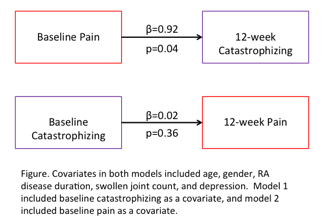
To cite this abstract in AMA style:
Cohen E, Wohlfahrt A, Edwards RR, Bingham C III, Bolster M, Moreland LW, Neogi T, Phillips K, Lee YC. Pain Catastrophizing Decreases in RA Patients Starting, Adding or Switching a DMARD [abstract]. Arthritis Rheumatol. 2016; 68 (suppl 10). https://acrabstracts.org/abstract/pain-catastrophizing-decreases-in-ra-patients-starting-adding-or-switching-a-dmard/. Accessed .« Back to 2016 ACR/ARHP Annual Meeting
ACR Meeting Abstracts - https://acrabstracts.org/abstract/pain-catastrophizing-decreases-in-ra-patients-starting-adding-or-switching-a-dmard/