
Background/Purpose: Patients with eosinophilic granulomatosis with polyangiitis (EGPA), polyarteritis nodosa (PAN) or microscopic polyangiitis (MPA) without poor-prognosis factors, as defined by their 1996 Five-Factor Scores (FFS)=0, were included in 2 prospective CHUSPAN trials and initially received corticosteroids (CS) alone. Because some patients required add-on therapies (AT) during follow-up, baseline characteristics associated with their use were sought.
Methods: Patients’ data were updated in 2012. Chapel Hill definitions classified EGPA, PAN and MPA. Analyzed AT were all cytotoxic agents, biologics (except omalizumab), intravenous immunoglobulins (IVIg) (>2 g/kg) and plasma exchange. Univariate and multivariate analyses were performed.
Results: The study included 193 patients (75 EGPA, 61 MPA and 57 PAN) initially treated with CS alone. Mean±SD overall follow-up was 97.6±39.6 months, with no difference among entities. During follow-up, 86/193 (24 PAN, 32 MPA and 30 EGPA) patients required AT (mean follow-up since CS onset: 23.3±34.1 months) because CS failed (37%), relapse (52%) or CS dependency (10%): 49 received IV cyclophosphamide (CYC), 13 oral CYC, 56 azathioprine, 15 methotrexate, 9 mycophenolate mofetil, 7 IVIg, 6 plasma exchange, 1 infliximab and 1 cyclosporine. The significant association of mononeuritis multiplex (MNM) with AT use (univariate analysis, Fig 1; P=0.008) was confirmed by multivariate analysis, with MM being the only factor independently associated with requiring AT (hazard ratio=1.81 [95% CI: 1.12–2.93]; P=0.02). AT prescription rates were comparable for the 3 entities. At last visit, 165/193 (85%) were alive, with 94 (57%) and 28 (17%), respectively, still taking CS and/or cytotoxic agent or biotherapy. Overall survival reached 90% at 7 years and was comparable for patients who had taken ≥1 AT vs those treated only with CS during follow-up (P=0.564). However, patients given ≥1 vs 0 AT had significantly higher Vasculitis Damage Indexes (VDI): 2.93±2.09 vs 1.96±1.40 (P<0.001), reflecting more frequent osteoporosis (33 vs 18%, P=0.013) or peripheral neuropathy (60 vs 38%, P=0.004).
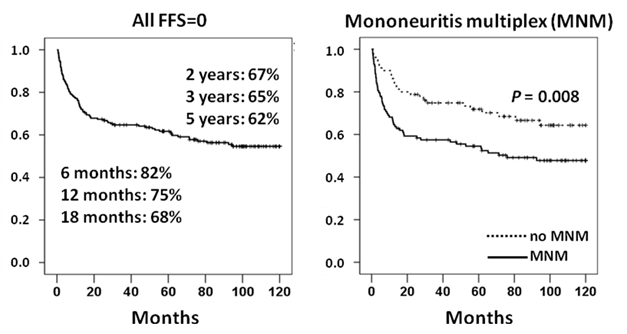
Figure 1. Probability of survival without prescription of new add-on therapies of 193 patients with EGPA, PAN or MPA without baseline poor-prognosis factors (FFS=0). P determined with log-rank test.
Conclusion: Despite the good and comparable overall survival of baseline-FFS=0 EGPA, PAN or MPA patients, 45% required AT, mostly those with MNM, and their VDI were significantly higher, indicating more sequelae than those of the other FFS=0 patients. Hence, this MNM subpopulation might be more likely to fail on CS alone, thereby supporting prospective evaluation of their initial cytotoxic agent use.
Disclosure:
M. Samson,
None;
X. Puéchal,
None;
H. Devilliers,
None;
C. Ribi,
None;
P. Cohen,
None;
B. Bienvenu,
None;
C. Pagnoux,
None;
L. Mouthon,
None;
L. Guillevin,
None;
F. V. Study Group (FVSG),
None.
« Back to 2013 ACR/ARHP Annual Meeting
ACR Meeting Abstracts - https://acrabstracts.org/abstract/mononeuritis-multiplex-predicts-the-need-for-immunosuppressive-or-immunomodulatory-drugs-for-eosinophilic-granulomatosis-with-polyangiitis-polyarteritis-nodosa-and-microscopic-polyangiitis-patients-w/