
Session Information
Session Type: ACR Concurrent Abstract Session
Session Time: 11:00AM-12:30PM
Background/Purpose: Primary Sjögren’s Syndrome (pSS) is characterized by lymphocytic infiltration of salivary glands. Unclear interactions between infiltrating cells and salivary gland ductal cells cause reduced gland function (hyposalivation), and significant decrease in patient quality of life. We recently isolated salivary gland stem cells from healthy human salivary gland biopsies, and characterized their self-renewal and differentiation capabilities. These stem cells are ductal cells and are therefore likely to be complicit in pSS manifestation. We sought to elucidate differences in salivary gland stem cells from pSS patients, compared to healthy controls.
Methods: Salivary gland stem cells were isolated as published from parotid gland biopsies of healthy control and pSS patients [1]. After 4 days, stem cells, grown as balls of cells termed ‘salispheres’, were dispersed into single cells and new salispheres generated. This passaging was repeated to ascertain the proliferative potential. Every week, culture medium samples were taken for mass spectrometry analysis. Immunohistochemistry stainings and electron microscopy were performed as standard.
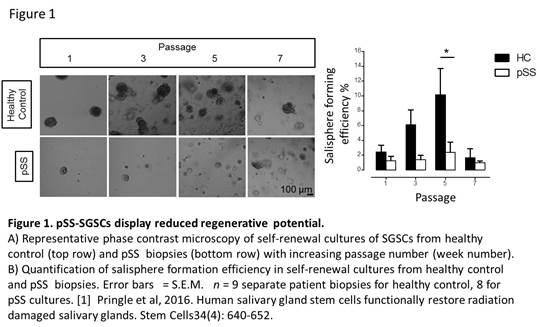
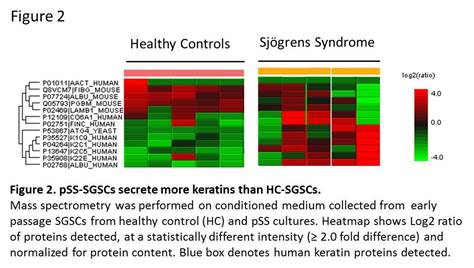
Results: Yield of salivary gland stem cells from pSS biopsies was significantly lower than from healthy control tissues. The self-renewal capability of stem cells from pSS biopsies was markedly reduced compared to healthy control samples (Fig. 1). Secretome analysis via mass spectrometry revealed an abundance of keratins in culture medium, suggesting expulsion/secretion/mislocalization of keratins by ductal cells in pSS (Fig. 2). In preliminary data, ductal cells cytoplasm from pSS biopsies contained less keratins. Keratin fibers were observed extracellularly basally to pSS ductal cells by electron microscopy.
Conclusion: Our data demonstrates that there is an innate difference in regenerative potential and secretome of salivary gland stem cells from pSS biopsies compared to healthy controls. This deficit suggests an innate defect in stem cell ability to regenerate damaged glandular tissue in pSS, and may hereby contribute to the hyposalivation. We suggest for the first time that expulsion, secretion or mislocalization of keratins may underpin salivary gland stem cell defects in pSS and provide a novel insight into how salivary gland malfunction is manifested in pSS. Further characterization of stem cells from pSS biopsies, including organoid generation (mini salivary glands-in-a-dish), will further reveal mechanisms underpinning ductal cell involvement in pSS, and generate new therapeutic options.
To cite this abstract in AMA style:
Pringle S, Bootsma H, Vissink A, Spijkervet FKL, Coppes R, Kroese FGM. Modelling Primary Sjögren’s Syndrome Using Salivary Gland Stem Cells [abstract]. Arthritis Rheumatol. 2016; 68 (suppl 10). https://acrabstracts.org/abstract/modelling-primary-sjogrens-syndrome-using-salivary-gland-stem-cells/. Accessed .« Back to 2016 ACR/ARHP Annual Meeting
ACR Meeting Abstracts - https://acrabstracts.org/abstract/modelling-primary-sjogrens-syndrome-using-salivary-gland-stem-cells/