
Session Information
Session Type: Poster Session B
Session Time: 10:30AM-12:30PM
Background/Purpose: The maternal antenatal attachment (MAA) is defined as the emotional bond between a pregnant woman and her unborn child. The quality of this relationship is considered relevant for the subsequent attachment relationship and the psychological development of the infant.
Autoimmune rheumatic diseases (ARDs) affect women in their reproductive years and have a significant impact on childbearing. Studies show that pregnant women with ARDs were ambivalent toward their pregnancy and had higher levels of depression. The aim of this study is to describe the quality and intensity of the MAA in women with ARDs and their relationship with depressive and anxious symptoms.
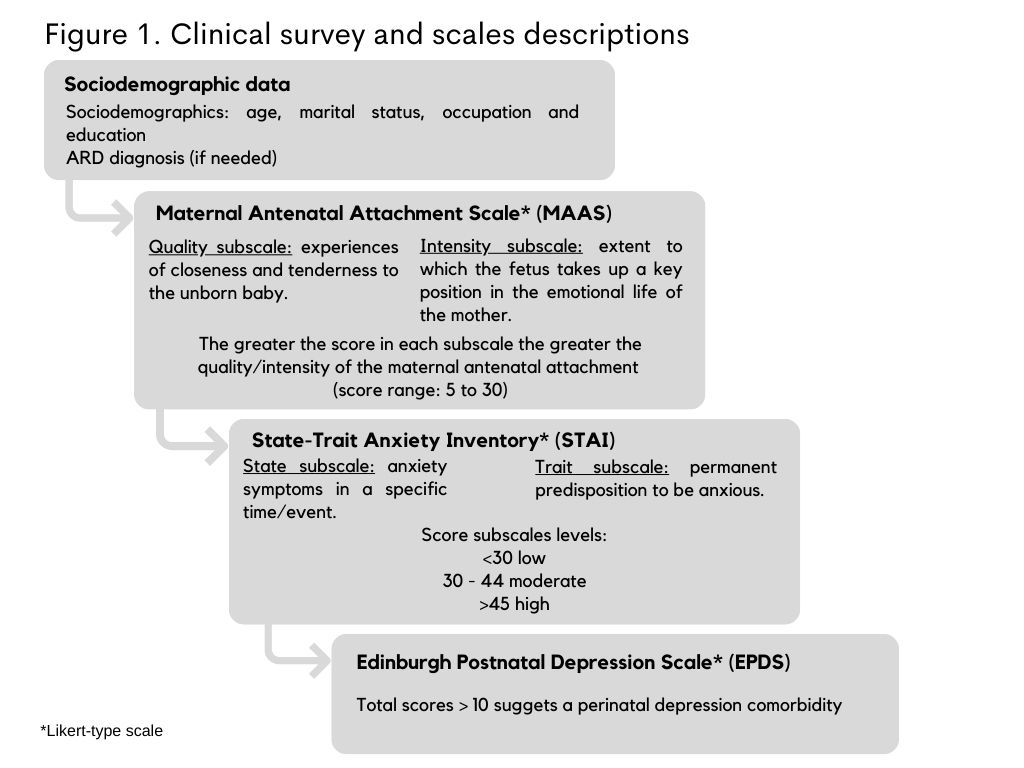
Methods: A descriptive, comparative, cross-sectional study was conducted among pregnant women in their third trimester with and without ARDs from the rheumatology and gynecology outpatient clinics in a university hospital. All women answer a survey including sociodemographic and medical history and three questionnaires: Maternal Antenatal Attachment Scale (MAAS), State-Trait Anxiety Inventory (STAI) and Edinburgh Postnatal Depression Scale (EPDS). The details of the questionnaires are shown in figure 1.
For statistical analysis the Kolmogorov-Smirnov test was employed to determine normality. Clinical and demographic characteristics were presented as frequencies and percentages, for the continuous variables we provided means (SD) and medians (IQR). Spearman correlation test was employed to assess the association between the MAAS, STAIT and EPDS. A p value = 0.005 was considered statistically significant. Statistical program SPSS version 25 (IBM Corp, Armonk, NY).
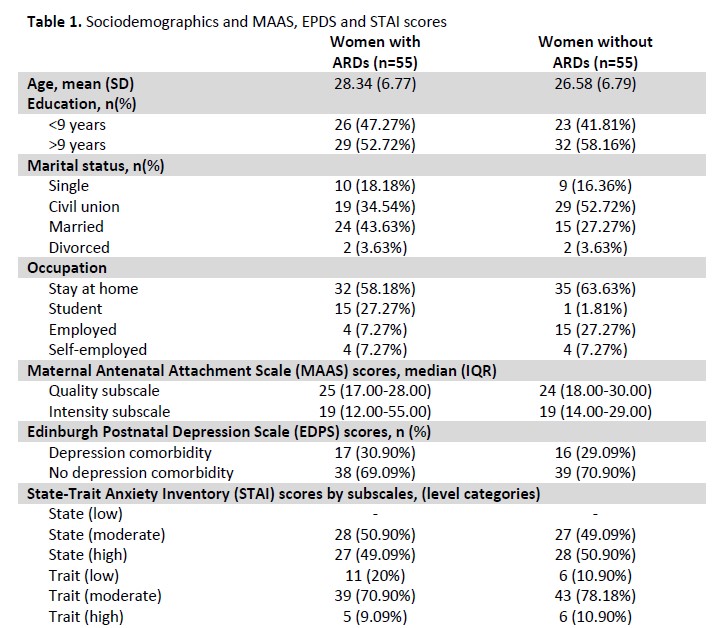
Results: A total of 110 pregnant women in their third trimester were included: 55 women with ARDs and 55 without ARDs. For the ARDs group, the most frequent diagnosis was rheumatoid arthritis (RA) with 28 (50.90%), followed by systemic lupus erythematosus (SLE) and antiphospholipid syndrome (APS) with 9 (16.36%) each. No significant correlations were found between the sociodemographic data and the MAAS, STAI and EPDS among groups. Sociodemographics and the scales’ scores by group are shown in table 1.
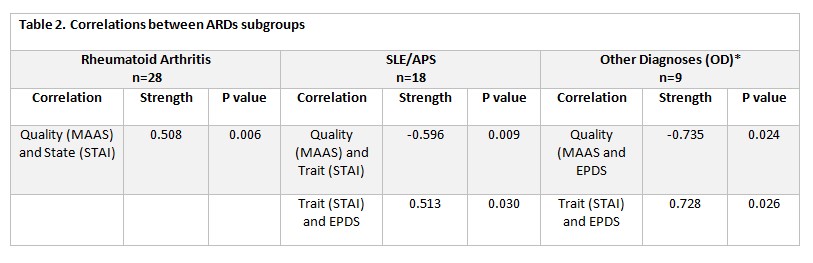
There were no significant differences between the ARDs group and control group. In the control group, a weak positive correlation was found between the trait subscale (STAI) and the EPDS (r=0.383, p=< 0.01). In the ARDs group, we found a strong positive correlation between the trait subscale (STAI) and the EPDS (r=0.613, p< 0.001). Based on the reported perinatal adverse outcomes, we divided in 3 subgroups: RA (n=28), SLE and APS (n=18), other diagnosis, (n=9); significant correlations are shown in table 2.
Conclusion: Women with ARDs were able to develop MAA with quality (25, IQR: 17-28) and intensity (19, IQR: 12-55). Relating MAA and psychiatric symptoms: experiencing closeness and tenderness toward their unborn child (quality subscale, MAAS) impact differently in developing psychiatric symptoms in each subgroup: RA women present anxiety symptoms; the OD subgroup reported depressive symptoms. The SLE + APS subgroup scores show a predisposition to be anxious (STAI TRAIT subscale) rather than having active psychiatric symptoms.
To cite this abstract in AMA style:
Corral-Trujillo M, Cerda González R, Berlanga-Muñoz L, Cantú-Barreda R, Montes-Rodríguez B, Carrazco Chapa A, Burciaga Garza A, Cardenas-de la Garza J, Perez-Barbosa L, SKINNER TAYLOR C, Galarza-Delgado D. Maternal Antenatal Attachment in Women with Rheumatic Diseases [abstract]. Arthritis Rheumatol. 2024; 76 (suppl 9). https://acrabstracts.org/abstract/maternal-antenatal-attachment-in-women-with-rheumatic-diseases/. Accessed .« Back to ACR Convergence 2024
ACR Meeting Abstracts - https://acrabstracts.org/abstract/maternal-antenatal-attachment-in-women-with-rheumatic-diseases/