ACR Meeting Abstracts

ACR Meeting Abstracts

  • Meeting Abstracts
    • All Meetings
    • PRSYM 2026
    • ACR Convergence 2025
    • Download Abstract Supplements
  • Keyword Index
  • Search
  • My Favorites
    • View and print all favorites
    • Clear all favorites

Abstract Number: 2269

Major Stressors in the Year Prior to Diagnosis Affects RA Characteristics at Presentation and 1 Year

Nicole Andersen1, Orit Schieir 2, Marie-France Valois 3, Gilles Boire 4, Janet Pope 5, Glen Hazlewood 6, Louis Bessette 7, Carol Hitchon 8, Diane Tin 9, Carter Thorne 10, Edward Keystone 11, Vivian Bykerk 12, Susan J. Bartlett 1 and Canadian Early Arthritis Cohort (CATCH) Investigators 13, 1McGill University, Montreal, QC, Canada, 2University of Toronto, Montreal, Canada, 3McGill University, Montreal, Canada, 4Sherbrooke University, Sherbrooke, QC, Canada, 5Western University, London, ON, Canada, 6University of Calgary, Calgary, Canada, 7Laval University, Quebec City, QC, Canada, 8University of Manitoba, Winnipeg, Canada, 9Southlake Regional Health Centre, Newmarket, Canada, 10Southlake Regional Health Centre, Newmarket, ON, Canada, 11Mount Sinai Hospital and University of Toronto, Toronto, ON, Canada, 12Hospital for Special Surgery, New York City, NY, 13Canadian Early Arthritis Cohort (CATCH) Study, Toronto, Canada

Meeting: ACR/ARP Annual Meeting 2019

Keywords: Disease Activity and chronic disease care, Early Rheumatoid Arthritis, psychosocial factors, stress

  • Tweet
  • Email a link to a friend (Opens in new window) Email
  • Print (Opens in new window) Print
Session Information

Date: Tuesday, November 12, 2019

Title: Psychology/Social Science Poster – ARP

Session Type: Poster Session (Tuesday)

Session Time: 9:00AM-11:00AM

Background/Purpose: Although many RA patients attribute their disease onset to recent life events, results from retrospective studies remain unclear. We compared characteristics of newly diagnosed RA patients who did and did not report significant stressful life events (+stress) in year prior to diagnosis at baseline and 12 months.

Methods: Data were from early RA patients (symptoms < 1 year) enrolled in the Canadian Early Arthritis Cohort (CATCH) from 01-2007 to 03-2017 with ≥ 12 months of follow-up. Patients were asked about major psychological (death, divorce/separation, family, financial, other) and physical (motor vehicle accident, surgery, major illness/infection, other) stressors in previous year. We used independent t-tests and chi square to compare characteristics by sex and stress classification and multivariable regression to examine the impact of stress on disease activity and patient reported outcomes (PROs) at 1 year after adjusting for age, sex, education, and baseline fibromyalgia diagnosis and swollen joint count.

Results: The 1933 adults were mostly female (72%), with a mean (SD) age of 55 (15) years. At baseline, 52% reported one or more stressors in previous year; family (48%), financial stress (36%), death (35%), surgery (28%), and major illness (26%) were the most common stressors. Patients with +stress were more likely to be women, were significantly younger, had more comorbidities, slightly higher mean DAS28, and were more likely to have fibromyalgia (Table 1). Patients with +stress also reported significantly baseline higher pain, fatigue, depression, sleep disturbance, patient global, and HAQ-DI scores.

At 1 year, swollen joint counts and the proportion of patients in DAS28 REM was similar between groups. However, PROs remained higher in those with a history of +stress, with some evidence of a dose-response relationship (Table 2). The greatest impacts were on mood, sleep disturbance, and fatigue.

Conclusion: In this pan-Canadian early RA cohort, stressful life events were common in the year prior to diagnosis and were associated with significantly worse depression, fatigue, sleep disturbance, pain, patient global and disability scores at diagnosis; 1 year later effects on PROs persisted even though disease activity was similar between groups. Newly diagnosed RA patients with a history of recent stressors may benefit from emotional support to optimize how they feel and function.


Table 1 ACR 2019 Stress Final
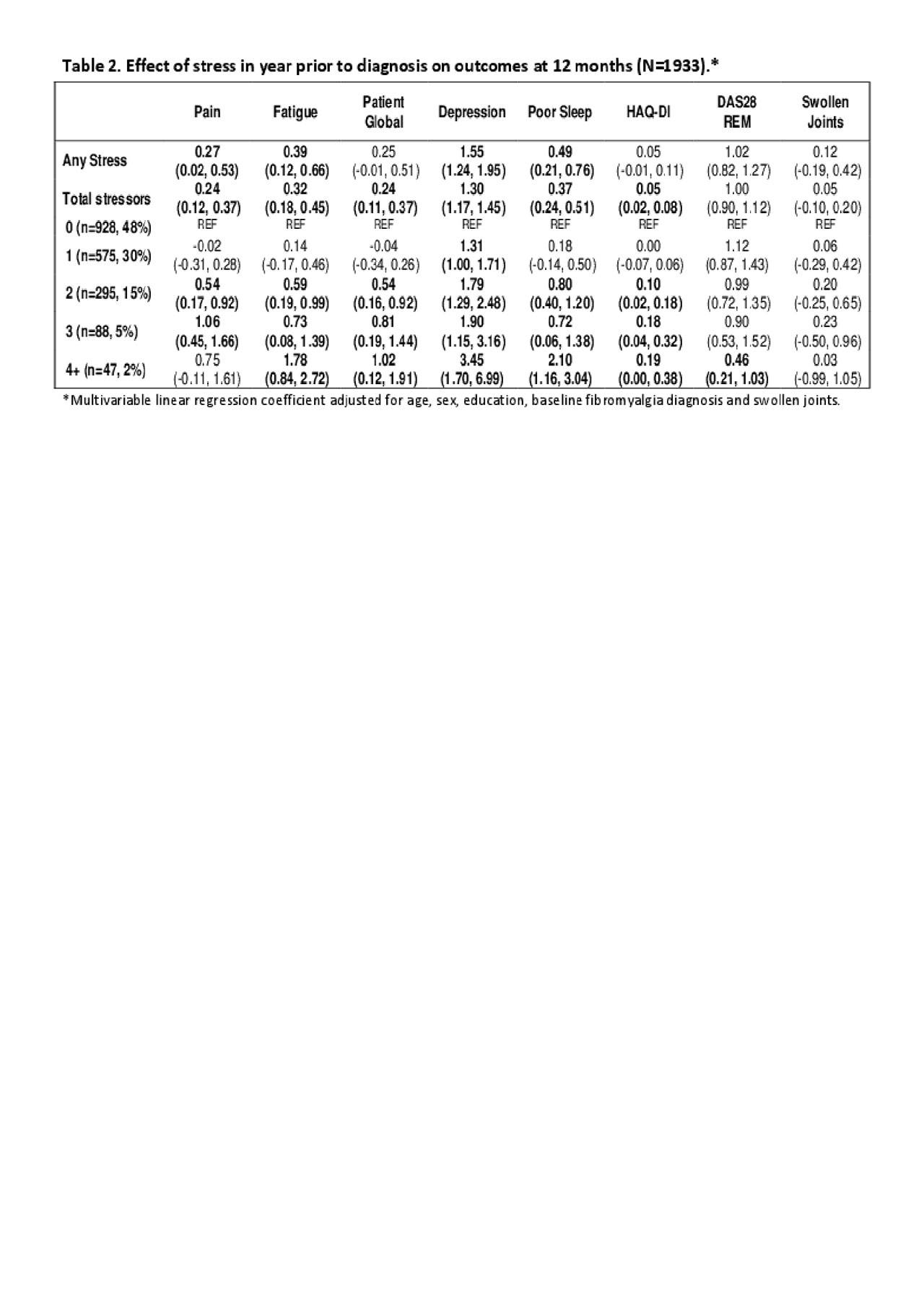

Table 2 ACR2019 Stress Nicole FINAL


Disclosure: N. Andersen, None; O. Schieir, None; M. Valois, None; G. Boire, Abbvie, 2, Amgen, 2, 5, BMS, 2, 5, 8, Bristol-Myers Squibb, 2, 5, 8, Celgene, 5, Eli Lilly, 2, 5, Lilly, 2, 5, Merck, 2, 8, Novartis, 2, Pfizer, 2, 5, 8; J. Pope, AbbVie, 5, Abbvie, 5, Actelion, 5, Actellion, 5, Amgen, 2, 5, AstraZeneca, 2, Astra-Zeneca, 2, Bayer, 2, 5, BMS, 2, 5, Eicos Sciences, 5, Eli Lilly & Company, 5, Eli Lilly and Company, 5, EMERALD, 5, Emerald, 5, Genzyme, 5, Janssen, 5, Lilly, 5, Merck, 2, 5, Novartis, 5, Pfizer, 2, 5, Roche, 2, 5, Sandoz, 5, Sanofi, 5, Seattle Genetics, 2, UCB, 2, 5, 8; G. Hazlewood, None; L. Bessette, AbbVie, 2, 5, 8, Abbvie, 2, 5, 8, Amgen, 2, 5, 8, Amgen, BMS, Janssen, Roche, UCB Pharma, AbbVie Inc, Pfizer, Merck, Celgene, Sanofi, Eli Lilly, and Novartis., 2, 5, 8, BMS, 2, 5, 8, Bristol-Myers Squibb, 2, 5, 8, Bristol-Myers-Squibb, 2, 5, 8, Celgene, 2, 5, 8, Eli Lilly, 2, 5, 8, Eli Lilly and Company, 2, 5, 8, Janssen, 2, 5, 8, Lilly, 2, 5, 8, Merck, 2, 5, 8, Novartis, 2, 5, 8, Pfizer, 2, 5, 8, Pfizer Inc, 2, 5, Roche, 2, 5, 8, Sanofi, 2, 5, 8, UCB, 2, 5, 8, UCB Pharma, 2, 5; C. Hitchon, Pfizer, 2, UCB, 2, UCB Canada, 2; D. Tin, None; C. Thorne, Abbvie, 2, 5, Amgen, 2, 5, CaREBiodam, 2, Celgene, 2, 5, Centocor, 5, Janssen, 5, Lilly, 5, Medexus/Medac, 5, 8, Merck, 5, Novartis, 2, 5, Pfizer, 2, 5, Sandoz, 5, Sanofi, 5; E. Keystone, Abbvie, 2, 5, 8, Amgen, 2, 5, 8, AstraZeneca, 5, Astra-Zeneca, 5, Biotest, 5, BMS, 2, 5, 8, Celltrion, 5, Crescendo, 5, Crescendo Bioscience, 5, F. Hoffmann-La Roche Inc, 2, 5, 8, Genentech, 5, Genentech Inc., 5, Genzyme, 5, Gilead, 2, 5, Gilead Sciences, Inc., 5, Janssen, 2, 5, 8, Lilly, 2, 5, 8, Merck, 5, 8, Pfizer, 2, 5, 8, Pfizer Pharmaceuticals, 2, 5, 8, Roche, 2, 5, 8, Sandoz, 5, Sanofi, 2, 5, 8, Sanofi-Aventis, 2, 8, UCB, 5, 8; V. Bykerk, AbbVie, 5, Amgen, 1, 2, 3, 5, 8, Brainstorm Therapeutics, 1, 2, 3, 5, 8, Bristol-Myers Squibb, 5, Genentech, 5, Gilead, 5, NIH, 2, Pfizer, 1, 2, 3, 5, 8, Regeneron, 5, Regeneron Pharmaceuticals, Inc, 5, Sanofi, 5, Sanofi/Genzyme-Regeneron, 5, Sanofi-Genzyme/Regeneron, 1, 2, 3, 5, 8, Scipher, 1, 2, 3, 5, 8, The Cedar Hill Foundation, 9, UCB, 1, 2, 3, 5, 8, UCB Pharma, 5; S. Bartlett, Abbie, 2, Abbvie, 2, 5, Bayer, 5, International Society of QOL Research, 6, Janssen, 5, 8, Lilly, 5, Merck, 5, 8, Novartis, 5, 8, Pfizer, 5, Pfizer Inc, 8, PROMIS International, 6, UCB, 5, 8; C. (CATCH) Investigators, Amgen, 2, Pfizer Canada, 2, AbbVie Corporation, 2, Medexus Inc., 2, Eli Lilly Canada, 2, Merck Canada, 2, Sandoz Canada Biopharmaceuticals, 2.

To cite this abstract in AMA style:

Andersen N, Schieir O, Valois M, Boire G, Pope J, Hazlewood G, Bessette L, Hitchon C, Tin D, Thorne C, Keystone E, Bykerk V, Bartlett S, (CATCH) Investigators C. Major Stressors in the Year Prior to Diagnosis Affects RA Characteristics at Presentation and 1 Year [abstract]. Arthritis Rheumatol. 2019; 71 (suppl 10). https://acrabstracts.org/abstract/major-stressors-in-the-year-prior-to-diagnosis-affects-ra-characteristics-at-presentation-and-1-year/. Accessed .
  • Tweet
  • Email a link to a friend (Opens in new window) Email
  • Print (Opens in new window) Print

« Back to ACR/ARP Annual Meeting 2019

ACR Meeting Abstracts - https://acrabstracts.org/abstract/major-stressors-in-the-year-prior-to-diagnosis-affects-ra-characteristics-at-presentation-and-1-year/

Advanced Search

My Favorites

Save and print abstracts during your browser session by clicking the “Favorite” button at the bottom of any abstract (must have cookies enabled in browser). See saved favorites.

Abstract Policies

  • ACR Convergence Abstract Embargo Policies
  • ACR Convergence Abstract Permissions & Reprints
  • PRSYM Abstract Policies

ACR Convergence. Where Rheumatology Meets

ACR Convergence 2026

Join us November 6-11 in Orlando, Florida.
See Registration Information

  • Contact ACR
  • Privacy Policy
  • ACR Policies
  • Cookie Preferences

© Copyright 2026 American College of Rheumatology