
Session Information
Date: Tuesday, November 10, 2015
Title: Spondylarthropathies and Psoriatic Arthritis - Clinical Aspects and Treatment Poster III: Therapy
Session Type: ACR Poster Session C
Session Time: 9:00AM-11:00AM
Background/Purpose: Anti-TNF therapy is successful for achieving low
disease activity (LDA) or clinical remission in patients with axial spondyloarhritis (axSpA).
Nevertheless, this therapy has not clearly shown to slow or inhibit
radiographic progression in these patients. Based on this, it is unclear what
therapeutic attitude should be adopted once remission has been achieved in
patients with axSpA. The aim of this study was
to evaluate if anti-TNF tapering is efficacious for maintaining remission or LDA
in patients with axSpA.
Methods: A systematic literature review until August 2014 was
performed using Medline, EMBASE and Cochrane databases. The research question
was formulated according to the PICOS method: Population (axSpA
patients); Intervention (anti-TNF dose tapering); Comparator (continue with
standard dose of anti-TNF); Outcome (flare or change on disease activity); and
Study design (longitudinal studies with at least 6 months of follow up after
dose adjustment). Data was extracted independently by two
reviewers using a form developed for this purpose.
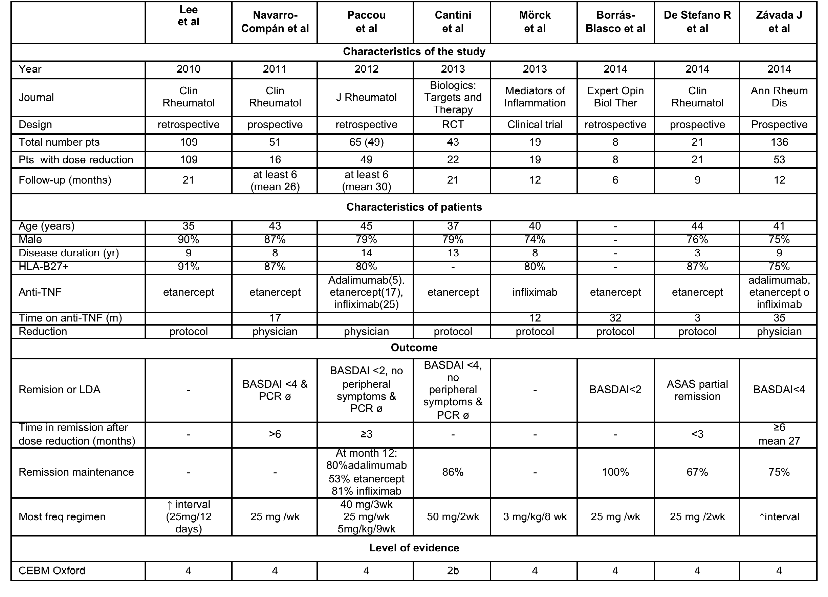
Results: In total, 8 studies from 763 citations were included.
All studies included patients with ankylosing spondylitis from single centers
and no study included patients with non-radiographic axSpA.
The study design was observational (n=6) and interventional (n=2). In these
studies, patients receiving standard doses of anti-TNF therapy who were in
remission (BASDAI<2 and normal CRP) or with LDA (BASDAI<4 and normal CRP)
reduced anti-TNF therapy dose according to an established protocol (n=5) or to
the physician«s criterion (n=3). Total number of patients on low-dose regimen ranged
between 8 and109 patients and the follow-up period after anti-TNF tapering between
6-21 months. Administered anti-TNF therapy was etanercept
(n=5), infliximab (n=1) and adalimumab/etancercept/infliximab (n=2). Data extracted for each study
are shown on the table.
The percentage of patients maintaining LDA or
remission after reducing anti-TNF dose was reported in 5 out of the 7 studies.
These were 67%, 75%, 53-81%, 86% and 100%. The remaining three studies reported
mean change in disease activity measures after reducing anti-TNF therapy. Mean
BASDAI in these studies before reducing anti-TNF dose was 2.3, 1.6 and 2.1 and
at the end of the study was 0.6, 1.4 and 3.2, respectively. Mean CRP (mg/L)
before reducing anti-TNF dose was 0.1, 1.0 and 8 and at the end of the study
was 0.1, 1.3 and 8, respectively. Anti-TNF tapering was most frequently done
increasing the interval between drug administrations than decreasing the dose
of the injection/infusion.
Conclusion: Published data indicates that anti-TNF therapy
tapering is successful in maintaining remission or LDA during at least one year
in a high number (>50%) of patients with AS. Further data are required to
identify which patients with axSpA are included
within this group.
Table: Results for quantitative variables are mean values.
To cite this abstract in AMA style:
Navarro-Compán V, Plasencia-Rodriguez C, De Miguel E, Balsa A, Martín-Mola E, Seoane-Mato D, Cañete JD. Is Anti-TNF Tapering Possible in Patients with Axial Spondyloarthritis? a Systematic Literature Review [abstract]. Arthritis Rheumatol. 2015; 67 (suppl 10). https://acrabstracts.org/abstract/is-anti-tnf-tapering-possible-in-patients-with-axial-spondyloarthritis-a-systematic-literature-review/. Accessed .« Back to 2015 ACR/ARHP Annual Meeting
ACR Meeting Abstracts - https://acrabstracts.org/abstract/is-anti-tnf-tapering-possible-in-patients-with-axial-spondyloarthritis-a-systematic-literature-review/