
Session Information
Title: Systemic Lupus Erythematosus - Clinical Aspects I - Renal, Malignancy, Cardiovascular Disease
Session Type: Abstract Submissions (ACR)
Accelerated atherosclerosis accounts for significant premature mortality rates among systemic lupus erythematosus (SLE) patients. Arterial stiffness reflects changes in mechanical properties of vascular wall that occurs early with onset of vascular disease. We aimed to characterize 1- the role for traditional and non-traditional CVD risk factors on carotid-femoral pulse wave velocity (PWV) as a measure of arterial stiffness, in this population and conversely, 2- if and how arterial stiffness impact on SLE-associated feature such as renal function.
- Methods:
Carotid-femoral pulse wave velocity (PWV) was prospectively in 42 SLE patients and 36 age- and sex-matched controls. Association between PWV and traditional and non-traditional risk factors for CVD, SLE disease history, steroid treatment, and renal function were analyzed.
- Results:
The mean age of SLE subjects was 40 ± 10 years and 34 (81%) were female. Five patients (11.9%) had antiphospholipid syndrome. All SLE patients were receiving hydroxychloroquine. All received long-term glucocorticoids and 28 (66.7%) were still under prednisone at a mean daily dose of 9 ± 3.2 mg (range: 5-17) at study time.
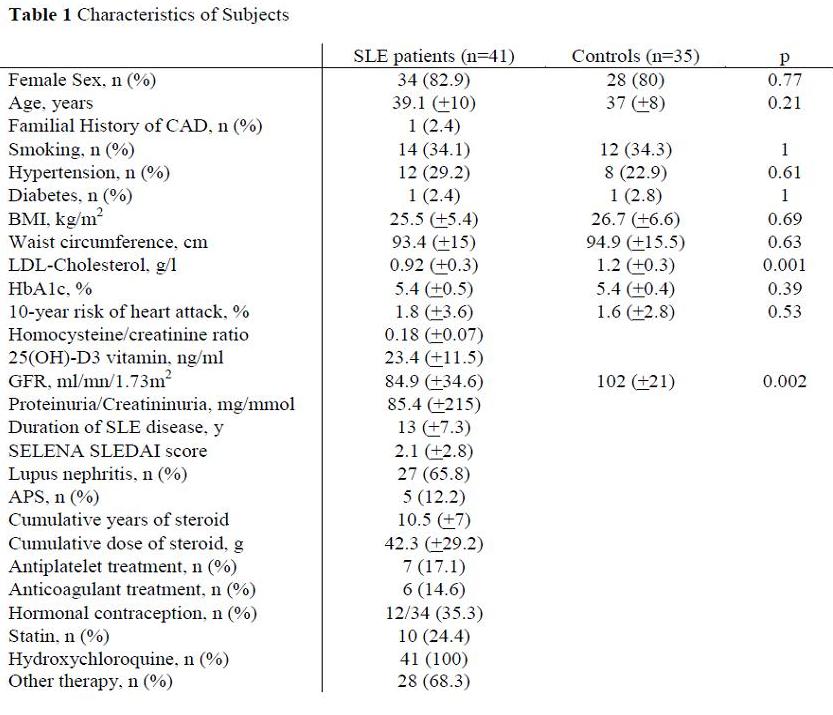
SLE patients were asymptomatic regarding cardiovascular diseases. Classical cardiovascular risks distribution did not differ between controls and SLE patients (Table 1)
PWV was higher in SLE patients than controls (7.1 ±1.6 m/s vs 6.4 ± 1 m/s; p=0.03). Among traditional and non-traditional CVD risk factors, PWV was associated with older age (r2=0.21, p=0.002), higher systolic blood pressure (SBP) (r2=0.44, p<0.0001) and higher cumulative glucocorticoid therapy (r2=0.14, p=0.01). The impact of SBP on PWV was higher in SLE patients than controls (p=0.0004). Eventually, impaired renal function assessed by the reduction of glomerular rate filtration correlated with PWV in SLE (r=-0.52, p=0.0004). No statistical relationship was found between PWV and Framingham score, BMI, SELENA SLEDAI score, duration of SLE disease, and blood levels of LDL-cholesterol, glycated hemoglobin, homocystein and, 25(OH)-D3 vitamin
- Conclusion:
Despite a low risk for CVD according to traditional factors, PWV was higher in SLE patients as compared to controls. Age, SBP and glucocorticoid therapy contribute to increased arterial stiffness. Conversely, arterial stiffness may contribute to alter renal function in SLE patients.
Disclosure:
K. Sacre,
None;
B. Escoubet,
None;
M. Chauchard,
None;
A. Dossier,
None;
M. P. Chauveheid,
None;
T. Papo,
None.
« Back to 2013 ACR/ARHP Annual Meeting
ACR Meeting Abstracts - https://acrabstracts.org/abstract/increased-arterial-stiffness-in-systemic-lupus-erythematosus-sle-patients-at-low-risk-for-cardiovascular-disease-a-cross-sectional-controlled-study/