
Session Information
Date: Friday, November 6, 2020
Title: SLE – Diagnosis, Manifestations, & Outcomes Poster I: Clinical Manifestations
Session Type: Poster Session A
Session Time: 9:00AM-11:00AM
Background/Purpose: Classification criteria are standardized definitions required to identify well defined cohorts of patients for research. In practice they are also used as a framework for the diagnosis of diseases with heterogeneous manifestations such as Systemic Lupus Erythematosus (SLE). Recently the 2019 European League Against Rheumatism/American College of Rheumatology classification criteria for SLE was published. The sensitivity and specificity of the 2019 EULAR/ACR criteria are different from the 1997 ACR criteria and the 2012 Systemic Lupus International Collaborating Clinics (SLICC) criteria. The effect on the incidence estimations of the disease using different criteria has not been studied. A reason to develop the new EULAR/ ACR criteria was to classify patients earlier in their disease process; however it has not been proven if this was indeed accomplished. We aimed to 1) estimate the incidence and time-to-classification of SLE using the 1997 ACR, 2012 SLICC and 2019 EULAR/ACR criteria.
Methods: We identified potential incident SLE cases from 2000-2018 in a geographically well-defined population using diagnostic codes for cutaneous and systemic lupus and the following laboratory measures: anti-nuclear antibodies, anti-double stranded DNA, anti-Sm, anticardiolipin, anti-beta 2 glycoprotein 1 antibodies, complement, coombs and lupus anticoagulant. Clinical data included in the 1997 ACR, 2012 SLICC and 2019 EULAR/ACR criteria were abstracted through chart reviews. If a disease manifestation could be better explained by another condition rather than SLE, it was not counted towards the criteria. We defined the time-to-classification based on the first lupus-attributable disease manifestation ever documented in the record to the time meeting criteria by each of the three definitions. Incidence rates were age and/or sex adjusted to the estimated 2010 white population of the US. To compute 95% confidence intervals for incidence rates, it was assumed that the number of incident cases followed a Poisson distribution. Time-to-classification among different criteria was compared using signed rank test.
Results: There were 127 incident cases that met the EULAR/ACR 2019 criteria, corresponding to an adjusted incidence of 4.7 per 100,000 (95% CI, 3.9-5.5). The incidence was higher than that of the 1997 ACR (91 cases; 3.3 per 100,000 [95%CI 2.6 – 4], p=0.015) but similar to 2012 SLICC criteria (114 cases; 4.2 per 100,000 [95%CI, 3.4 – 4.9], p=0.40). (Table 1)
The median time from first disease manifestation to criteria fulfillment was shorter for the EULAR/ACR 2019 criteria (28.47 months) than the 1997 ACR criteria (45.3 months, p< 0.001) and similar to the SLICC 2012 criteria (33.2 months, p=0.89).
The demographic characteristics are detailed in Table 2. Female : male ratio, mean age at classification and the proportion across different races/ethnic groups were similar across the three criteria.
Conclusion: In this population-based study, the incidence of SLE was higher and time to criteria fulfillment sooner by 2019 EULAR/ACR criteria compared to the 1997 ACR but not significantly different than the 2012 SLICC criteria.
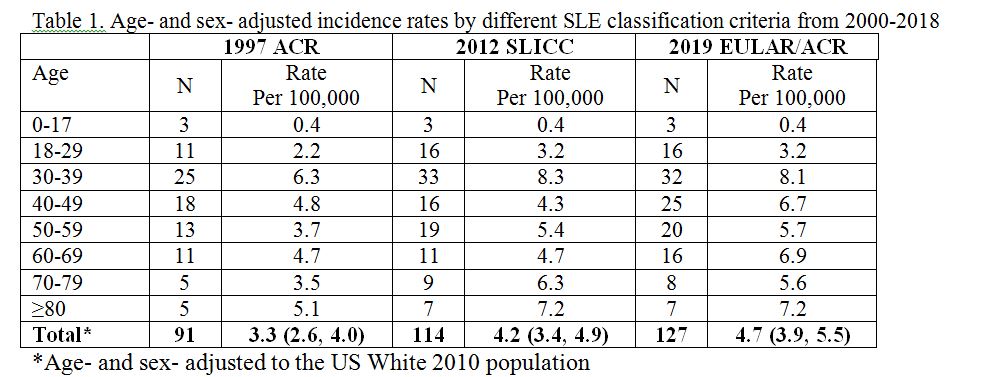 Table 1. Age- and sex- adjusted incidence rates by different SLE classification criteria from 2000-2018
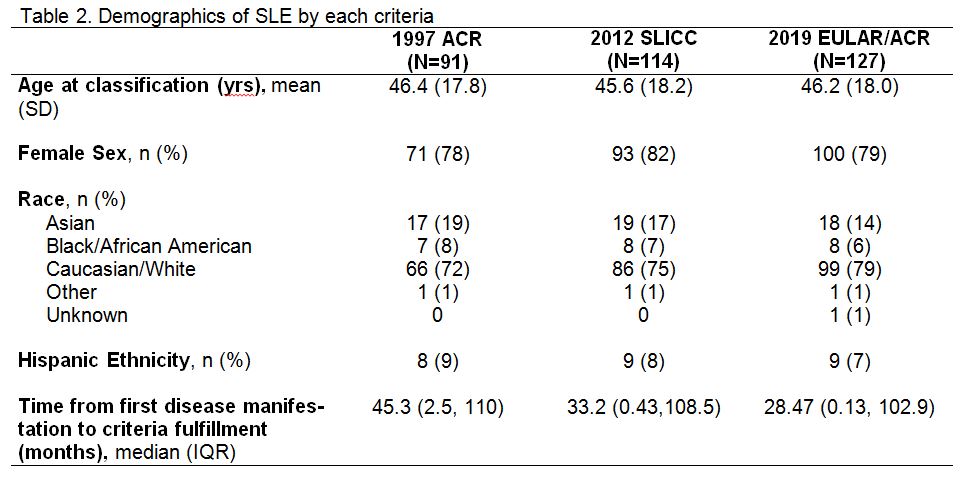 Table 2. Demographics of SLE by each criteria
To cite this abstract in AMA style:
Duarte-Garcia A, Hocaoglu M, Osei-Onomah S, Dabit J, Giblon R, Crowson C. Incidence and Time to Classification of Systemic Lupus Erythematosus by Three Different Classification Criteria [abstract]. Arthritis Rheumatol. 2020; 72 (suppl 10). https://acrabstracts.org/abstract/incidence-and-time-to-classification-of-systemic-lupus-erythematosus-by-three-different-classification-criteria/. Accessed .« Back to ACR Convergence 2020
ACR Meeting Abstracts - https://acrabstracts.org/abstract/incidence-and-time-to-classification-of-systemic-lupus-erythematosus-by-three-different-classification-criteria/