ACR Meeting Abstracts

ACR Meeting Abstracts

  • Meeting Abstracts
    • All Meetings
    • PRSYM 2026
    • ACR Convergence 2025
    • Download Abstract Supplements
  • Keyword Index
  • Search
  • My Favorites
    • View and print all favorites
    • Clear all favorites

Abstract Number: 595

Improved Patient-Reported Outcomes in Psoriatic Arthritis Patients Treated with Abatacept: Results from a Phase III Trial

Vibeke Strand1, E Alemao2, T Lehman2, A Johnsen2, S Banerjee2, HA Ahmad2 and Philip J Mease3, 1Stanford University, Palo Alto, CA, 2Bristol-Myers Squibb, Princeton, NJ, 3Swedish Medical Center and University of Washington, Seattle, WA

Meeting: ACR/ARHP Annual Meeting 2017

Date of first publication: September 18, 2017

Keywords: Biologics, patient-reported outcome measures and psoriatic arthritis

  • Tweet
  • Email a link to a friend (Opens in new window) Email
  • Print (Opens in new window) Print
Session Information

Date: Sunday, November 5, 2017

Title: Spondyloarthropathies and Psoriatic Arthritis – Clinical Aspects and Treatment Poster I

Session Type: ACR Poster Session A

Session Time: 9:00AM-11:00AM

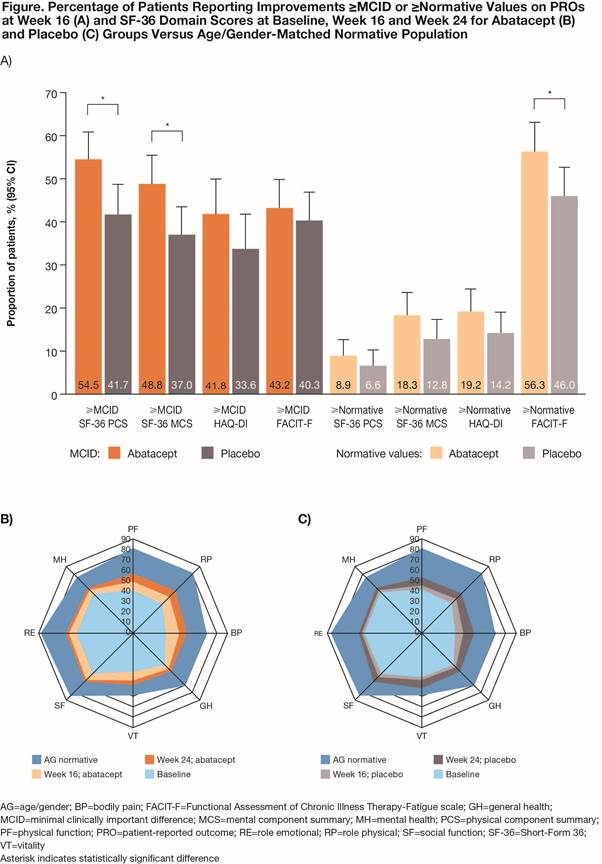
Background/Purpose: In the Phase III ASTRAEA study (NCT01860976), abatacept (ABA) significantly increased ACR20 responses, alleviating musculoskeletal symptoms in patients (pts) with active psoriatic arthritis (PsA).1 Here we explore the effect of ABA on pt-reported outcomes (PROs) in ASTRAEA. Methods: Pts were randomized (1:1) to SC ABA 125 mg weekly or placebo (PBO) for 24 weeks (W). At W16, pts without ≥20% improvement in joint counts escaped to open-label ABA. Adjusted mean changes from baseline to W16 (all pts) and W24 (non-escape responder analysis) in Short Form-36 (SF-36; physical and mental component summary [PCS, MCS] and individual domain scores using spydergrams), HAQ-DI, Dermatology QoL Index (DLQI), and Functional Assessment of Chronic Illness Therapy-Fatigue (FACIT-F) scores were evaluated in total population (prespecified intent-to-treat analysis) and subgroups (post hoc) stratified by baseline CRP and prior TNF inhibitor (TNFi) use. Proportions of pts reporting improvements from baseline ≥minimal clinically important difference (MCID) in SF-36 summary (≥2.5) and domains (≥5.0), FACIT-F (≤−4.0), and HAQ-DI (≤–0.35), and scores ≥normative values in SF-36 summary (≥50) and individual domains, FACIT-F (<40), and HAQ-DI (<0.5) at W16 were analyzed in the total population. Results: In the total population, numerical improvements in most PROs were reported with ABA (n=213) vs PBO (n=211) at both time points (significant for SF-36 PCS at W16, HAQ-DI at W24, and DLQI at both time points; Table). At W16 before escape, improvements in all SF-36 domains were numerically greater with ABA (significant for physical function, bodily pain, and vitality). A higher proportion of pts receiving ABA vs PBO reported improvements ≥MCID in SF-36 PCS, SF-36 MCS, SF-36 domains, FACIT-F, HAQ-DI (Figure), and DLQI (not shown) at W16. Proportion of pts reporting scores ≥normative values at W16 was higher with ABA vs PBO for SF-36 PCS, SF-36 MCS, FACIT-F, and HAQ-DI. At W24, improvements in most SF-36 domain scores accrued in responders in both groups; numerical differences favored ABA. Improvements were observed in all PROs in the ABA vs PBO group for TNFi-naïve and -exposed subpopulations at W16. Improvements in all PROs were reported with ABA in baseline CRP >upper limit of normal (ULN) vs CRP ≤ULN subpopulation at W16 (Table). Subgroup data at W24 were difficult to interpret due to lower number of pts assessed vs W16.

Conclusion: Abatacept treatment improved many PROs in pts with active PsA, with larger benefits in the elevated CRP subpopulation and regardless of prior TNFi exposure. 1. Mease PJ, et al. Ann Rheum Dis 2017 [Epub ahead of print]


86897c_Figure


Disclosure: V. Strand, AbbVie, Amgen Corporation, AstraZeneca, Biogen, BMS, Boehringer Ingelheim, Celgene, Celltrion, Corrona, Crescendo / Myriad Genetic, EMD Serono, Genentech / Roche, GlaxoSmithKline, Janssen, Lilly, Merck, Novartis, Pfizer, Regeneron, Samsung, Sandoz, Sano, 5; E. Alemao, Bristol-Myers Squibb, 1,Bristol-Myers Squibb, 3; T. Lehman, Bristol-Myers Squibb, 3,Bristol-Myers Squibb, 1, 9; A. Johnsen, Bristol-Myers Squibb, 1,Bristol-Myers Squibb, 3; S. Banerjee, Bristol-Myers Squibb, 3,Bristol-Myers Squibb, 1, 9; H. Ahmad, Bristol-Myers Squibb, 3,Bristol-Myers Squibb, 1, 9; P. J. Mease, AbbVie, Amgen, BMS, Celgene, Janssen, Lilly, Novartis, Pfizer, Sun, UCB, 2,AbbVie, Amgen, BMS, Celgene, Crescendo Bioscience, Corrona, Demira, Janssen, Lilly, Novartis, Pfizer, Sun, UCB, Zynerba, Speaker Bureau: AbbVie, Amgen, BMS, Celgene, Crescendo Bioscience, Genentech, Janssen, Novartis, Pfizer, UCB, 5.

To cite this abstract in AMA style:

Strand V, Alemao E, Lehman T, Johnsen A, Banerjee S, Ahmad H, Mease PJ. Improved Patient-Reported Outcomes in Psoriatic Arthritis Patients Treated with Abatacept: Results from a Phase III Trial [abstract]. Arthritis Rheumatol. 2017; 69 (suppl 10). https://acrabstracts.org/abstract/improved-patient-reported-outcomes-in-psoriatic-arthritis-patients-treated-with-abatacept-results-from-a-phase-iii-trial/. Accessed .
  • Tweet
  • Email a link to a friend (Opens in new window) Email
  • Print (Opens in new window) Print

« Back to ACR/ARHP Annual Meeting 2017

ACR Meeting Abstracts - https://acrabstracts.org/abstract/improved-patient-reported-outcomes-in-psoriatic-arthritis-patients-treated-with-abatacept-results-from-a-phase-iii-trial/

Advanced Search

My Favorites

Save and print abstracts during your browser session by clicking the “Favorite” button at the bottom of any abstract (must have cookies enabled in browser). See saved favorites.

Abstract Policies

  • ACR Convergence Abstract Embargo Policies
  • ACR Convergence Abstract Permissions & Reprints
  • PRSYM Abstract Policies

ACR Convergence. Where Rheumatology Meets

ACR Convergence 2026

Join us November 6-11 in Orlando, Florida.
See Registration Information

  • Contact ACR
  • Privacy Policy
  • ACR Policies
  • Cookie Preferences

© Copyright 2026 American College of Rheumatology