
Session Information
Session Type: ACR Poster Session C
Session Time: 9:00AM-11:00AM
Background/Purpose:
Flare
or episodic worsening of disease
activity is an important aspect of the disease experience
for patients with rheumatoid arthritis (RA), with significant
impact on quality of life, well-being, joint damage and
comorbidity. Improving trends towards lower RA
disease activity have been suggested in recent years as compared to previous
decades. However, long-term data on flare and remission rates in RA over
calendar time are lacking. We aimed to assess trends in
the occurrence of flares and remission in RA over the last decades.
Methods: In
a population-based cohort of patients with RA (age≥30 years; 1987 ACR
criteria met in 1988-2007) we performed a retrospective medical records review
of each clinical visit to estimate flare and remission status. RA flare was
defined as any worsening of RA activity leading to initiation/change/increase
of therapy (OMERACT 9). Remission was defined as the absence of disease
activity (i.e. tender joint count [TJC] = 0 + swollen joint count [SJC] = 0 +
ESR ≤ 10 mm/hr) (OMERACT 7). All subjects were followed until death,
migration or July 1, 2012. Flare and remission rates were calculated as the
percentage of visits in flare or remission in each calendar year. Time spent in
flare was calculated as days in flare divided by days of follow-up in each
calendar year.
Results: The
study included 525 RA patients (mean age 54.5 years; 71% female) with mean
follow up of 10.1 years. Flare/ remission status was collected for a total of
15,649 clinical visits. Patients were flaring in 2829 (18%) visits and were in
remission in 1545 (10%) visits. The median duration of flare was 2.4 months (Q1
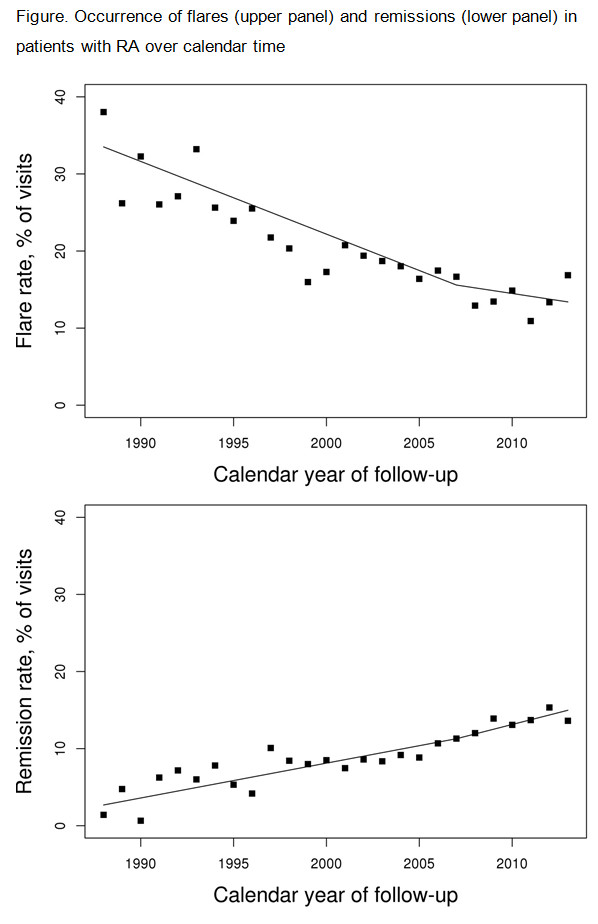
1, Q3 5.4 months). The figure shows trends in flare and remission occurrence in
RA patients over time.
There
has been a statistically significant decline in the RA flare rate over calendar
time, from 32% of visits per year in 1990 to 15% of visits per year in 2010 (p<0.001).
In contrast, remission rates went up from 0.6% of visits per year in 1990 to 13.1%
of visits per year in 2010 (p<0.001). During the study period, there has
been a statistically significant annual decline in the percentage of time spent
in flare (3.6% per year, p<0.001), while the percentage of time spent in
remission has been increasing by 3.0% per year (p<0.001).
Conclusion: Our
findings show significant decline in flare occurrence and concurrent increase
in remission rates in patients with RA over the last two decades, likely
reflecting improved control of RA activity and possibly milder RA disease
course in the recent time. Concordantly, there has been a decrease in time
spent in RA flare accompanied by an increase in remission time over the years. These
positive trends are highly relevant to patients with RA and rheumatology health
care providers and have potentially important impact on health care
organization and management of RA. The implications of this improved trend on
outcomes and mortality in RA require further study.
To cite this abstract in AMA style:
Myasoedova E, Gabriel SE, Matteson EL, Davis JM III, Crowson CS. Improved Flare/ Remission Pattern in Rheumatoid Arthritis over the Recent Decades [abstract]. Arthritis Rheumatol. 2015; 67 (suppl 10). https://acrabstracts.org/abstract/improved-flare-remission-pattern-in-rheumatoid-arthritis-over-the-recent-decades/. Accessed .« Back to 2015 ACR/ARHP Annual Meeting
ACR Meeting Abstracts - https://acrabstracts.org/abstract/improved-flare-remission-pattern-in-rheumatoid-arthritis-over-the-recent-decades/