
Session Information
Session Type: ACR Poster Session C
Session Time: 9:00AM-11:00AM
Background/Purpose: For
individuals living with chronic widespread pain (CWP), physical activity (PA)
can be an effective non-pharmacological therapy for symptom management. PA Interventions
may enhance PA levels in the near term, however less is known about longer-term
PA maintenance (i.e., ≥2 years) in those with CWP. This study examined PA
levels over time and investigated whether subgroups followed distinct PA trajectories
that could be useful in developing future stratified interventions.
Methods: Data
are from individuals with CWP who took part in a 2×2 factorial randomized
controlled trial with data at baseline (-6), treatment end (0), 3, 24 and 60 month
post-treatment. Participants’ self-report of total PA was generated from a
brief two question assessment tool which queried on number of bouts of
vigorous-intensity activity ≥20 minutes and on bouts of walking or
moderate-intensity activity ≥30 minutes in a usual week. Analyses were
conducted on 196 men and women who had either received exercise or combined
exercise + cognitive behavioural therapy treatment and who had ≥3 PA
data-points. Group-based trajectory modelling was used to identify latent PA
trajectory groups between which descriptive statistics were used to identify
whether baseline variables (e.g., demographics, chronic pain grade, self-rated
health, fatigue, sleep problems, coping strategy use, kinesiophobia)
differed (α=0.05).
Results: The
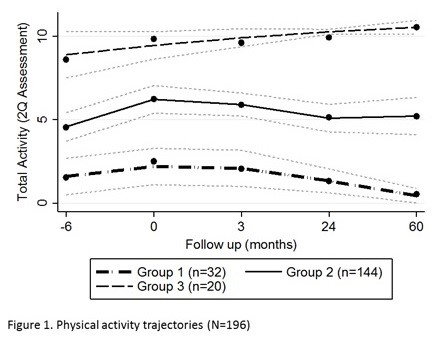
best fitting model identified was one with three trajectories: non-maintainers
(Group 1: G1), maintainers (G2) and super-maintainers (G3) (Figure 1). Overall,
baseline PA levels (mean (SD)) were significantly different between groups (G1:
1.1 (1.2); G2: 4.6 (2.8); G3: 8.6 (2.7), p<0.001)
and all other follow up points. While PA levels were higher for all groups (G1:
2.2 (2.2); G2: 6.2 (2.4); G3: 9.9 (1.8)) at treatment end, only G2 and G3 reached
‘adequate’ or ‘high’ PA levels (total activity score 5-7 or ≥8) and
maintained activity over time. Non-maintainers more often reported greater BMI,
higher chronic pain grade, poorer self-rated health and SF-36 PCS, as well as
greater use of passive coping strategies and reduced use of active coping
strategies. Groups did not vary on treatment group, age, gender or baseline employment
status, SF-36 MCS, fatigue, sleep, and kinesiophobia.
Conclusion: The majority of individuals
with CWP who received an exercise treatment as part of a trial were identified
as long-term PA maintainers or super-maintainers. A smaller subset of
participants with poorer self-reported health and behavioural response to
symptoms were non-maintainers, and as such might benefit the most from
intensively targeted interventions to improve long-term PA maintenance for
optimal symptom management.
To cite this abstract in AMA style:
Martin KR, Druce KL, D'Ambruoso L, Macfarlane GJ. Identification of Long-Term Physical Activity Trajectories in Individuals with Chronic Widespread Pain Who Received Exercise Treatment As Part of a Randomized Controlled Trial [abstract]. Arthritis Rheumatol. 2015; 67 (suppl 10). https://acrabstracts.org/abstract/identification-of-long-term-physical-activity-trajectories-in-individuals-with-chronic-widespread-pain-who-received-exercise-treatment-as-part-of-a-randomized-controlled-trial/. Accessed .« Back to 2015 ACR/ARHP Annual Meeting
ACR Meeting Abstracts - https://acrabstracts.org/abstract/identification-of-long-term-physical-activity-trajectories-in-individuals-with-chronic-widespread-pain-who-received-exercise-treatment-as-part-of-a-randomized-controlled-trial/