ACR Meeting Abstracts

ACR Meeting Abstracts

  • Meeting Abstracts
    • All Meetings
    • PRSYM 2026
    • ACR Convergence 2025
    • Download Abstract Supplements
  • Keyword Index
  • My Favorites
    • View & print my favorites
  • Search

Home » Meeting Abstracts » ACR/ARHP Annual Meeting 2017

Abstract Number: 919

HLA Type Imputation in the Genome Research in African American Scleroderma Patients (GRASP) Cohort Reveals Strong Associations of African Ancestry MHC Class II Types with Scleroderma and Lack of Class I HLA Type Associations

Elaine F. Remmers1, Pravitt Gourh2, Steven Boyden3, Nadia D. Morgan4, Ami A. Shah4, Adebowale Adeyemo1, Amy Bentley1, Mary A. Carns5, Settara C. Chandrasekharappa1, Lorinda Chung6, Lindsey A. Criswell7, Chris T. Derk8, Robyn T. Domsic9, Ayo Doumatey1, Heather Gladue10, Avram Goldberg11, Jessica K. Gordon12, Vivien M Hsu13, Reem Jan14, Dinesh Khanna15, Maureen D. Mayes16, Thomas A. Medsger Jr.17, Paula S. Ramos18, Marcin A. Trojanowski19, Lesley A. Saketkoo20, Elena Schiopu15, Victoria K. Shanmugam21, Daniel Shriner1, Richard M. Silver22, Virginia D. Steen23, Antonia Valenzuela24, John Varga25, Charles Rotimi1, Fredrick M. Wigley26, Francesco Boin27 and Daniel L. Kastner28, 1National Institutes of Health (NIH), National Human Genome Research Institute, Bethesda, MD, 2NIAMS-Rheumatology, National Institutes of Health (NIH), National Institute of Arthritis and Musculoskeletal and Skin Diseases, Bethesda, MD, 3National Institutes of Health (NIH), National Institute on Deafness and Other Communication Disorders, Bethesda, MD, 4Rheumatology, Johns Hopkins University School of Medicine, Baltimore, MD, 5Northwestern University, Feinberg School of Medicine Scleroderma Program, Chicago, IL, 6Rheumatology, Stanford University Medical Center, Palo Alto, CA, 7Medicine/Rheumatology, University of California, San Francisco, San Francisco, CA, 8Rheumatology, University of Pennsylvania, Philadelphia, PA, 9Rheumatology, University of Pittsburgh, Pittsburgh, PA, 10Rheumatology, Arthritis and Osteoporosis Consultants of the Carolinas, Charlotte, NC, 11NYU Langone Medical Center, New York, NY, 12Rheumatology, Hospital for Special Surgery, New York, NY, 13University of Medicine and Dentistry of New Jersey--Robert Wood Johnson Medical School, New Brunswick, NJ, 14Medicine, Rheumatology, University of Chicago, Chicago, IL, 15University of Michigan, Ann Arbor, MI, 16University of Texas McGovern Medical School, Houston, TX, 17Department of Medicine/Rheumatology, University of Pittsburgh, Pittsburgh, PA, 18Department of Public Health Sciences, Medical University of South Carolina, Charleston, SC, 19Boston University School of Medicine, Boston, MA, 20Rheumatology, Tulane University School of Medicine, New Orleans, LA, 21Rheumatology, The George Washington University, Washington, DC, 22Division of Rheumatology and Immunology, Department of Medicine, Medical University of South Carolina, Charleston, SC, 23Rheumatology, MedStar Georgetown University Hospital, Washington, DC, 24Stanford University School of Medicine, Stanford, CA, 25Rheumatology and Dermatology, Northwestern University, Feinberg School of Medicine Scleroderma Program, Chicago, IL, 26Rheum Div/Mason F Lord, Johns Hopkins University, Baltimore, MD, 27Rheumatology, University California, San Francisco, San Francisco, CA, 28Inflammatory Disease Section, National Human Genome Research Institute, National Institutes of Health, Bethesda, MD

Share on X (Twitter) Share on Facebook Share on LinkedIn Share on Email
Print

Meeting: ACR/ARHP Annual Meeting 2017

Date of first publication: September 18, 2017

Keywords: African-Americans, genetics, major histocompatibility complex (MHC), scleroderma and systemic sclerosis

Session Information

Date: Sunday, November 5, 2017

Title: Healthcare Disparities in Rheumatology

Session Type: ACR Concurrent Abstract Session

Session Time: 4:30PM-6:00PM

Background/Purpose: The Genome Research in African American Scleroderma Patients (GRASP) consortium was created to obtain a collection of African American (AA) scleroderma patients to facilitate genomic studies to identify novel genetic variants that could account for the increased scleroderma prevalence and severity in African Americans compared with individuals of European ancestry. In a companion abstract we report a genome-wide association study establishing significant genetic associations for AA scleroderma in the MHC and for TGFB3.  Here we used MHC region genotypes to impute classical HLA types and analyzed their associations with scleroderma in the GRASP cohort.   

Methods: SNP genotyping of 934 scleroderma cases and 946 controls was performed on the Illumina Multi-Ethnic Global array.  We extracted the genotypes of 25,256 markers from 20 Mb encompassing the greater MHC region and used the Michigan Imputation Server with 1000G Phase 3 v5 reference and Eagle phasing algorithm to obtain input data for submission to the HLA*IMP:03 web server. HLA types were converted to presence or absence genotypes (PP/PA/AA) for each typed allele and disease association was determined using a dominant model.  Regression and conditional analyses were performed after recoding the genotype data to 0 or 1 using a dominant model and the top 10 principal components were included as covariates.

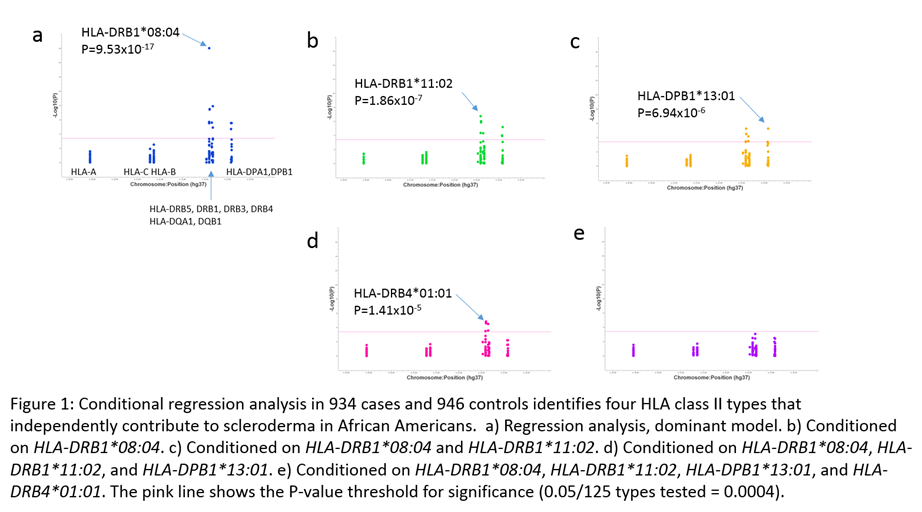
Results:   The most significantly scleroderma-associated HLA type was a predominantly African allele, HLA-DRB1*08:04, with odds ratio 2.95, 95%CI 2.26-3.85 (Figure 1).  Regression analysis conditioning on the disease-associated alleles identified another African DRB1 allele, *11:02, as well as HLA-DPB1*13:01, and HLA-DRB4*01:01 as independent contributors to disease risk, but no association was found for MHC class I alleles (Figure 1).  34.6% of GRASP cases carry either DRB1*08:04 or *11:02 compared with 16.3% of controls. Analysis of 246 anti-topoisomerase antibody positive cases revealed a strong disease risk conferred by HLA-DPB1*13:01 (P=4.93×10⁻¹⁷, OR=4.10, 2.90-5.79).  Remarkably, 30.49% of anti-topoisomerase antibody-positive cases carry HLA-DPB1*13:01, compared with 9.7% of controls.

Conclusion: The scleroderma risk-associated HLA-DRB1 types identified in the GRASP cohort differ from those reported in individuals of European ancestry.  These HLA types are found at a higher population frequency than the European scleroderma risk types and therefore could contribute to the increased disease incidence or severity observed in African American patients.


Disclosure: E. F. Remmers, None; P. Gourh, None; S. Boyden, None; N. D. Morgan, None; A. A. Shah, None; A. Adeyemo, None; A. Bentley, None; M. A. Carns, None; S. C. Chandrasekharappa, None; L. Chung, Cytori, Actelion, Reata, 5; L. A. Criswell, None; C. T. Derk, None; R. T. Domsic, None; A. Doumatey, None; H. Gladue, None; A. Goldberg, None; J. K. Gordon, Corbus Pharmaceuticals, 2,Cumberland Pharmaceuticals, 2,Bayer Pharmaceuticals, 2; V. M. Hsu, None; R. Jan, None; D. Khanna, Actelion, Bayer, BoehringerIngelheim, Chemomab, Corbus, Covis, Cytori,Eicos, EMD Serono, Genentech/Roche, Gilead, GSK, Sanofi-Aventis,UCB Pharma, 5,NIH/NIAMS, NIH/NIAID,Bayer, BMS, Genentech/Roche, Pfizer, 2,Eicos, 4; M. D. Mayes, None; T. A. Medsger Jr., None; P. S. Ramos, None; M. A. Trojanowski, None; L. A. Saketkoo, None; E. Schiopu, None; V. K. Shanmugam, Multiple, 9; D. Shriner, None; R. M. Silver, None; V. D. Steen, None; A. Valenzuela, None; J. Varga, BMS, 2,Pfizer Inc, 2; C. Rotimi, None; F. M. Wigley, None; F. Boin, None; D. L. Kastner, None.

To cite this abstract in AMA style:

Remmers EF, Gourh P, Boyden S, Morgan ND, Shah AA, Adeyemo A, Bentley A, Carns MA, Chandrasekharappa SC, Chung L, Criswell LA, Derk CT, Domsic RT, Doumatey A, Gladue H, Goldberg A, Gordon JK, Hsu VM, Jan R, Khanna D, Mayes MD, Medsger TA Jr., Ramos PS, Trojanowski MA, Saketkoo LA, Schiopu E, Shanmugam VK, Shriner D, Silver RM, Steen VD, Valenzuela A, Varga J, Rotimi C, Wigley FM, Boin F, Kastner DL. HLA Type Imputation in the Genome Research in African American Scleroderma Patients (GRASP) Cohort Reveals Strong Associations of African Ancestry MHC Class II Types with Scleroderma and Lack of Class I HLA Type Associations [abstract]. Arthritis Rheumatol. 2017; 69 (suppl 10). https://acrabstracts.org/abstract/hla-type-imputation-in-the-genome-research-in-african-american-scleroderma-patients-grasp-cohort-reveals-strong-associations-of-african-ancestry-mhc-class-ii-types-with-scleroderma-and-lack-of-class/. Accessed .

ACR Meeting Abstracts - https://acrabstracts.org/abstract/hla-type-imputation-in-the-genome-research-in-african-american-scleroderma-patients-grasp-cohort-reveals-strong-associations-of-african-ancestry-mhc-class-ii-types-with-scleroderma-and-lack-of-class/

My Favorites

Save and print abstracts during your browser session by clicking the “Favorite” button at the bottom of any abstract (must have cookies enabled in browser). See saved favorites.

Abstract Policies

  • ACR Convergence Abstract Embargo Policies
  • ACR Convergence Abstract Permissions & Reprints
  • PRSYM Abstract Policies

ACR Convergence. Where Rheumatology Meets

ACR Convergence 2026

Join us November 6-11 in Orlando, Florida.
See Registration Information

  • Contact ACR
  • Privacy Policy
  • ACR Policies
  • Cookie Preferences

© Copyright 2026 American College of Rheumatology