
Session Information
Date: Tuesday, November 12, 2019
Title: Epidemiology & Public Health Poster III: OA, Gout, & Other Diseases
Session Type: Poster Session (Tuesday)
Session Time: 9:00AM-11:00AM
Background/Purpose: A high sodium intake has been reported to adversely affect bone health and to be associated with an increased inflammatory response. However, the relationship between dietary sodium intake and OA has not been established. This study aimed to analyze the association between sodium intake and OA in Korean population using the fifth Korean National Health and Nutrition Examination Survey (KNHANES V).
Methods: We included participants aged 50 to 75 years who completed urinary sodium evaluation, plain knee radiographs, health interview and nutritional surveys in the 2010 to 2011 KNHANES V. Knee OA (KOA) was defined as the presence of radiographic features of Kellgren-Lawrence grade ≥2. We used the Tanaka formula to estimate 24-hour urinary sodium excretion from a fasting morning specimen as a surrogate for daily sodium intake. All of the statistical analyses were performed on the basis of a sampling weight to represent the entire Korean population. The association between symptomatic KOA and the dietary indices was statistically analyzed using univariate and multivariate logistic regression methods.
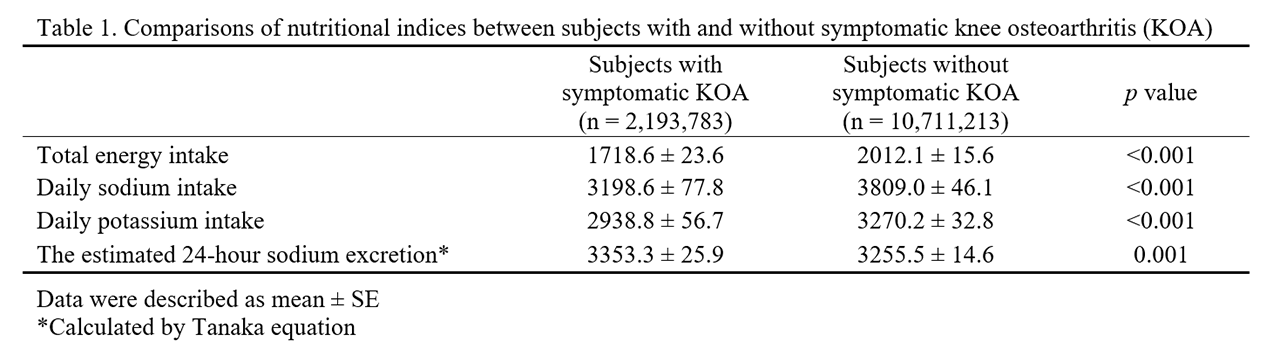
Results: Among study population, 10.5% (weighted n=1,214,665/11,610,574) had symptomatic KOA, of which 80.7% was female. Of the total, 86.8% of study participants had sodium intake levels well above the recommendation of World Health Organization (2,000 mg of sodium per day). Compared to the non-KOA group, the KOA group was older, more obese, less educated, and less earned. The percentages of subjects with depression or taking anti-hypertensive medications, and non-smokers in KOA were higher than those in non-KOA. Although total energy intake in KOA group was lower than in non-KOA group, the mean estimated 24-hour urinary sodium excretion level in KOA group was significantly higher than in non-KOA group. After adjusting for covariates, the statistical significance of the estimated 24-hour urinary sodium excretion was lost in total participants. However, subgroup analysis in subjects with high sodium intake (daily sodium intake ≥2,000 mg) demonstrate that 24-hr urinary sodium excretion was positively associated with symptomatic KOA even after adjustment with confounding factors (Odds ratio 1.165, 95% confidence interval 1.019-1.331, p < 0.001).
Conclusion: The present study suggested that sodium intake levels could be dose-dependently associated with symptomatic knee OA in subjects consuming dietary salt intake ≥2,000 mg/day.
To cite this abstract in AMA style:
Ha Y, Ji E, Park E, Kang E, Song Y, Lee Y. High Dietary Sodium Intake May Be Associated with Symptomatic Knee Osteoarthritis in a Korean Population: Korean National Health and Nutrition Examination Survey, 2010-2011 [abstract]. Arthritis Rheumatol. 2019; 71 (suppl 10). https://acrabstracts.org/abstract/high-dietary-sodium-intake-may-be-associated-with-symptomatic-knee-osteoarthritis-in-a-korean-population-korean-national-health-and-nutrition-examination-survey-2010-2011/. Accessed .« Back to 2019 ACR/ARP Annual Meeting
ACR Meeting Abstracts - https://acrabstracts.org/abstract/high-dietary-sodium-intake-may-be-associated-with-symptomatic-knee-osteoarthritis-in-a-korean-population-korean-national-health-and-nutrition-examination-survey-2010-2011/