ACR Meeting Abstracts

ACR Meeting Abstracts

  • Meeting Abstracts
    • All Meetings
    • PRSYM 2026
    • ACR Convergence 2025
    • Download Abstract Supplements
  • Keyword Index
  • My Favorites
    • View & print my favorites
  • Search

Home » Meeting Abstracts » ACR Convergence 2023

Abstract Number: 0733

Global Identification of Lupus Genetic Risk Variants Facilitating the Type I Interferon Pathway Through CRISPR-based Genomic Screening

Guojun Hou1, Xinyi Zhu1, Yutong Zhang1, Zhaorui Cheng1 and Nan Shen2, 1Shanghai Institute of Rheumatology, Renji Hospital, School of Medicine, Shanghai Jiao Tong University (SJTUSM), Shanghai, China, 2Shanghai Jiao Tong University School of Medicine, Shanghai, China

Share on X (Twitter) Share on Facebook Share on LinkedIn Share on Email
Print

Meeting: ACR Convergence 2023

Keywords: Gene Expression, genetics, genomics, interferon, Systemic lupus erythematosus (SLE)

Session Information

Date: Sunday, November 12, 2023

Title: Abstracts: Genetics, Genomics & Proteomics

Session Type: Abstract Session

Session Time: 2:00PM-3:30PM

Background/Purpose: Genome-Wide Association Studies (GWAS) have unveiled over 1000 risk variants for lupus, predominantly situated in non-coding genomic regions. Their functional roles, especially their potential impacts on the dysregulated type I interferon pathway inherent in lupus, remain largely uncharted. To bridge this knowledge gap, our study employs CRISPR/Cas9 technology, enabling a deeper exploration into the functional implications of these risk loci.

Methods: Our novel strategy entailed CRISPR-based screening for functional variants that regulate the type I interferon pathway. We collected all known SLE-associated SNPs and expanded them through linkage disequilibrium in the population where the SNP was reported. We designed an sgRNA library covering these SLE-associated SNPs and developed a cellular model using U-937, Jurkat, and Raji cells that stably express the CRISPR/Cas9-ISRE-GFP and CRISPR/SAM-ISRE-GFP systems. Post-transduction with the sgRNA lentiviral library, we sorted cells based on GFP intensity and extracted and sequenced DNA from these sorted cells. The functional variants were identified and characterized using multi-omics analysis (eQTL data, HiC data, RNA-sequencing data). We validated the function of the rs11152966-located region and identified PRDM1 as the target gene of rs11152966 through integration of advanced technologies like capture-HiC, CRISPR-SAM, and prime editing technology.

Results: We’ve characterized the comprehensive landscape of functional SNPs related to lupus that regulate the Type I interferon pathway. Notably, we discovered that the majority of these functional variant regions are cell type-specific .Utilizing the CRISPR/Cas9 and CRISPR/SAM systems effectively, we found these tools to have complementary benefits in the identification of these functional variants. Furthermore, these functional variant regions were found to be associated with the expression of critical regulators within the JAK-STAT pathway and interferon-stimulated genes (ISGs). Importantly, we observed a correlation between the expression of transcription factors disrupted by these functional variants and the expression of ISGs in SLE patients. One standout finding was the negative regulatory effect on the Type I interferon pathway upon activation of the region containing the SNP rs11152966. This region, inclusive of the SNP, forms a gene loop with the PRDM1 promoter, thereby managing PRDM1 expression. Additionally, we provided evidence that PRDM1 acts as a novel negative regulator of the Type I interferon pathway. Lastly, our research revealed a link between the presence of the risk allele T and a reduction in PRDM1 expression. This reduced expression appears to be due to the allele T’s effect on the binding of the transcription factor SPI1.

Conclusion: Our study leveraged advanced gene-editing tools to elucidate the landscape of functional SNPs in lupus, revealing their cell type-specific regulation of the Type I interferon pathway and their influence on key genes in the JAK-STAT pathway. Notably, we highlighted the significant role of SNP rs11152966 and its target gene PRDM1 in regulating the interferon pathway in lupus.
Supporting image 1

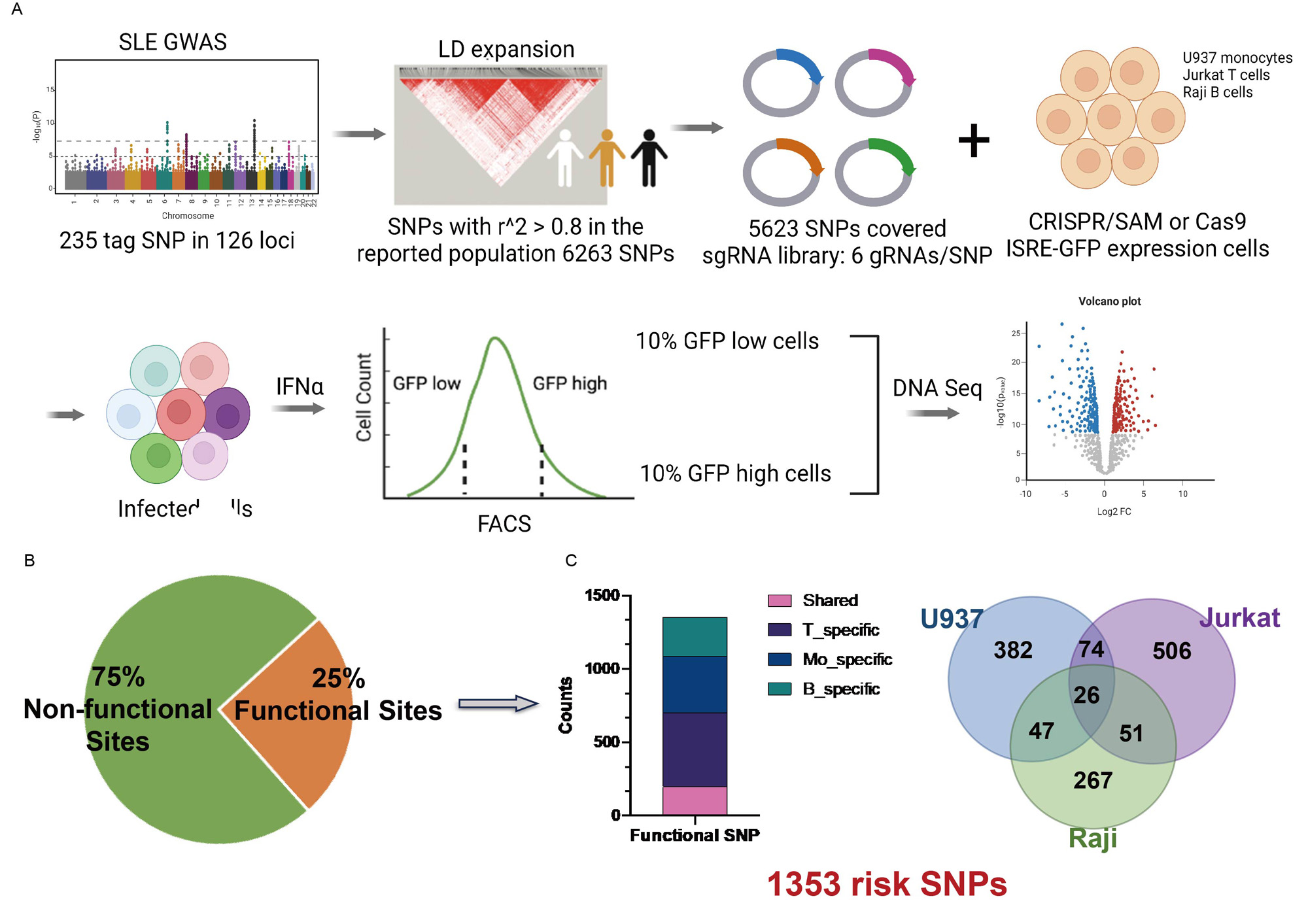
Figure 1. Functional Variant Screening for Regulation of Type I Interferon Pathway Activation Using CRISPR/SAM and CRISPR/Cas9 Across Various Immune Cells. (A) A depiction of the CRISPR screening workflow. (B) Representation of the proportion of functional regions implicated in the modulation of the type I interferon pathway. (C) Evaluation of functional variant regions that are common or specific to individual cell types.

Supporting image 2

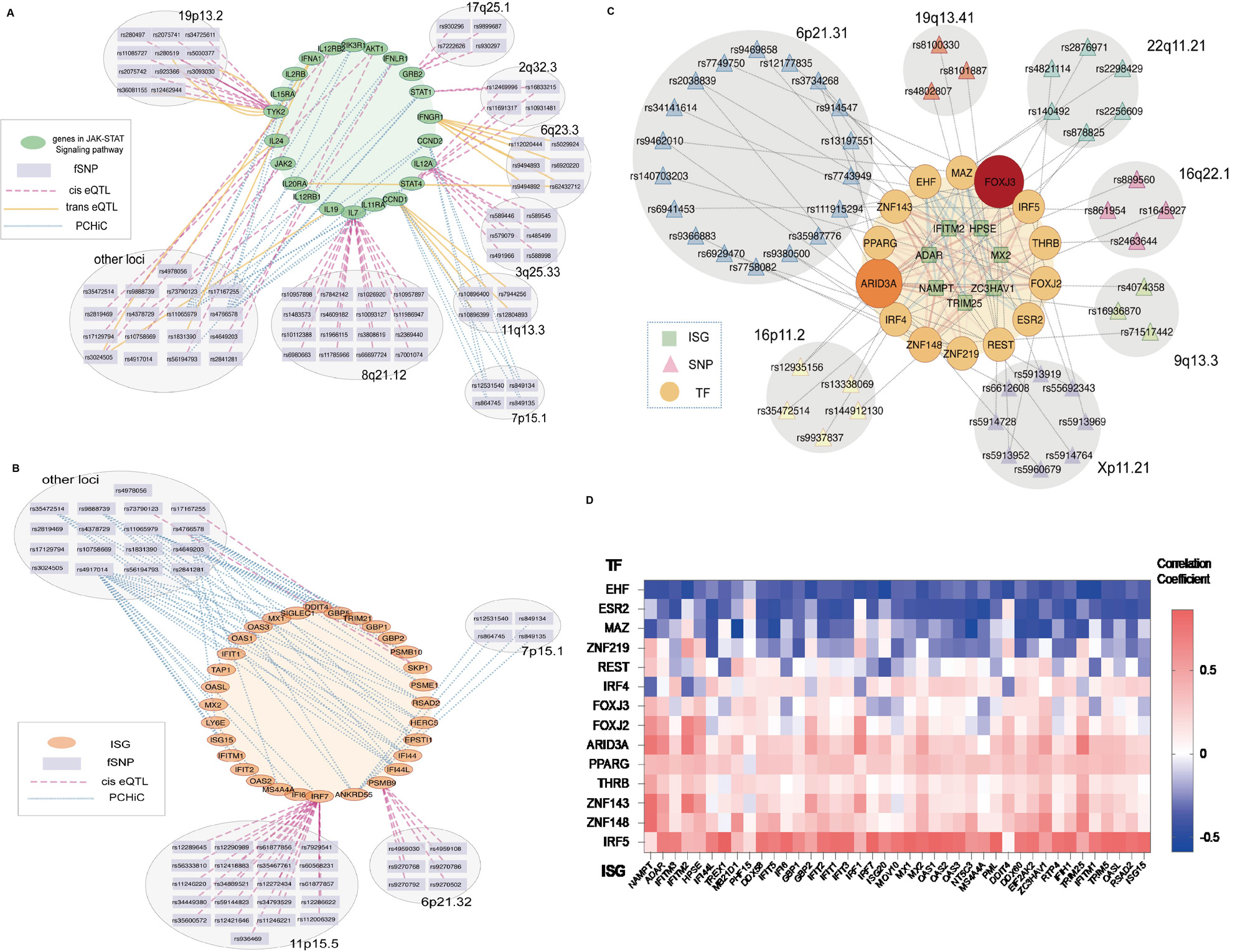
Figure 2. Annotation of SNP-Target Gene-TF Interaction Network and Their Role in the Interferon (IFN) Pathway (A-B) Illustrates the interconnection of functional SNPs and associated genes in the JAK-STAT signaling pathway and ISGs, with lines denoting eQTL signals or 3D genomic interactions. Gene size and color correspond to differential expression results in SLE patients. (C) Shows a network of functional SNPs, disrupted TFs due to SNP, and ISGs with significant correlation to these TFs. Gray lines suggest disruption of TF binding motifs by SNPs. Blue and red lines indicate negative and positive correlations between ISGs and TFs, respectively. TF size and color display its degree or interaction count, as determined by Cytoscape. (D) Demonstrates Spearman correlation analysis between transcription factors and ISGs expression levels (RPKMs) in whole blood samples from SLE patients.

Supporting image 3

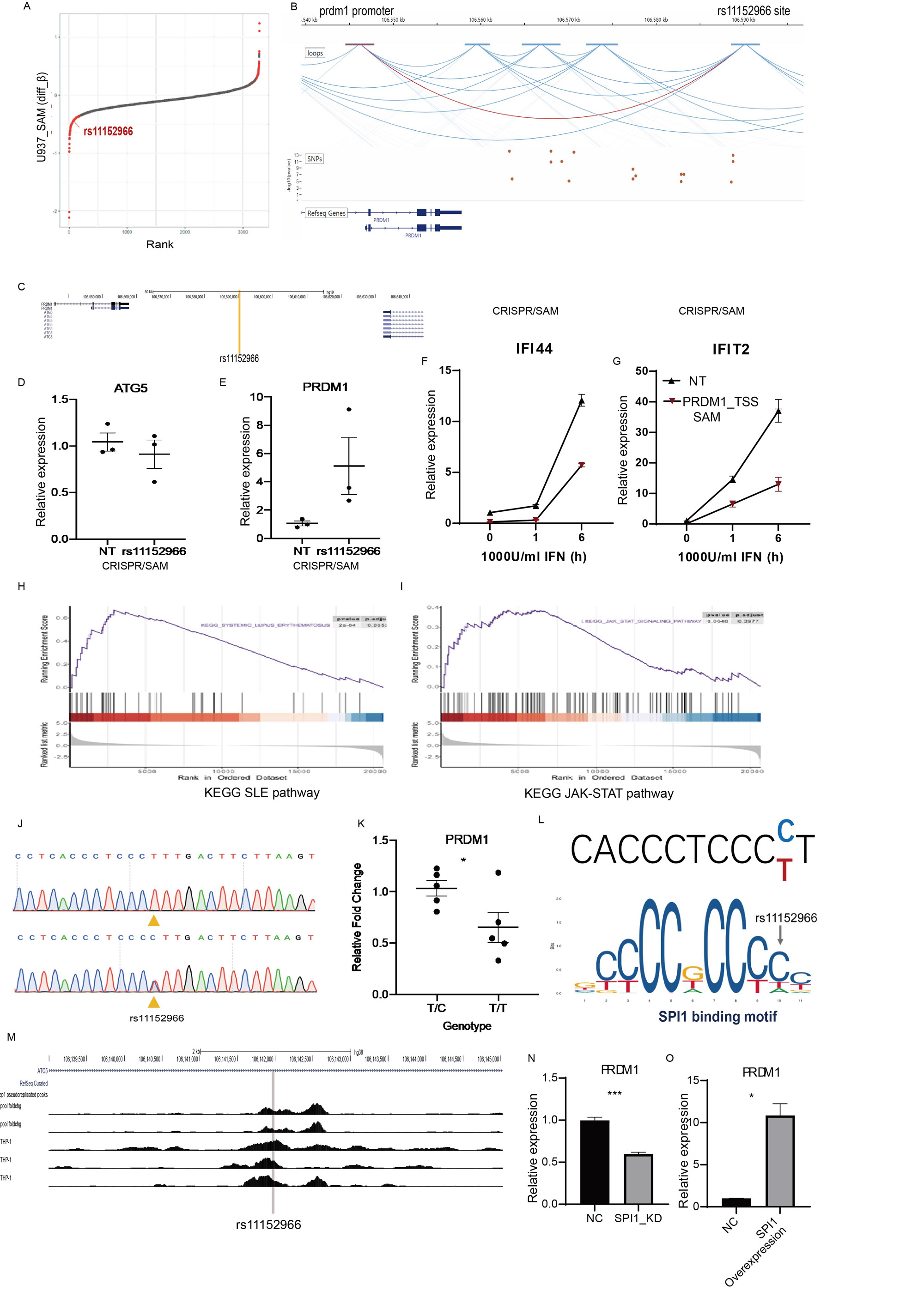
Figure 3. PRDM1 expression is regulated by rs11152966, contributing to the modulation of the type Ⅰ interferon pathway. (A) A region containing rs11152966, revealed by CRISPR screening, inhibits the activation of the type Ⅰ interferon pathway. (B) Gene loop between the rs11152966 location and PRDM1 promoter, as evidenced by HiC data. (C-E) CRISPR/SAM targeting the area containing rs11152966 boosts PRDM1 expression, but not the adjacent gene ATG5. (F-G) Targeting of the PRDM1 TSS region by CRISPR/SAM results in reduced ISGs expression. (H-I) Analysis by GSEA of JAK-STAT and SLE pathways in PRDM1 KO U-937 cells post-IFNα stimulation for 1 hour. (J) Genotype of rs11152966 in cell clones established by prime editing technology. (K) The T risk allele of rs11152966 results in diminished PRDM1 expression compared to the C non-risk allele. (L) SPI1 has a preference for binding to the non-risk C allele of rs11152966. (M) ChIP-seq data indicate SPI1 binding within the rs11152966 region. (N-O) PRDM1 expression following SPI1 overexpression or knockdown.


Disclosures: G. Hou: None; X. Zhu: None; Y. Zhang: None; Z. Cheng: None; N. Shen: None.

To cite this abstract in AMA style:

Hou G, Zhu X, Zhang Y, Cheng Z, Shen N. Global Identification of Lupus Genetic Risk Variants Facilitating the Type I Interferon Pathway Through CRISPR-based Genomic Screening [abstract]. Arthritis Rheumatol. 2023; 75 (suppl 9). https://acrabstracts.org/abstract/global-identification-of-lupus-genetic-risk-variants-facilitating-the-type-i-interferon-pathway-through-crispr-based-genomic-screening/. Accessed .

ACR Meeting Abstracts - https://acrabstracts.org/abstract/global-identification-of-lupus-genetic-risk-variants-facilitating-the-type-i-interferon-pathway-through-crispr-based-genomic-screening/

My Favorites

Save and print abstracts during your browser session by clicking the “Favorite” button at the bottom of any abstract (must have cookies enabled in browser). See saved favorites.

Abstract Policies

  • ACR Convergence Abstract Embargo Policies
  • ACR Convergence Abstract Permissions & Reprints
  • PRSYM Abstract Policies

ACR Convergence. Where Rheumatology Meets

ACR Convergence 2026

Join us November 6-11 in Orlando, Florida.
See Registration Information

  • Contact ACR
  • Privacy Policy
  • ACR Policies
  • Cookie Preferences

© Copyright 2026 American College of Rheumatology