
Session Information
Session Type: Poster Session (Tuesday)
Session Time: 9:00AM-11:00AM
Background/Purpose: Genetics influences kidney function (estimated glomerular filtration rate (eGFR)), systemic lupus erythematosus (SLE) and lupus nephritis (LN) risk. Genome-wide association studies (GWAS) have identified single nucleotide polymorphisms (SNPs) associated with eGFR in the general population as well as SLE. However, few loci have been identified and replicated for LN risk, in part due to heterogeneity with LN. Using quantitative, repeated eGFR measures as opposed to binary LN may be more informative in detecting LN genetic loci. Our objective was to demonstrate repeated eGFR measures as potentially informative measures in GWAS by showing an association exists between SNPs associated with eGFR and SLE on (1) mean and (2) variance of eGFR.
Methods: We included 1167 patients followed in Toronto Lupus Clinics from SickKids and/or the Toronto Western Hospital. Patients met ≥4 ACR and/or SLICC criteria for SLE and were genotyped on the Illumina MEGA or Omni1-Quad arrays. Ungenotyped SNPs were imputed. Non-HLA additive genetic risk scores (GRS) were calculated for SLE, and for eGFR, using published GWAS weights for loci that met p < 5×10⁻⁸. LN was confirmed by renal biopsy. Longitudinal, prospectively collected clinical and laboratory data, including serum creatinine, were extracted from lupus databases. eGFR was calculated using the CKD-EPI (≥18y), and Schwartz equations (< 18y). We tested the effect of SLE-GRS and eGFR-GRS with respect to (1) eGFR mean using linear mixed models and (2) eGFR variance through Gamma regression of squared-ordinary least squares jackknife residuals in R. Models included a time-varying indicator for eGFR taken as a child or adult.
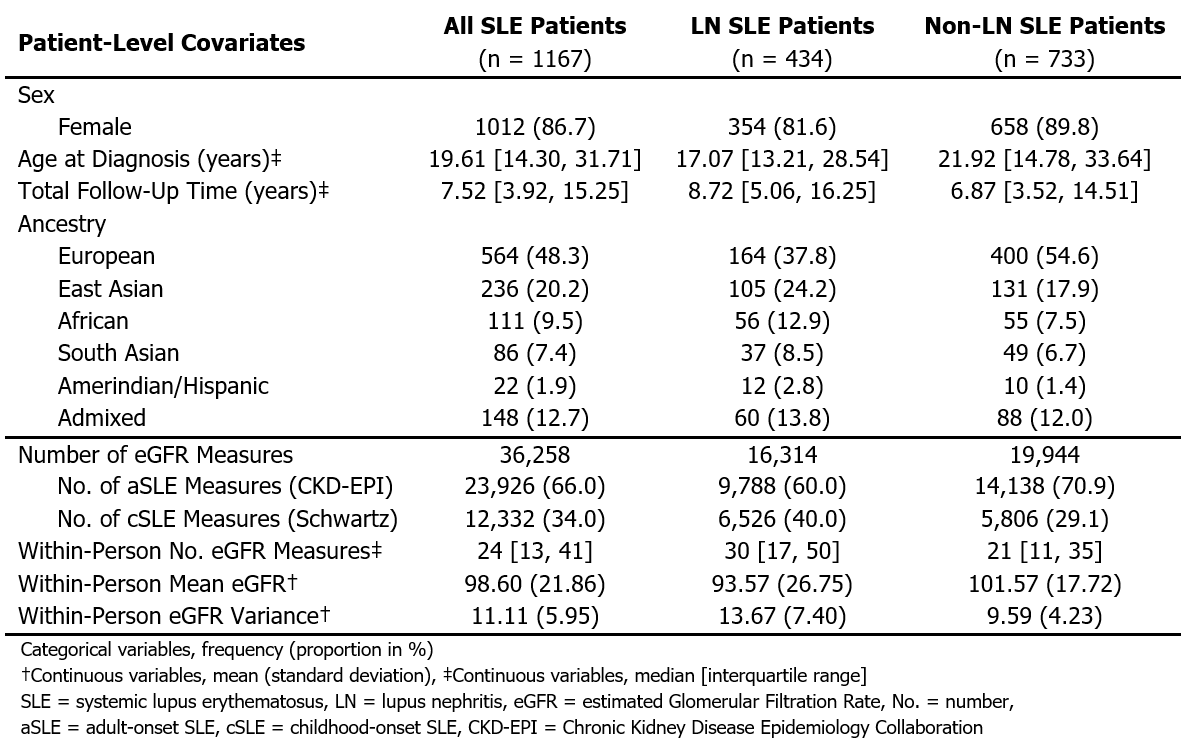
Results: Our cohort included 567 (47%) patients with childhood-onset SLE (cSLE) and 615 (53%) adult-onset SLE (aSLE) with a total of 36,258 eGFR measures (23,926 measures (66%) during aSLE). Median follow-up time was 7.52 years [IQR: 3.92, 15.25 years] (Table). The majority were female (87%) and of European ancestry (48%). There was a median lag of 77 days [IQR: 0, 1193 days] between SLE diagnosis and first visit. Under a t-test of independence, we observed lower within-person mean eGFR (p < 0.001) and higher within-person eGFR variance (p < 0.001) in patients with LN compared to those without LN. From linear mixed models and Gamma regression, a unit increase in eGFR-GRS was associated with a 0.60 mL/min/1.73 m2 increase in eGFR (0.60; 95% CI: [0.24, 0.96]; p = 0.001) and a 2% increase in eGFR variance (1.02; 95% CI: [1.02, 1.03]; p < 0.001). A unit increase in SLE-GRS was associated with a 1.28 mL/min/1.73 m2 decrease in eGFR (-1.28; 95% CI: [-2.42, -0.13]; p = 0.029) and a 4% increase in eGFR variance (1.04 95% CI: [1.01, 1.06]; p < 0.001).
Conclusion: Using a large number of repeated eGFR measures taken from people with aSLE and cSLE, we observed that as expected, patients with LN had both lower mean eGFR and higher variability in eGFR, when compared to patients without LN. We demonstrated that eGFR and SLE loci are influencing (1) eGFR mean and (2) eGFR variance in SLE patients. This suggests that longitudinal eGFR measures may be more informative outcomes than binary LN categories for identifying genetics of kidney disease in SLE.
To cite this abstract in AMA style:
Tang T, Webber D, Cao J, Dominguez D, Gladman D, Knight A, Levy D, Ng L, Paterson A, Silverman E, Touma Z, Urowitz M, Wither J, Pullenayegum E, Hiraki L. Genetics of Longitudinal Kidney Function in Children and Adults with Systemic Lupus Erythematosus [abstract]. Arthritis Rheumatol. 2019; 71 (suppl 10). https://acrabstracts.org/abstract/genetics-of-longitudinal-kidney-function-in-children-and-adults-with-systemic-lupus-erythematosus/. Accessed .« Back to 2019 ACR/ARP Annual Meeting
ACR Meeting Abstracts - https://acrabstracts.org/abstract/genetics-of-longitudinal-kidney-function-in-children-and-adults-with-systemic-lupus-erythematosus/