
Session Information
Session Type: Poster Session (Sunday)
Session Time: 9:00AM-11:00AM
Background/Purpose: Patient reported outcomes (PROs) reflect patients’ opinion on disease activity, impact of disease, quality of life (QoL), disability and are essential in the assessment of PsA patients. PROs may be influenced by several factors other than disease activity and severity. US is an objective tool to evaluate inflammation and structural damage in PsA. This cross-sectional study aimed at evaluating the role of US-detected inflammation (synovitis, tenosynovitis, enthesitis, dactylitis) and structural damage (erosions, enthesophytes, osteophytes and cortical irregularities), according to the OMERACT definitions and scoring [1], to explain PROs in PsA and to compare that to psoriasis (PsO) patients with and without musculoskeletal (MSK) symptoms.
Methods: PsA (CASPAR criteria) [2], PsO with MSK symptoms without fulfilling CASPAR criteria (symptoPsO) and PsO with no MSK symptoms (asymptoPsO) were included. Socio-demographic characteristics, comorbidities, disease duration and treatment were collected. All patients underwent dermatological and rheumatologic assessment: PsO severity, swollen joint count (SJC), tender JC (TJC), number of dactylitis and enthesitis, fibromyalgia criteria; and US evaluation on joints, tendons and entheses as shown in figure 1. PROs were evaluated in all patients: assessment of skin psoriasis and of fatigue on a numeric rating scale (NRS), HAQ and QoL assessed by SF36. Variables were compared across groups (chi square or one-way ANOVA test). Correlations were evaluated using Spearman’s test.
Results: One hundred fifty eight patients (54 PsA, 52 symptoPsO and 52 asymptoPsO) with similar socio-demographic characteristics and PsO duration were included (table 1). Most of PsA patients had low/moderate disease activity. With the exception of US enthesophytes, all US changes were significantly higher in PsA, followed by symptoPsO patients.
Across all 3 groups, all PROs correlated mainly with demographic variables, comorbidities, TJC, number of enthesitis, skin severity, depression and fibromyalgia (r=0.29-0.66). SymptoPsO and PsA reported similar scores of fatigue and impact on some QoL domains (vitality, pain, general health, social and mental), significantly higher than asymptoPsO. Only in PsA, HAQ correlated with the total number of US enthesitis (r=0.35, p=0.01) and of joints with ostheophytes/cortical irregularities (r=0.28, p=0.04) as well as the physical function domain of SF36 with the number of joints with ostheophytes/cortical irregularities (r=-0.33, p=0.02).
Conclusion: Quality of life, disability and fatigue were more impaired in PsA and symptoPsO patients than asymptoPsO. In all groups, PROs were mostly associated with socio-demographic characteristics, comorbidities and some clinical variables rather than objective measures such as US changes.
Acknowledgement: The study was supported by a grant from The PARTNER Psoriatic Arthritis Network fellowship.
References:
- Bruyn GA et al. J Rheumatol 2019
- Taylor W et al. Arthritis Rheum 2006

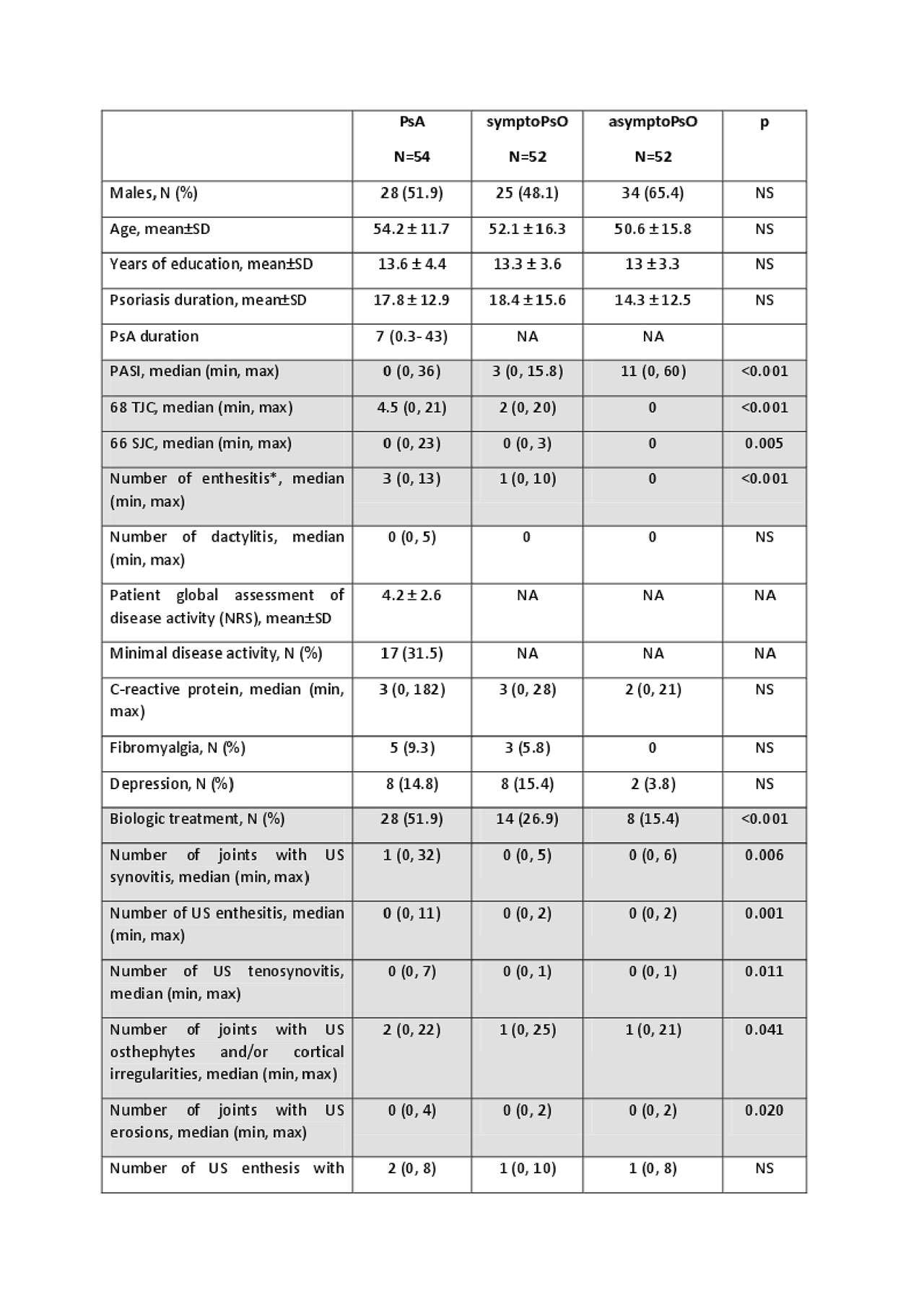
table 1
PsA: psoriatic arthritis; PsO: psoriasis; PASI: Psoriasis Area and Severity Index; TJC: total tender joint count; SJC: total swollen joint count; N: number; SD: standard deviation; NRS: numeric rating scale; SF36: Medical Outcome Study Short Form-36; PF: Physical Functioning; RP: Physical Role functioning; BP: Bodily Pain; GH: General Health; VT: Vitality; SF: Social role Functioning; MH: Mental Health; RE: Emotional Role functioning
* Number of enthesitis was calculated according to the Spondyloarthritis Research Consortium of Canada -SPARCC- Enthesitis Index
To cite this abstract in AMA style:
Gudu T, Padovano I, Gouze H, Vidal F, Mahé E, Lara Gonzalez L, Guyot A, Saiag P, Bourgault Villada I, Ruel-Gagné S, Hayem G, Costantino F, Breban M, D’Agostino M. Factors Explaining Patient Perspective in Psoriasis and Psoriatic Arthritis: The Role of Inflammation and Structural Damage Detected by Ultrasound [abstract]. Arthritis Rheumatol. 2019; 71 (suppl 10). https://acrabstracts.org/abstract/factors-explaining-patient-perspective-in-psoriasis-and-psoriatic-arthritis-the-role-of-inflammation-and-structural-damage-detected-by-ultrasound/. Accessed .« Back to 2019 ACR/ARP Annual Meeting
ACR Meeting Abstracts - https://acrabstracts.org/abstract/factors-explaining-patient-perspective-in-psoriasis-and-psoriatic-arthritis-the-role-of-inflammation-and-structural-damage-detected-by-ultrasound/