ACR Meeting Abstracts

ACR Meeting Abstracts

  • Meeting Abstracts
    • All Meetings
    • PRSYM 2026
    • ACR Convergence 2025
    • Download Abstract Supplements
  • Keyword Index
  • My Favorites
    • View & print my favorites
  • Search

Home » Meeting Abstracts » ACR/ARP Annual Meeting 2019

Abstract Number: 519

Efficacy of Biosimilar Candidate ABP 710 in a Phase 3 Study in Subjects with Moderate to Severe RA: Additional Analysis Focusing on the ACR Individual Components

Mark Genovese1, Juan Sanchez-Burson 2, Éva Balázs 3, Andrea Everding 4, MyungShin Oh 5, Gary Fanjiang 5 and Stanley Cohen 6, 1Stanford University, Stanford, CA, 2Hospital Infanta Luisa, Sevilla, Spain, 3Dr. Bugyi István Hospital, Szentes, Hungary, 4HRF Hamburger Rheuma Forschungszentrum, Hamburg, Germany, 5Amgen, Thousand Oaks, CA, 6Metroplex Clinical Research Center, Dallas, TX

Share on X (Twitter) Share on Facebook Share on LinkedIn Share on Email
Print

Meeting: ACR/ARP Annual Meeting 2019

Keywords: biosimilars, clinical trials and pain, Disease-modifying antirheumatic drugs, infliximab

Session Information

Date: Sunday, November 10, 2019

Title: RA – Treatments Poster I: Novel Treatments

Session Type: Poster Session (Sunday)

Session Time: 9:00AM-11:00AM

Background/Purpose: ABP 710 is being developed as a biosimilar to infliximab. Both ABP 710 and infliximab reference product (RP) inhibit tumor necrosis factor-alpha. Following demonstration of analytical (structural and functional) similarity and clinical pharmacokinetic equivalence in a phase 1 study, a comparative phase 3 clinical trial in patients with moderate to severe RA was conducted. The objective of this analysis was to show the results of the ACR individual components for ABP 710 in comparison with infliximab RP.

Methods: In this multicenter, randomized, double-blind study, the efficacy and safety of ABP 710 was compared with the RP in subjects with moderate to severe RA. Subjects were maintained on a stable 7.5 to 25 mg/week dose of methotrexate and received 3 mg/kg infusions of the investigational products at predetermined intervals. The primary endpoint of the study was response difference (RD) of at least 20% improvement compared with baseline in ACR core set of measurements (ACR20) at week 22. Individual components of ACR were summarized descriptively at each visit, which included swollen joint count and tender joint count, Subject’s Global Health Assessment, Investigator’s Global Health Assessment, Subject’s Assessment of Disease-related Pain, Health Assessment Questionnaire – Disability Index (HAQ-DI) total score, and C-reactive protein (CRP).

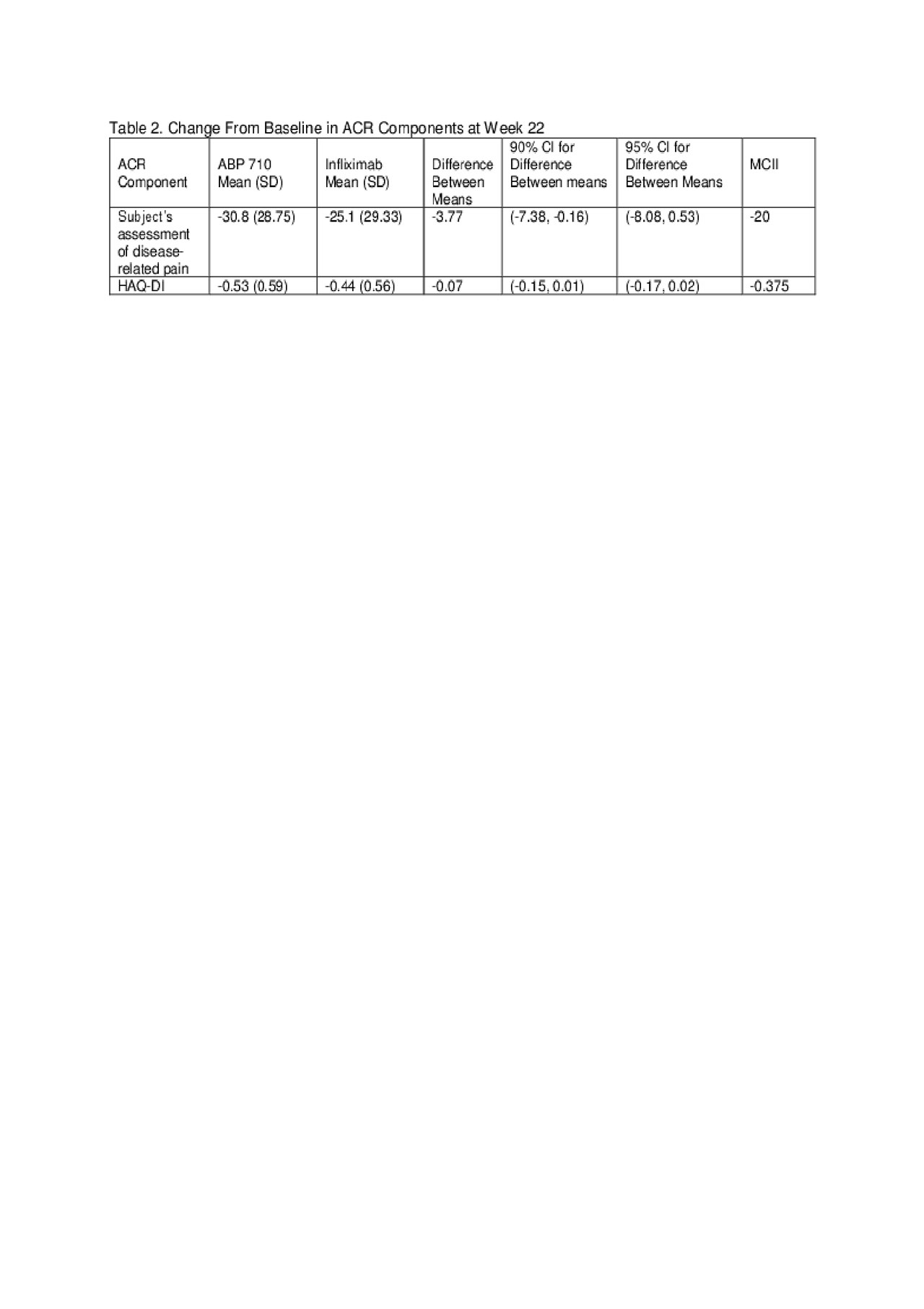
Results: Of the 558 randomized subjects, 556 were treated (ABP 710 n=278; RP n=278); 484 subjects continued in the study through week 22 to be re-randomized (ABP 710/ABP 710: n=244; infliximab RP/infliximab RP: n=121; infliximab RP/ABP 710: n=119), and 435 subjects completed the study. Results of the ACR components (based on a response of ≥20% improvement) at week 22 are shown in Table 1. ACR components with the largest RD between treatment groups were Subject’s Assessment of Disease-related Pain and HAQ-DI; yet the difference in mean change from baseline and associated 90% and 95% confidence intervals (CIs) were well below the thresholds of minimal clinically important improvement and thus, not clinically meaningful (Table 2).

Conclusion: This analysis of ACR individual components further supports the similarity of ABP 710 and infliximab RP.
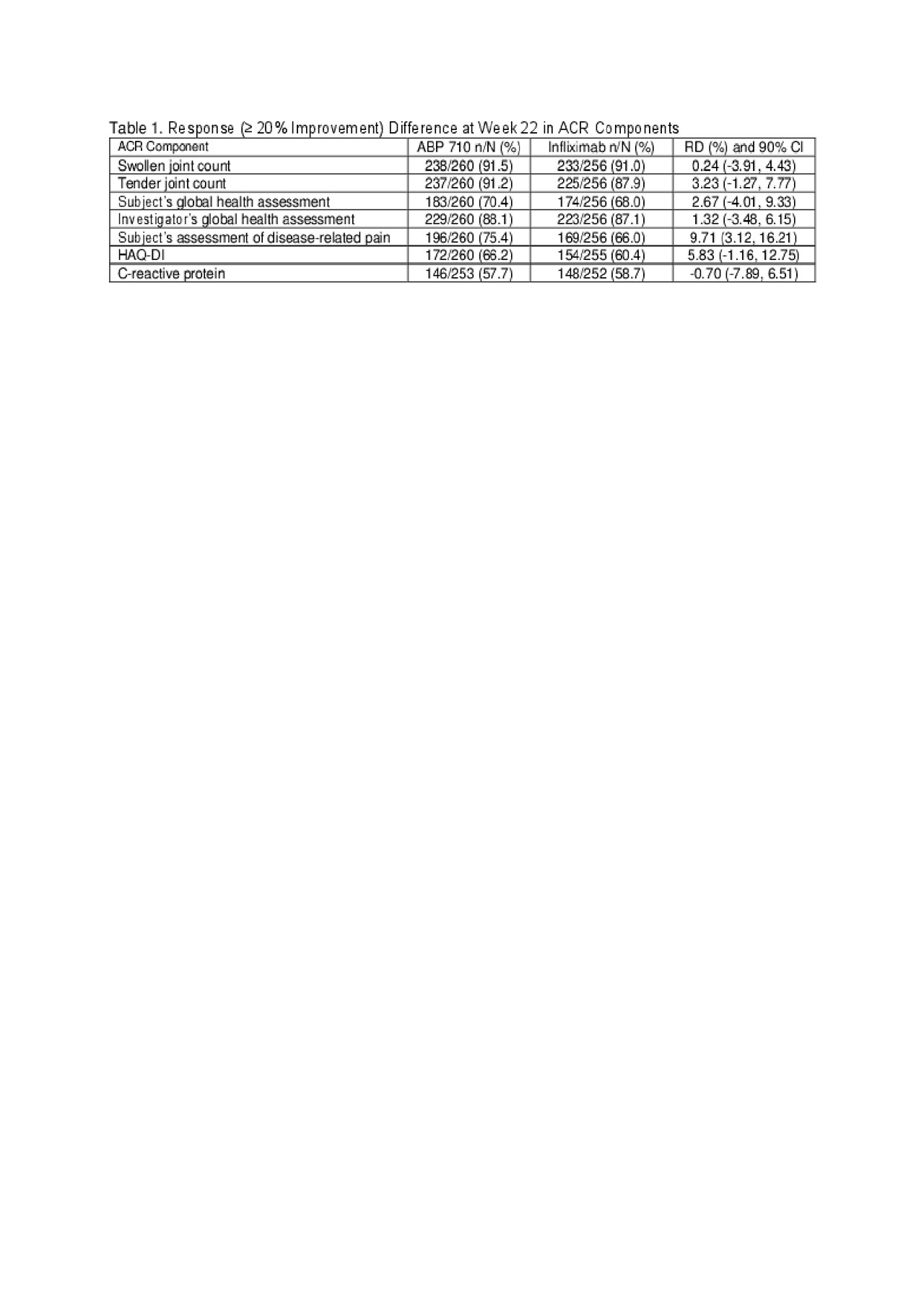

Table 1 20190603
Abbreviations: CI = confidence interval; HAQ-DI = Health Assessment Questionnaire – Disability Index; RD = response difference. Note: The point estimate of RD was estimated by the Mantel-Haenszel estimate and the 90% CI was estimated using stratified Newcombe confidence limits adjusting for actual stratification factors.


Table 2 20190603

Abbreviations: ANOVA = analysis of variance; CI = confidence interval; HAQ-DI = Health Assessment Questionnaire – Disability Index; MCII = minimal clinically important improvement; RD = response difference. Note: Difference between means, 90% and 95% CIs for difference between means was based on ANOVA model with change from baseline in HAQ-DI or pain as the response and adjusted for baseline HAQ-DI or pain and the actual stratification factors: geographic region and prior biologic use for RA.


Disclosure: M. Genovese, AbbVie, 2, 5, Abbvie, 2, 5, AbbVie, Inc., 9, Astellas, 2, 5, Eli Lilly, 2, 5, Eli Lilly and Company, 2, 5, EMD Merck Serono, 2, 5, Galapagos, 2, 5, Galapagos NV, 2, 5, 9, Genentech/Roche, 2, 5, Gilead, 2, 5, Gilead Science, 9, Gilead Sciences, Inc., 2, 5, 9, GSK, 5, Lilly, 2, 5, 9, Novartis, 2, 5, Pfizer, 2, 5, 9, Pfizer Inc, 2, 5, Pfizer, Inc., 9, Pzier, 9, RPharm, 5, Sanofi Genzyme, 2, 5, Vertex, 2, 5; J. Sanchez-Burson, Amgen, 5; �. Balázs, Celltrion, Inc., 2, Amgen, 5; A. Everding, Amgen, 5, Eli Lilly, 5, Novartis, 5; M. Oh, Amgen, 1, 3, 4; G. Fanjiang, Amgen, 1, 3, 4; S. Cohen, AbbVie, 2, 5, Abbvie, 5, Amgen, 5, Amgen Inc., 2, 5, AstraZeneca, 2, 5, Biogen-IDEC, 2, 5, Bristol Meyer Squibb, 2, 5, Genentech, 2, 5, Janssen, 2, 5, Lilly, 2, 5, Merck, 2, 5, Novartis, 2, 5, Pfizer, 2, 5, Roche, 2, 5.

To cite this abstract in AMA style:

Genovese M, Sanchez-Burson J, Balázs �, Everding A, Oh M, Fanjiang G, Cohen S. Efficacy of Biosimilar Candidate ABP 710 in a Phase 3 Study in Subjects with Moderate to Severe RA: Additional Analysis Focusing on the ACR Individual Components [abstract]. Arthritis Rheumatol. 2019; 71 (suppl 10). https://acrabstracts.org/abstract/efficacy-of-biosimilar-candidate-abp-710-in-a-phase-3-study-in-subjects-with-moderate-to-severe-ra-additional-analysis-focusing-on-the-acr-individual-components/. Accessed .

ACR Meeting Abstracts - https://acrabstracts.org/abstract/efficacy-of-biosimilar-candidate-abp-710-in-a-phase-3-study-in-subjects-with-moderate-to-severe-ra-additional-analysis-focusing-on-the-acr-individual-components/

My Favorites

Save and print abstracts during your browser session by clicking the “Favorite” button at the bottom of any abstract (must have cookies enabled in browser). See saved favorites.

Abstract Policies

  • ACR Convergence Abstract Embargo Policies
  • ACR Convergence Abstract Permissions & Reprints
  • PRSYM Abstract Policies

ACR Convergence. Where Rheumatology Meets

ACR Convergence 2026

Join us November 6-11 in Orlando, Florida.
See Registration Information

  • Contact ACR
  • Privacy Policy
  • ACR Policies
  • Cookie Preferences

© Copyright 2026 American College of Rheumatology