ACR Meeting Abstracts

ACR Meeting Abstracts

  • Meeting Abstracts
    • All Meetings
    • PRSYM 2026
    • ACR Convergence 2025
    • Download Abstract Supplements
  • Keyword Index
  • My Favorites
    • View & print my favorites
  • Search

Home » Meeting Abstracts » ACR/ARHP Annual Meeting 2015

Abstract Number: 2428

Efficacy and Safety of Adalimumab in Adult Patients with Polyarticular Juvenille Idiopathic Arthritis

Daniel Lovell1,2, Nicolino Ruperto3, Andreas Reiff4, Lawrence Jung5, Katerina Jarosova6, Pierre Quartier7, Christy Sandborg8, John F. Bohnsack9, Dirk Elewaut10, Ivan Foeldvari11, Joseph Rovensky12, Edward H. Giannini2, Nupun A. Varothai13, Jasmina Kalabic13 and Alberto Martini14,15,16, 1PRCSG, Cincinnati Children’s Hospital Medical Center, Cincinnati, OH, 2PRCSG, Cincinnati, OH, 3Paediatric Rheumatology International Trials Organization (PRINTO), Istituto Giannina Gaslini, Genova, Italy, 4Children's Hospital, Los Angeles, CA, 5Pediatric Rheumatology, Children's National Med Ctr, Washington, DC, 6Revmatologicky ustav, Prague, Czech Republic, 7Hospital Necker Enfants Malades, Paris, France, 8Stanford University Medical Center, Standford, CA, 9Pediatrics, University of Utah Health Sciences Center, Salt Lake City, UT, 10Laboratory for Molecular Immunology and Inflammation, Department of Rheumatology, VIB, Ghent University and Ghent University Hospital, Ghent, Belgium, 11Hamburger Zentrum für Kinder-und Jugendrheumatologie, Hamburg, Germany, 12The National Institute of Rheumatic Diseases, Piestany, Slovakia, 13AbbVie, North Chicago, IL, 14University of Genova, Genova, Italy, 15Department of Pediatrics, University of Genova, Genova, Italy, 16Istituto Gaslini-PRINTO, Genova, Italy

Share on X (Twitter) Share on Facebook Share on LinkedIn Share on Email
Print

Meeting: ACR/ARHP Annual Meeting 2015

Date of first publication: September 29, 2015

Keywords: Adalimumab and juvenile idiopathic arthritis (JIA)

Session Information

Date: Tuesday, November 10, 2015

Title: Pediatric Rheumatology - Clinical and Therapeutic Aspects Posters (ACR): Imaging and Novel Clinical Interventions

Session Type: ACR Poster Session C

Session Time: 9:00AM-11:00AM

Background/Purpose: The
diagnosis of polyarticular JIA (pJIA) is made in childhood but the disease and
the diagnosis are carried into adulthood. Adults with pJIA have heterogeneous
clinical manifestations, many of which differ from rheumatoid arthritis. These
adults warrant a tailored approach for optimal management of pJIA. The
objective of this study was to assess adalimumab (ADA) effectiveness and safety
in pts with pJIA who turned 18 years (yrs) of age anytime during Study DE038.

Methods: This was
a multicenter, phase 3, randomized, double-blind (DB), stratified study in
children (4 to 17 yrs at baseline) with pJIA treated with or without MTX prior
to the study entry. Pts in the MTX arm were treated concomitantly with MTX
during the entire study duration.  Pts in
the non-MTX arm were either naïve to or withdrawn from MTX at least 2 weeks
(wks) prior to study drug administration. The study consisted of 16 wk open
label lead-in, a 32 wk DB phase and an open label (OL) extension phase. This
post-hoc analysis assessed outcomes during the OLE for pts who turned 18 yrs anytime
during the course of study in comparison to pts who remained under 18 yrs
during their study participation. Twenty sevenjoint juvenile arthritis disease
activity score (JADAS27), based on C-reactive protein (CRP) response was
measured upto 312 wks of the OLE. Adverse events (AEs) were also monitored and
compared between the two age groups throughout the study duration.

Results: 171 pts
with pJIA between 4-17 yrs of age at the time of study entry were enrolled. Among
them, 51(30%) turned 18 yrs of age during the course of their participation in
the study and were compared to the remaining 120 pts that remained  <18 yrs throughout the study participation.
There were (42; <18 yrs) vs  (46;
≥18 yrs) pts who received at least 4 yrs of ADA. The mean age at the time
of study enrollment was 14.6 yrs vs 9.8 yrs in pts ≥18 yrs and <18 yrs
respectively. The majority of pts were white (90.2% vs 92.5%) and female (74.5%;
≥18 yrs) vs 80.8%; <18 yrs). The subgroup of 51 pts that turned 18 yrs
had a mean age of 19.8 ± 1.5 yrs at the time of their last dose of ADA in the
study.
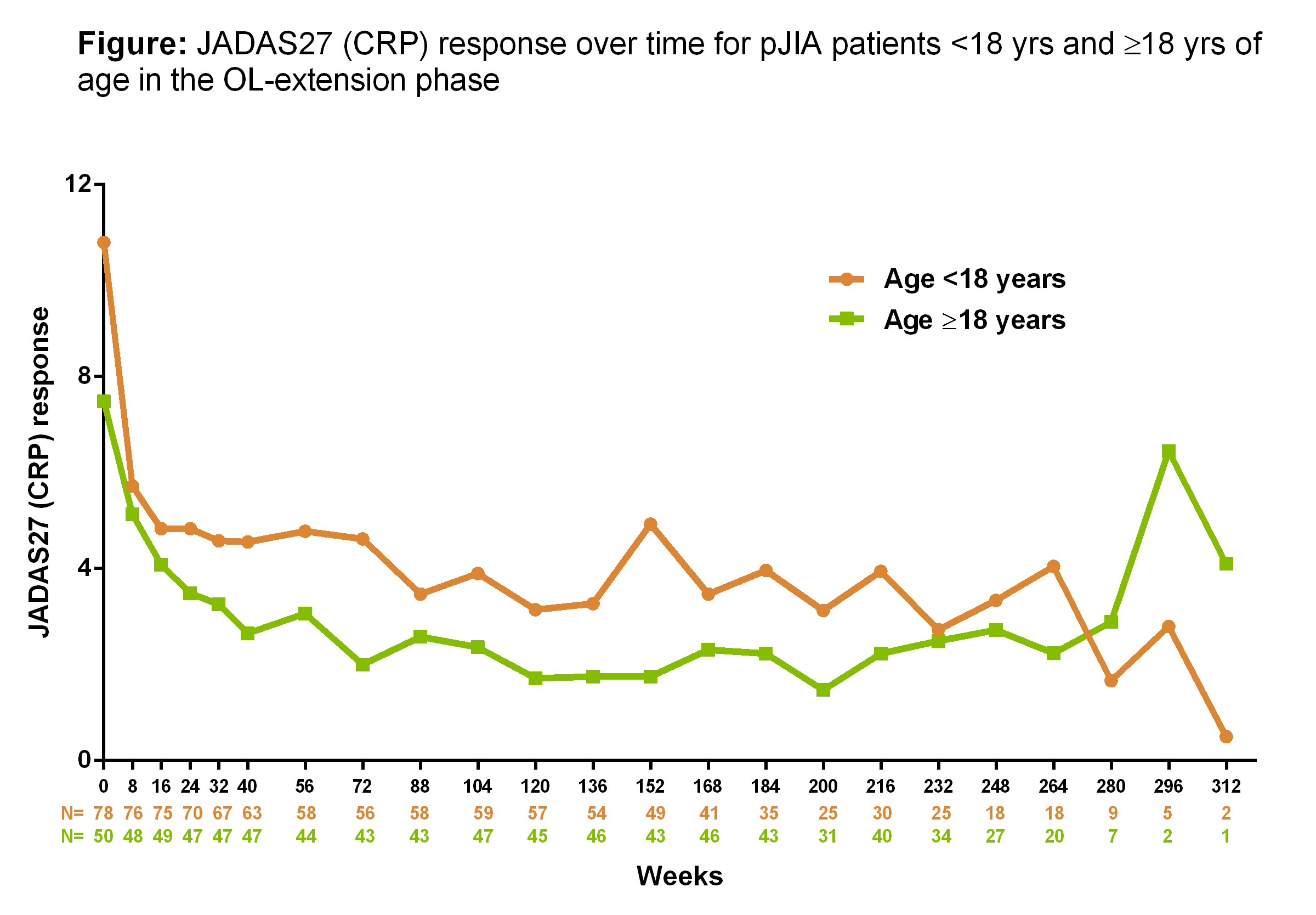
The JADAS27(CRP)
response was measured from baseline up to 312 wks and demonstrated maintainance
of efficacy (p<0.05)from week 72 onwards, irrespective of age (Figure). The overall rate of AEs was
lower in pts ≥18 yrs than pts <18 yrs (432 [95% CI, 407.6 – 458.6] vs 701 [95% CI, 672.1 –
731.0] events/100 pt-y) respectively.

Conclusion: The efficacy results based
on the JASDAS27(CRP)responses demonstrated maintenance
of efficacy over time for both age groups. Safety data showed the
overall rate of AEs was lower in pts ≥18 yrs than pts
<18 yrs. No new safety signals were observed; thus the safety profile of ADA
remained unchanged. The findings from this study support a favorable
benefit-risk profile of for the ADA treatment in adult pts (≥18 yrs of age) with moderately to severely active pJIA.

Disclosure: D. Lovell, AbbVie Inc., AstraZeneca, Centocor, Bristol-Myers Squibb, Pfizer, Regeneron, Hoffman La-Roche, Novartis, UBC, Xoma, and Genentech, 9; N. Ruperto, from AbbVie Inc., AstraZeneca, Bristol-Myers Squibb, Janssen Biologics B.V., Eli Lilly and Co., "Francesco Angelini", GlaxoSmithKline, Italfarmaco, Novartis, Pfizer, Roche, Sanofi Aventis, Schwarz Biosciences GmbH, Xoma, medimmune and Wyeth Pharmaceutical, 9; A. Reiff, Amgen, Pfizer, Regeneron and AbbVie, 9; L. Jung, AbbVie and OncoImmune, 9; K. Jarosova, None; P. Quartier, AbbVie, Novartis, Pfizer, BMS, Chugai-Roche, Medimmune, Servier, and Swedish Orphan Biovitrum., 9; C. Sandborg, Immunex, Abbott Laboratories, Barr Pharmaceuticals, Bristol-Myers Squibb, Centocor, Hoffmann–La Roche, and Amgen, 9; J. F. Bohnsack, Novartis Pharmaceutical Corporation, 5; D. Elewaut, Abbott, 9; I. Foeldvari, AbbVie and Novartis, 9; J. Rovensky, None; E. H. Giannini, Abbott Laboratories, BMS and Pfizer, 9; N. A. Varothai, AbbVie, 1; J. Kalabic, AbbVie, 1; A. Martini, AbbVie Inc., AstraZeneca, Bristol-Myers Squibb, Janssen Biologics B.V., Eli Lilly and Co., "Francesco Angelini", GlaxoSmithKline, Italfarmaco, Novartis, Pfizer, Roche, Sanofi Aventis, Schwarz Biosciences GmbH, Xoma, Astellas, medImmune and Wyeth Pharmaceu, 9.

To cite this abstract in AMA style:

Lovell D, Ruperto N, Reiff A, Jung L, Jarosova K, Quartier P, Sandborg C, Bohnsack JF, Elewaut D, Foeldvari I, Rovensky J, Giannini EH, Varothai NA, Kalabic J, Martini A. Efficacy and Safety of Adalimumab in Adult Patients with Polyarticular Juvenille Idiopathic Arthritis [abstract]. Arthritis Rheumatol. 2015; 67 (suppl 10). https://acrabstracts.org/abstract/efficacy-and-safety-of-adalimumab-in-adult-patients-with-polyarticular-juvenille-idiopathic-arthritis/. Accessed .

ACR Meeting Abstracts - https://acrabstracts.org/abstract/efficacy-and-safety-of-adalimumab-in-adult-patients-with-polyarticular-juvenille-idiopathic-arthritis/

My Favorites

Save and print abstracts during your browser session by clicking the “Favorite” button at the bottom of any abstract (must have cookies enabled in browser). See saved favorites.

Abstract Policies

  • ACR Convergence Abstract Embargo Policies
  • ACR Convergence Abstract Permissions & Reprints
  • PRSYM Abstract Policies

ACR Convergence. Where Rheumatology Meets

ACR Convergence 2026

Join us November 6-11 in Orlando, Florida.
See Registration Information

  • Contact ACR
  • Privacy Policy
  • ACR Policies
  • Cookie Preferences

© Copyright 2026 American College of Rheumatology