
Session Information
Date: Sunday, November 5, 2017
Title: Rheumatoid Arthritis – Clinical Aspects Poster I: Treatment Patterns and Response
Session Type: ACR Poster Session A
Session Time: 9:00AM-11:00AM
Background/Purpose: Men seem to respond better to antirheumatic treatment than women with RA. In daily practice, expectations towards responsiveness may influence rheumatologists when making treatment choices. We investigated whether male and female RA patients are treated differently and whether they respond differently to treatment in daily clinical practice.
Methods: DMARD naive RA patients with symptom duration ≤5 years, ≥3 months follow-up, available data regarding medication use and baseline DAS≥1.6 were selected from the international observational METEOR database. Patients starting biologic DMARD treatment were excluded due to low numbers. Follow-up visits were selected until the first medication switch or the end of follow-up. Missing data were imputed using multiple imputation. Linear mixed model (LMM) analyses were performed to assess whether differences in treatment between men and women lead to differences in DAS or HAQ over time within each treatment group. If an added interaction between gender and treatment was statistically significant (p<0.05), models were stratified for treatment. Analyses were adjusted for potential confounders.
Results: Women (n 4393) more often started treatment with HCQ (HCQ monotherapy, MTX + HCQ and HCQ + glucocorticoid, but not more often with MTX + SSZ + HCQ), whereas men (n 1142) more often started treatment with SSZ and/or MTX (SSZ monotherapy, MTX + SSZ and MTX + glucocorticoid, table 1).
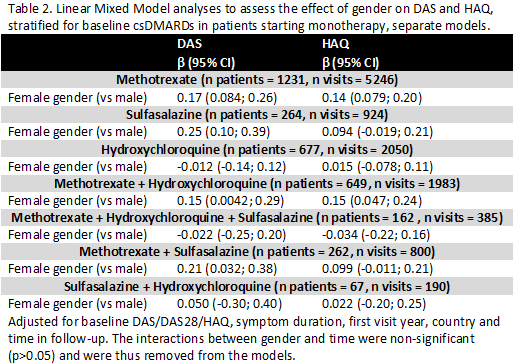
Mean (SD) baseline DAS and HAQ for women and men were DAS 3.7 (1.0) vs 3.5 (1.1) and HAQ 1.1 (0.7) vs 1.0 (0.7). LMM analyses showed that in general women improved less on initial treatment over time than men: DAS [β (95% CI) 0.16 (0.12; 0.20)] and HAQ [β (95% CI) 0.13 (0.10; 0.16)]. A statistically significant interaction was only found between female gender and initial HCQ [DAS β (95% CI) -0.17 (-0.33; -0.0045) and HAQ -0.12 (-0.23; -0.0047)] and between female gender and initial MTX + HCQ + SSZ for the outcome HAQ [β (95% CI) -0.19 (-0.38; -0.0048)]. Results were therefore stratified for individual DMARDs and for combination therapy with csDMARDs (table 2). It was found that women had a worse response than men to MTX monotherapy, MTX + HCQ and SSZ + HCQ (for DAS and HAQ) and for SSZ monotherapy and MTX + SSZ (for DAS). For patients using HCQ monotherapy or MTX + HCQ + SSZ there were no gender differences over time.
Conclusion: Women more often started treatment with HCQ, as monotherapy or in combination with MTX or a glucocorticoid, whereas men more often started treatment with MTX and/or SSZ. In general women had worse response to treatment than men, but we found no gender differences in response to HCQ monotherapy or to combination of MTX + HCQ + SSZ.

To cite this abstract in AMA style:
Bergstra SA, Allaart CF, Ramiro S, Chopra A, Silva CA, Govind N, Landewé RBM. Do We Treat Men and Women Differently, and Is This a Good Thing? [abstract]. Arthritis Rheumatol. 2017; 69 (suppl 10). https://acrabstracts.org/abstract/do-we-treat-men-and-women-differently-and-is-this-a-good-thing/. Accessed .« Back to 2017 ACR/ARHP Annual Meeting
ACR Meeting Abstracts - https://acrabstracts.org/abstract/do-we-treat-men-and-women-differently-and-is-this-a-good-thing/