
Session Information
Date: Sunday, November 5, 2017
Title: Rheumatoid Arthritis – Human Etiology and Pathogenesis Poster I
Session Type: ACR Poster Session A
Session Time: 9:00AM-11:00AM
Background/Purpose:
Protein citrullination, the post-translational conversion of arginine to citrulline, mediated by peptidylarginine deiminase (PAD) enzymes, is considered a likely mechanism for the stimulation of anti-citrullinated protein antibodies (ACPA) in patients with rheumatoid arthritis (RA). Hypercitrullination, the citrullination of multiple intracellular proteins, is seen in synovial fluid (SF) cells from RA patients. This unique form of citrullination is proposed to occur via immune-mediated, pore-forming membranolytic pathways such as perforin-granzyme activation. Indeed, perforin and granzyme-producing CD8+ T effector cells are found in the synovium of pre-clinical RA patients as well as in the peripheral blood (PB) and SF of active RA patients, persisting into disease remission.
Insight into the existence of potential cytotoxic mechanisms occurring in RA comes from the co-occurrence of RA in up to 36% of cases of T-cell Large Granular Lymphocyte (T-LGL) Leukemia, a clonal condition characterized by neutropenia attributed to the killing of neutrophils or their precursors by cytotoxic CD8+ T cells. We thus queried LGL leukemia as a model for neutrophil (PMN)-directed cytotoxicity contributing to hypercitrullination and disease propagation in inflamed joints of ACPA+ RA patients.
Methods:
The sera of 15 T-LGL leukemia patients (T-LGL), 19 T-LGL leukemia patients with co-existing RA (T-LGL/RA), and 4 healthy controls (HC) were analyzed for ACPA positivity by ELISA. ACPA titers of each group of patients were compared using unpaired two-tailed T tests. Neutrophils (PMN) from each of these groups were isolated from blood cells by density gradient centrifugation. Hypercitrullination of these cells (n=4/patient group) was compared with that of seropositive RA patients by proteomic analysis using Rhodamine-PG labeling, protein precipitation followed by Streptavidin enrichment, and sequent digestion. The resulting products were analyzed using LC-MS/MS on an LTQ-Orbitrap mass spectrometer. The tandem MS data were searched using SEQUEST algorithm using a concatenated target/decoy variant of the human and mouse International Protein Index database.
Results:
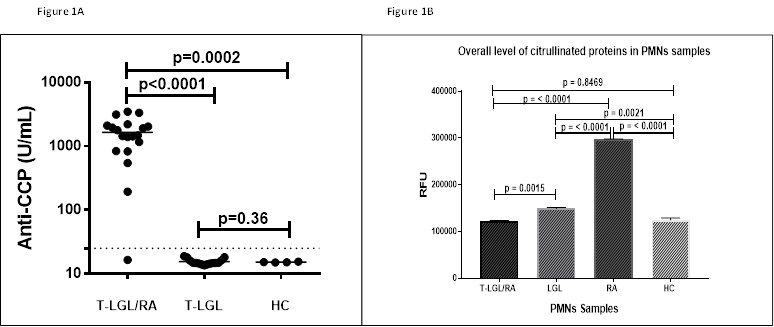
T-LGL/RA patients had significantly higher serum ACPA positivity than T-LGL patients or HC (Fig. 1A). Surprisingly, however, the overall level of citrullinated proteins in PMN (Fig.1B) was not increased in T-LGL/RA compared to T-LGL patients, and was highest in PMN obtained from RA patients (Fig. 1B).
Conclusion:
These results reveal an interesting dichotomy between RA that occurs spontaneously versus that occurring in patients with LGL leukemia. Whereas both spontaneous and LGL-associated RA develop high titer ACPA, only RA patients show a high degree of citrullination of neutrophil proteins. Whether this suggests a different source of immunogenic proteins or relates to other biologic processes, remains to be determined.
To cite this abstract in AMA style:
Gazitt T, Nguyen SH, Salinger A, Lood C, Sun X, Tanaka LM, Feith D, Ledbetter J, Starkebaum G, Loughran T Jr., Thompson PR, Elkon KB. Different Citrullination Profiles in Spontaneous Versus Leukemia-Associated Rheumatoid Arthritis [abstract]. Arthritis Rheumatol. 2017; 69 (suppl 10). https://acrabstracts.org/abstract/different-citrullination-profiles-in-spontaneous-versus-leukemia-associated-rheumatoid-arthritis/. Accessed .« Back to 2017 ACR/ARHP Annual Meeting
ACR Meeting Abstracts - https://acrabstracts.org/abstract/different-citrullination-profiles-in-spontaneous-versus-leukemia-associated-rheumatoid-arthritis/