ACR Meeting Abstracts

ACR Meeting Abstracts

  • Meeting Abstracts
    • All Meetings
    • PRSYM 2026
    • ACR Convergence 2025
    • Download Abstract Supplements
  • Keyword Index
  • Search
  • My Favorites
    • View and print all favorites
    • Clear all favorites

Abstract Number: 2533

Delta Neutrophil Index As a Marker For Differential Diagnosis Between Flare and Infection In Febrile Systemic Lupus Erythematosus Patients

You-Jung Ha1, Jung Yoon Pyo2, Jin Su Park2, Hee-Jin Park2, Jason Jungsik Song2, Yong-Beom Park2, Soo-Kon Lee2 and Sang-Won Lee3, 1Division of Rheumatology, Department of Internal Medicine, Yonsei University College of Medicine, Seoul, South Korea, 2Department of Internal Medicine, Yonsei University College of Medicine, Seoul, South Korea, 3Department of Internal Medicine, Yonsei University College of Medicine, Seoul, NV, South Korea

Meeting: ACR/ARHP Annual Meeting 2013

Keywords: infection and systemic lupus erythematosus (SLE)

  • Tweet
  • Email a link to a friend (Opens in new window) Email
  • Print (Opens in new window) Print
Session Information

Title: Systemic Lupus Erythematosus-Clinical Aspects III: Biomarkers, Quality of Life and Disease Indicators, Late Complications

Session Type: Abstract Submissions (ACR)
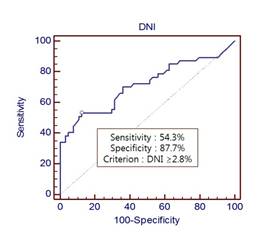
Background/Purpose: The immature granulocyte count has been reported to be a marker of infection and sepsis. The difference in leukocyte subfractions (delta neutrophil index, DNI), automatically determined by the ADVIA 2120 electronic cell analyzer, reflect the fraction of circulating immature granulocytes in the blood. Because fever is a common symptom of systemic lupus erythematosus (SLE), it is difficult to discriminate between SLE flare and infection. In this study, we investigated the utility of DNI in discriminating infections from SLE flares in febrile SLE patients.

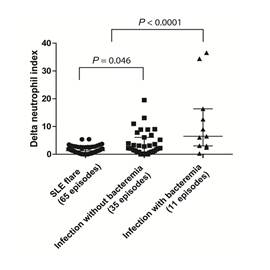
Methods: We included all consecutive SLE patients hospitalized due to febrile episodes at Severance Hospital, Yonsei University Health System, Seoul, South Korea, from January 2010 to February 2012. In total, 111 episodes in 92 febrile SLE patients were reviewed. All SLE patients were assigned to three groups: (1) patients with SLE flare, (2) patients with infection without bacteremia, and (3) patients with infection and bacteremia. DNI was determined using a specific blood cell analyzer.

Results: The infection group showed significantly higher white blood cell counts, neutrophil counts, C-reactive protein and procalcitonin than the SLE flare group. Complement (C)3 and C4 levels were decreased significantly in the SLE flare group. Patients in the SLE flare group had significantly lower DNI than those in both infection groups, with or without bacteremia. When we selected a DNI value of 2.8% as the cutoff for infection, SLE patients with DNI >= 2.8% were found to be at higher risk for infection than those with DNI < 2.8% (relative risk 8.48-fold). In a multivariate logistic regression analysis, only DNI >= 2.8% was a significant independent factor for the presence of infection (OR 18.9).

Conclusion: SLE patients with infection showed higher DNI than SLE flare group, and febrile SLE patients with DNI >= 2.8% are likely to have infection. Our findings suggest that DNI may be a useful marker to differentiate infections from SLE flares in febrile SLE patients.


Disclosure:

Y. J. Ha,
None;

J. Y. Pyo,
None;

J. S. Park,
None;

H. J. Park,
None;

J. J. Song,
None;

Y. B. Park,
None;

S. K. Lee,
None;

S. W. Lee,
None.

  • Tweet
  • Email a link to a friend (Opens in new window) Email
  • Print (Opens in new window) Print

« Back to ACR/ARHP Annual Meeting 2013

ACR Meeting Abstracts - https://acrabstracts.org/abstract/delta-neutrophil-index-as-a-marker-for-differential-diagnosis-between-flare-and-infection-in-febrile-systemic-lupus-erythematosus-patients/

Advanced Search

My Favorites

Save and print abstracts during your browser session by clicking the “Favorite” button at the bottom of any abstract (must have cookies enabled in browser). See saved favorites.

Abstract Policies

  • ACR Convergence Abstract Embargo Policies
  • ACR Convergence Abstract Permissions & Reprints
  • PRSYM Abstract Policies

ACR Convergence. Where Rheumatology Meets

ACR Convergence 2026

Join us November 6-11 in Orlando, Florida.
See Registration Information

  • Contact ACR
  • Privacy Policy
  • ACR Policies
  • Cookie Preferences

© Copyright 2026 American College of Rheumatology