
Session Information
The 2020 Pediatric Rheumatology Symposium, originally scheduled for April 29 – May 2, was postponed due to COVID-19; therefore, abstracts were not presented as scheduled.
Date: Friday, May 1, 2020
Title: Poster Session 2
Session Type: ACR Abstract Session
Session Time: 5:00PM-6:00PM
Background/Purpose: We aimed to evaluate the prevalence of depressive and/or anxiety symptoms in adolescents with juvenile idiopathic arthritis (JIA) and explore the association with demographic and disease activity measures.
Methods: This cross-sectional study collected survey data from consecutive adolescents with JIA aged 12-18 seen during regularly scheduled rheumatology clinic appointments over a 3-month period at a Canadian tertiary care pediatric hospital. The presence of depressive and anxiety symptoms was assessed using the Revised Child Anxiety and Depression Scale (RCADS), a 47-item youth self-report questionnaire with 6 subscales: Separation Anxiety Disorder, Social Phobia, Generalized Anxiety Disorder, Panic Disorder, Obsessive Compulsive Disorder, and Major Depressive Disorder as well as a Total Anxiety (TA) Scale (sum of the 5 anxiety subscales) and a Total Internalizing (TI) Scale (sum of all 6 subscales). The RCADS subscales align with anxiety and depression diagnosis criteria in the DSM-IV. Raw scores were converted to T-scores with scores ≥ 65 indicating borderline clinical threshold for the subscale and ≥ 70 being above the clinical threshold. Patient and physician disease activity visual analogue scale (VAS), active joint count, and physician reported presence/absence of wide-spread pain were collected. Descriptive statistics were used to report the prevalence of borderline and clinically significant T-scores for each of the subscales. Chi-square and Mann-Whitney U tests were used to compare demographic and disease-related variables between subjects with T-scores < 65 (below clinical threshold) and those with T-score ≥ 65 (borderline and above clinical threshold) as appropriate (p-values < 0.05 were considered significant in this exploratory analysis).
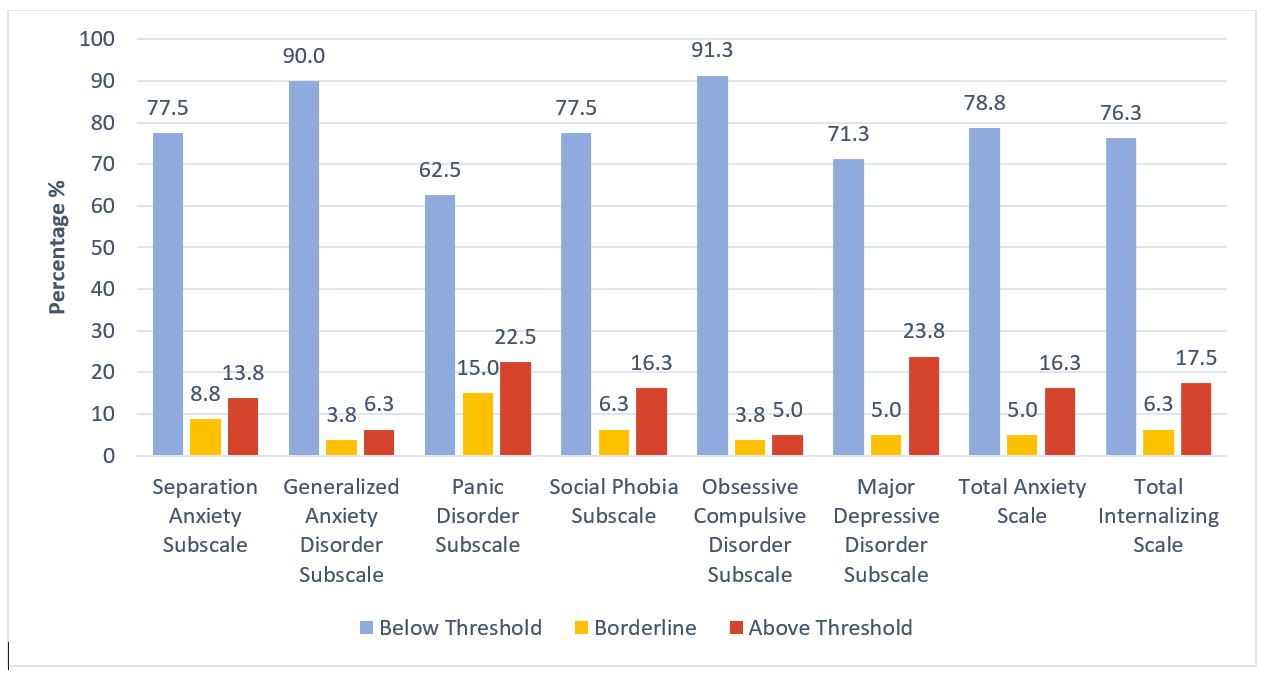
Results: 80/82 (98%) consecutively approached patients completed the survey (58F:22M, mean age 14.8y). Scores above clinical threshold were seen most frequently for The Major Depressive Disorder subscale [19 participants (23.8%)]. Panic Disorder, Social Phobia, and Separation Anxiety followed with 18 (22.5%), 13 (16.3%) and 11 (13.8%) participants scoring above clinical threshold, respectively. When clinical threshold and borderline scores were combined, Panic Disorder had the highest prevalence of 30 (37.5%). Seventeen (21%) participants scored borderline or above clinical threshold on the TA Scale and 19 (23.8%) on the TI Scale (see Figure 1). In the exploratory analysis, females were more likely to have a T-score ≥ 65 on the TI scale and participants who rated their disease activity more severely were more likely to have T-scores ≥ 65 on the TA and TI scales. Age, physician VAS, active joint count, and presence of widespread pain were not associated with T-scores ≥ 65 on any of the scales.
Conclusion: Depression and anxiety symptoms were prevalent in this population of adolescents with JIA. These results highlight the need for mental health screening protocols and mental health services for adolescents with JIA. The relationship between patient-reported disease activity and the presence of anxiety and depressive symptomatology requires further research.
To cite this abstract in AMA style:
L Li, Merchant M, Gordon S, Lovas D, Gillespie J, Huber A, Lang B, Ramsey S, Stringer E. Defining the Prevalence of Depression and Anxiety Symptoms in Adolescents with Juvenile Idiopathic Arthritis [abstract]. Arthritis Rheumatol. 2020; 72 (suppl 4). https://acrabstracts.org/abstract/defining-the-prevalence-of-depression-and-anxiety-symptoms-in-adolescents-with-juvenile-idiopathic-arthritis/. Accessed .« Back to 2020 Pediatric Rheumatology Symposium
ACR Meeting Abstracts - https://acrabstracts.org/abstract/defining-the-prevalence-of-depression-and-anxiety-symptoms-in-adolescents-with-juvenile-idiopathic-arthritis/