
Session Information
Session Type: ACR Poster Session C
Session Time: 9:00AM-11:00AM
Background/Purpose: Quadriceps weakness is associated with functional limitations and a target in the treatment of knee osteoarthritis (OA). There are limited data on the effect of modest strengthening on improvements in function. Our objective was to evaluate concurrent changes in quadriceps strength and physical function over 5 years.
Methods: We examined subjects in the Multicenter Osteoarthritis (MOST) study who had knee extensor strength measured using an isokinetic dynamometer at 60o/sec at baseline and 60-month visits. We excluded those with knee replacement after baseline, and those whose values at baseline, at 60 months or in change from baseline were in the most extreme 1%.
Based on studies using 15% change in a person’s strength as a clinically important cutoff (ArchPMR 88:626, 2007), we created a 3-category variable defined by whether, at 60 months, strength increased ≥15%, decreased ≥15% , or remained within 15% of baseline. Sensitivity analyses assessed 20% and 30% change in strength.
Physical function was measured with the Five-Times Sit-to-Stand-Test, 20-Meter Walk Test, and WOMAC physical function score. Generalized linear models were used to evaluate if a 15% change in strength was associated with a change in physical function over 60 months. Analyses were stratified by sex and adjusted for baseline age and weight. Based on cross-sectional analyses in MOST which suggested a threshold of strength for function in women, we stratified analyses at 56Nm at baseline to determine whether associations differed in weaker vs. stronger women.
Results: Of 1534 study participants (60.6% women; mean age 62 years, mean BMI 30) 44% of women and 43% of men had Kellgren-Lawrence grades ≥2. 89% had a walking speed of ≥1 m/s. Mean quadriceps strength in women (68±23Nm) was lower than in men (124±38Nm). 22% of men and 30% of women increased strength at least 15% at 60 months; 31% of men and 23% of women decreased strength at least 15%. Decreases of ≥15% strength were associated with slower walking and chair stand times and worse WOMAC scores.
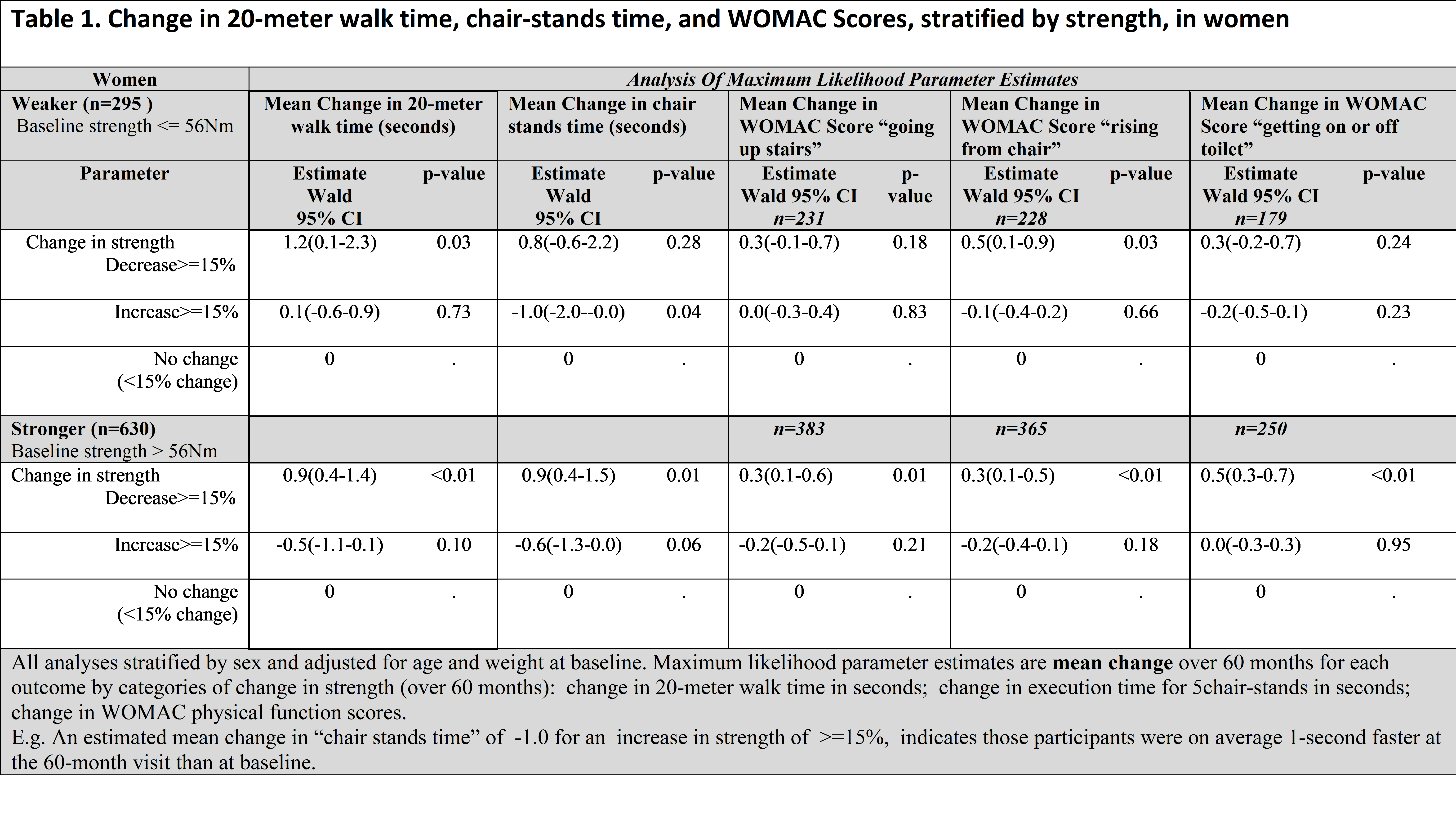
Compared with women whose strength did not change by at least 15%, among weaker women (<56 Nm) at baseline (see table), a 15% increase in strength was associated with 1.0 second faster chair stands time, but there was no effect on 20-meter walking time or WOMAC scores. In stronger women (>56 Nm), a 15% increase in strength was associated with faster chair stands time of 0.6 seconds (p=0.06). but little improvement in walk time or WOMAC scores. A 15% increase in strength had no effect in men.
Sensitivity analyses of 20% and 30% change in strength showed similar results.
Conclusion: An increase in measured strength was associated with improved chair stand performance in women, but not improved walk time or self-reported functional limitations. Increase in strength was not associated with change in physical function in men. Modest improvements in strength may not affect physical function.
To cite this abstract in AMA style:
Bacon K, Segal N, Øiestad B, Lewis CE, Nevitt MC, Brown C, Felson DT. Concurrent Change in Quadriceps Strength and Physical Function over 5 Years in the Multicenter Osteoarthritis Study [abstract]. Arthritis Rheumatol. 2017; 69 (suppl 10). https://acrabstracts.org/abstract/concurrent-change-in-quadriceps-strength-and-physical-function-over-5-years-in-the-multicenter-osteoarthritis-study/. Accessed .« Back to 2017 ACR/ARHP Annual Meeting
ACR Meeting Abstracts - https://acrabstracts.org/abstract/concurrent-change-in-quadriceps-strength-and-physical-function-over-5-years-in-the-multicenter-osteoarthritis-study/