
Session Information
Session Type: Poster Session A
Session Time: 10:30AM-12:30PM
Background/Purpose: Systemic Lupus Erythematosus (SLE) is a chronic inflammatory, autoimmune disease that can present with pervasive self-reported fatigue, which negatively impacts the lives of most individuals with SLE even when disease activity is controlled with standard of care medications. Non-pharmacological approaches to mitigate fatigue including improving diet and physical activity (PA), are tested in an ongoing trial, Lupus Intervention Fatigue Trial (LIFT), (NCT02653287). In this ancillary project, beyond focusing on diet quality, we also examine a measure of neighborhood resources in 150 participants in LIFT. The aim of this exploratory analysis is to assess the relationship between neighborhood resources and dietary intake at the initial study visit.
Methods: All LIFT participants met criteria: 1. ≥18 years of age, 2. BMI: 18-40 kg/m2, 3. Ambulate household distances (50ft), 4. Classification criteria for SLE per American College of Rheumatology (ACR) or per Systemic Lupus International Collaborating Clinics (SLICC). Dietary intake was obtained by a registered dietician using the 24-hour recall from Nutritional Data System for Research (NDSR) from which the Healthy Eating Index, (HEI) total & food groups scores were calculated. Total HEI scores are reported on a scale from 0-100, (higher=healthier diet); subscores 0-5 or 0-10. The Areas of Deprivation Index (ADI) uses nine-digit zip codes to calculate a national ranking score on a scale from 0-100 (higher=more deprivation), incorporating 17 variables such as education, income, employment, and housing quality. This analysis examines relationships between ADI and HEI in an exploratory descriptive strategy, thus no corrections were made.
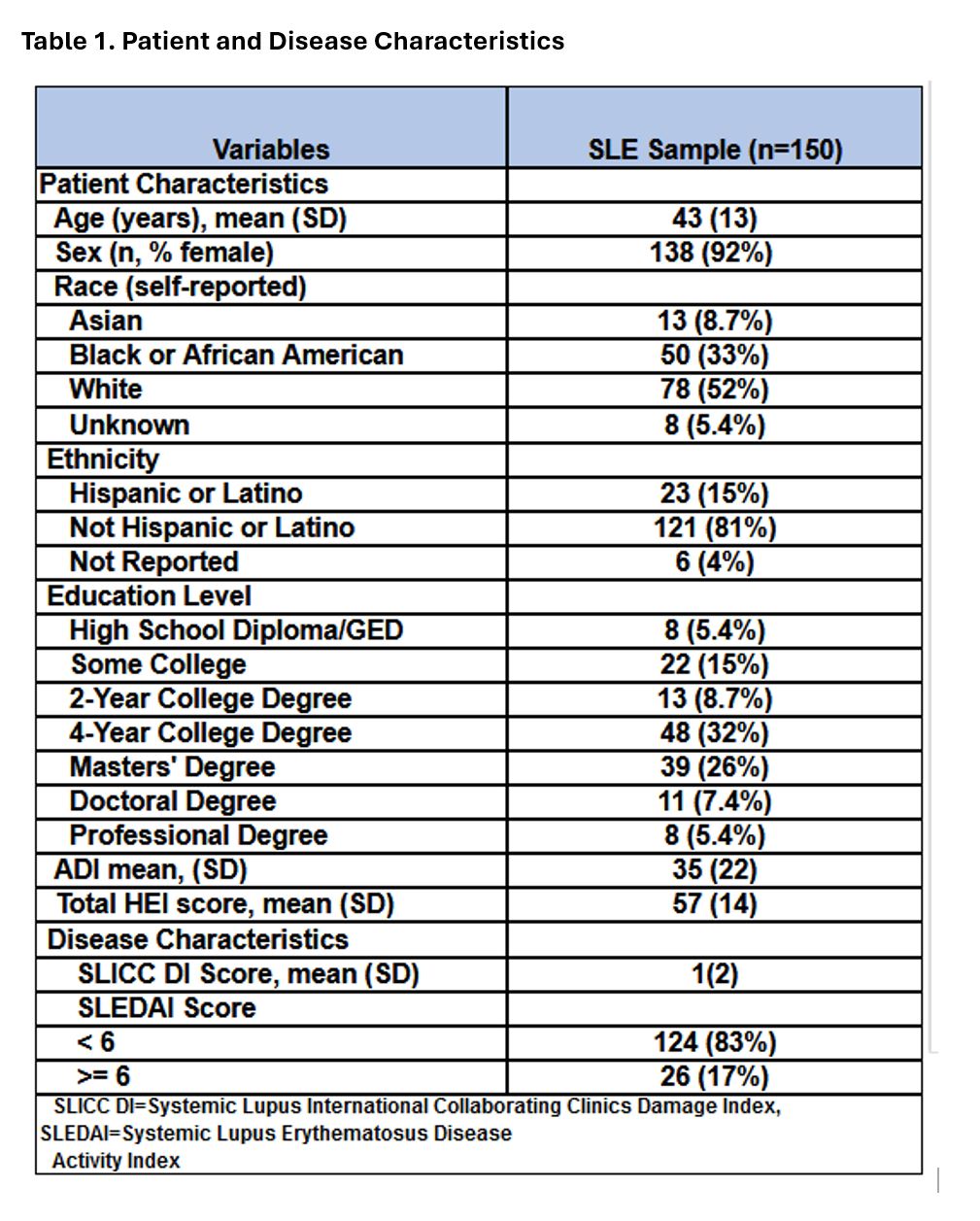
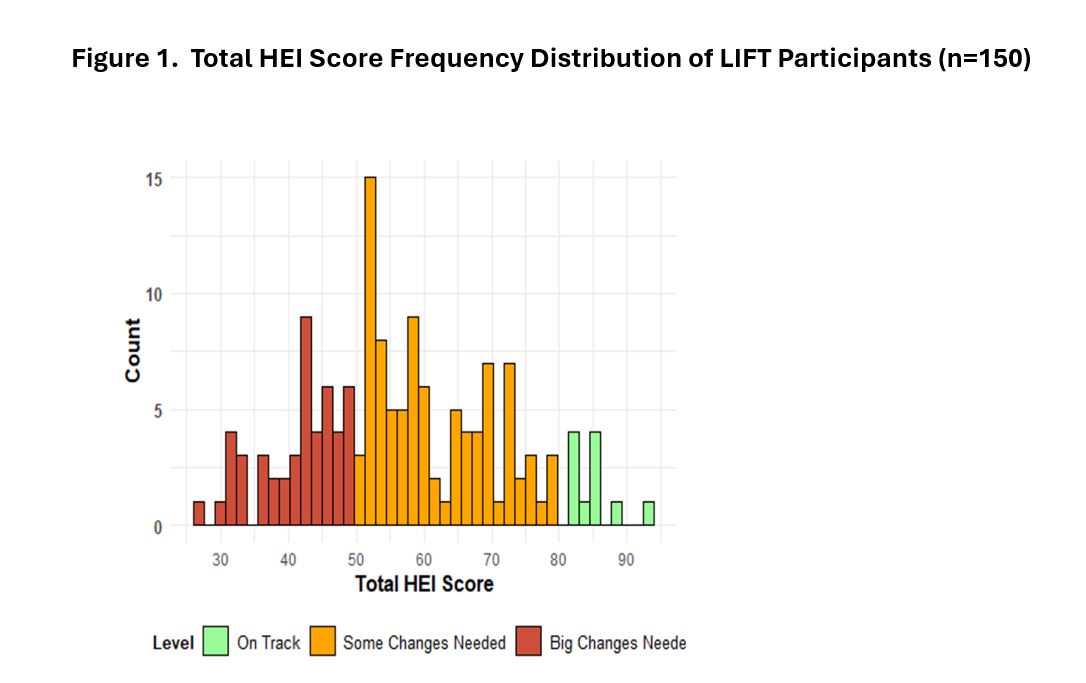
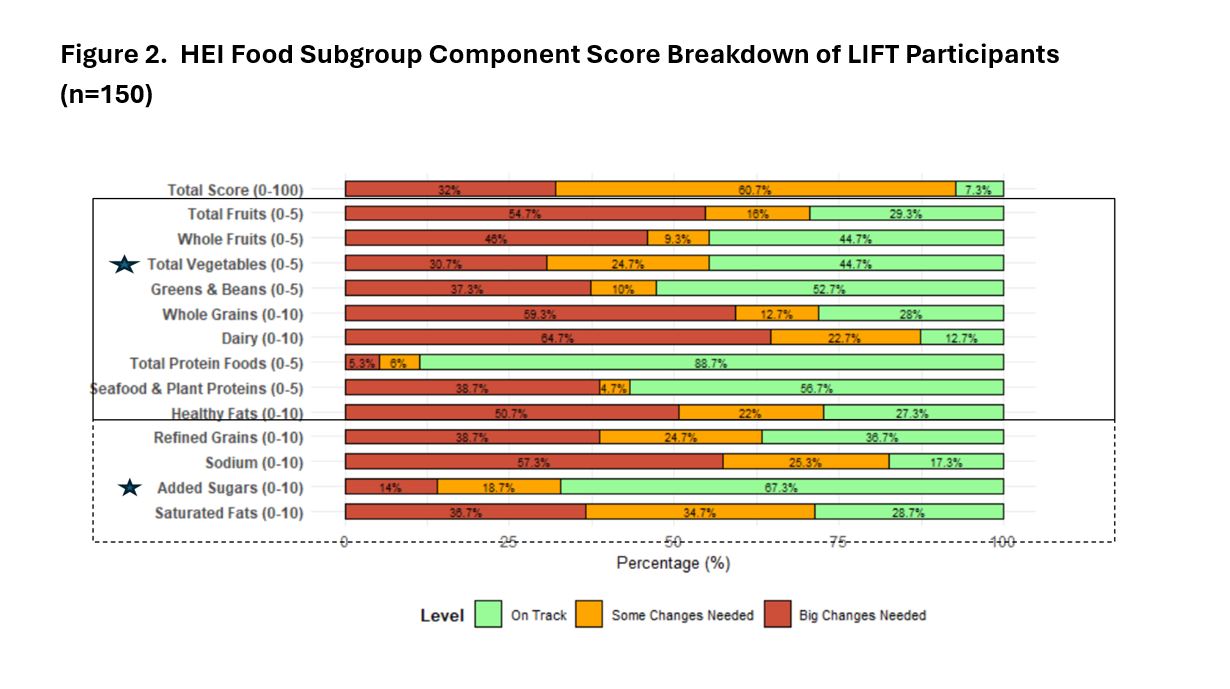
Results: Of the first 150 participants in LIFT, mean (SD) age is 43 (13), and 92% identify as female with 52% participants identifying as white, 33% as Black or African American, 9% as Asian, 1% Hawaiian/Pacific Islander, and 5% unknown. Mean (SD) total HEI was 57 (14). Total HEI scores showed 80% of participants needed either big changes (n=75, 50%) or some change (n=45, 30%), whereas those on track needed no changes (n=30, 20%). (Figure 1). When assessing the food subgroups, the largest deficits needing big changes were seen in dairy, whole grains, and daily sodium intake subgroups, 64.7%, 59.3%, and 82.7%, respectively (Figure 2.). The mean (SD) ADI rank was 35 (22) indicating that most participants lived in neighborhoods with resources. (Table 1). In this exploratory analysis there were modest statistically significant relationships between the participants living in the highest ADIs and HEI subcategories: low total vegetable intake (correlation coefficient, -.17, p-value .041) and high added sugars (correlation coefficient -.16, p-value .047).
Conclusion: This exploratory analysis documents dietary issues in HEI total score & noted significant changes needed in dairy, whole grain, and sodium food groups. Although few participants in LIFT lived in the most deprived areas, trends suggest that some food groups merit personalized dietary counseling & advocacy in the future. Future analyses are planned to explore changes in total HEI and food group scores between baseline & 6-month visit results as they relate to ADI.
To cite this abstract in AMA style:
Arnold J, Kinnett-Hopkins D, Van Horn L, Whiteford G, Muhammad L, Song J, Chmiel J, Chung A, Erickson D, Milaeger H, Bartels C, Ehrlich-Jones L, Ramsey-Goldman r. Characterizing Diet and Neighborhood Resources in Patients with Systemic Lupus Erythematosus [abstract]. Arthritis Rheumatol. 2024; 76 (suppl 9). https://acrabstracts.org/abstract/characterizing-diet-and-neighborhood-resources-in-patients-with-systemic-lupus-erythematosus/. Accessed .« Back to ACR Convergence 2024
ACR Meeting Abstracts - https://acrabstracts.org/abstract/characterizing-diet-and-neighborhood-resources-in-patients-with-systemic-lupus-erythematosus/