
Session Information
Session Type: ACR Poster Session A
Session Time: 9:00AM-11:00AM
Background/Purpose:
Despite significant interest in the collection of patient-reported outcomes (PROs) to make care more patient-centered, few studies have evaluated implementation efforts to collect PROs in real-world practice settings that serve diverse patient populations. In this study, we assessed the collection of PROs from rheumatoid arthritis (RA) patients in an academic rheumatology clinic, using a paper form and subsequently, an online form through the electronic health record (EHR) patient portal.
Methods:
We identified patients seen at the clinic from June 2012-July 2016 with at least 2 face-to-face encounters with a rheumatology provider and ICD codes for RA, ≥30 days apart. In February 2013, the clinic implemented a paper version of the Patient Reported Outcome Measurement Information System (PROMIS) physical function (PF) form that was administered to patients upon their check-in at the clinic; in January 2015, an online version of the form became available via the EHR patient portal to patients with active portal accounts. We queried our EHR’s SQL server to obtain demographic information, paper and online PROMIS scores, and their dates of completion. We compared the proportion of visits with documented PROMIS scores across age, race/ethnicity, and language, using chi-square and ANOVA tests and p-chart.
Results:
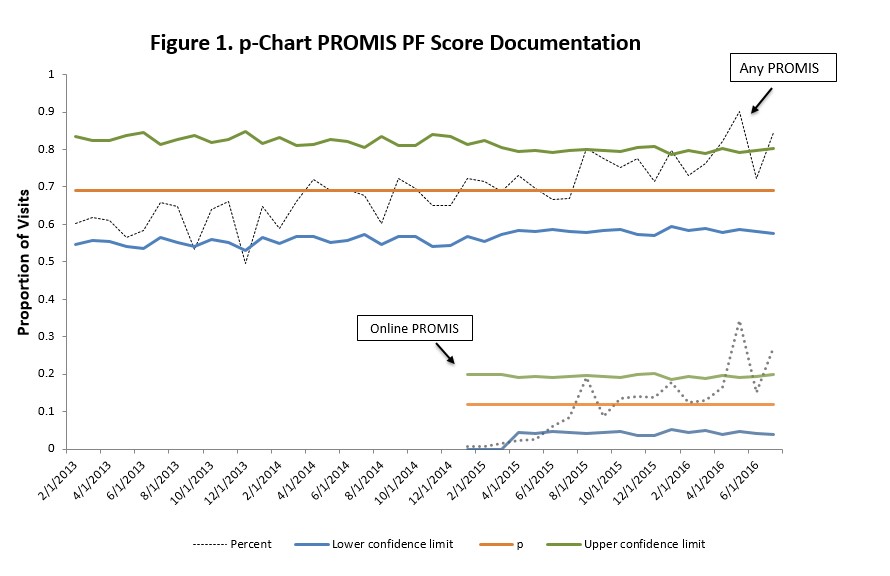
We included 1,078 patients with RA with 7,049 in-person encounters at the rheumatology clinic over 4 years, with an average of 168 visits/month. 80% of patients were female; mean age was 55 (SD 16). Overall PROMIS PF score documentation increased from 60% of visits in 2013 to 74% in 2016. Online score documentation increased from 10% in 2015 to 19% in 2016 (Figure 1). Most users of the online form used it only once, reverting to the paper form in subsequent visits. African Americans were less likely to have any PROMIS PF recorded (63% vs. 81% for other racial groups, p<0.001). Compared with Whites, both African American and Hispanics were less likely to have active online EHR portal accounts (50% and 57% respectively, vs. 84% of Whites; p<0.001) and, once activated, less likely to use the online survey (14% and 18% respectively, vs. 31% of Whites; p=0.02). There was no significant difference in the proportion of any PROMIS PF recorded between Non-English vs. English speakers. However, Non-English speakers were less likely to use the online survey, likely because the online survey existed only in English (7% vs. 23% of English speakers; p<0.001). No significant differences were found across age or gender.
Conclusion:
PROMIS PF form completion improved overall over 4 years, but lagged among racial/ethnic minorities and non-English speaking patients. Future studies should address issues of portal access, enrollment, satisfaction and persistence, and focus on developing PRO implementation strategies that accommodate the needs and preferences of diverse populations.
To cite this abstract in AMA style:
Li J, Yazdany J, Trupin L, Izadi Z, Gianfrancesco M, Goglin S, Schmajuk G. Challenges and Opportunities of Implementing a Patient-Reported Measure of Physical Function through an Online Electronic Health Record Patient Portal in Routine Rheumatology Practice [abstract]. Arthritis Rheumatol. 2017; 69 (suppl 10). https://acrabstracts.org/abstract/challenges-and-opportunities-of-implementing-a-patient-reported-measure-of-physical-function-through-an-online-electronic-health-record-patient-portal-in-routine-rheumatology-practice/. Accessed .« Back to 2017 ACR/ARHP Annual Meeting
ACR Meeting Abstracts - https://acrabstracts.org/abstract/challenges-and-opportunities-of-implementing-a-patient-reported-measure-of-physical-function-through-an-online-electronic-health-record-patient-portal-in-routine-rheumatology-practice/