
Session Information
Date: Sunday, November 17, 2024
Title: Orthopedics, Low Back Pain, & Rehabilitation – ACR/ARP Poster
Session Type: Poster Session B
Session Time: 10:30AM-12:30PM
Background/Purpose: Fibromyalgia (FM) is a common and disabling condition characterized by widespread muscular pain. Meditation has been shown to alleviate affective pain in people with chronic pain1 but may be less effective for those with FM2. Immersive virtual reality (IVR) has been shown to significantly affect pain3. In this pilot study we hypothesized that IVR enhanced meditation (IVRm) would have a greater effect on pain, affect and physiological outcomes than non-immersive meditation (NIm).
Methods: We recruited 9 females with FM. In this cross-over RCT design participants were randomly assigned the order in which they received two interventions over two visits with at least 48 hours between. In IVRm participants took part in a 10-minute guided meditation while participants were immersed in a virtual beautiful and peaceful environment of their choice via a headset (Oculus Rift S). In NIm participants did the same 10-minute guided meditation while watching the same environment on a computer screen. Before and after the meditation, pain intensity was obtained using a standard numerical rating scale (NRS) and affect using the Positive and Negative Affect Scale (PANAS). We measured physiological vital signs of heart rate (HR) and blood pressure from which we calculated the average mean arterial pressure (MAP). We also measured the meditation experience using the Meditation Experience Questionnaire (MEQ)
Data Analysis: Because this was a pilot study we calculated the effect size r, and interpreted results as follows: negligible < 0.10; small 0.10-0.29; moderate 0.30-0.49; large ≥ 0.50.
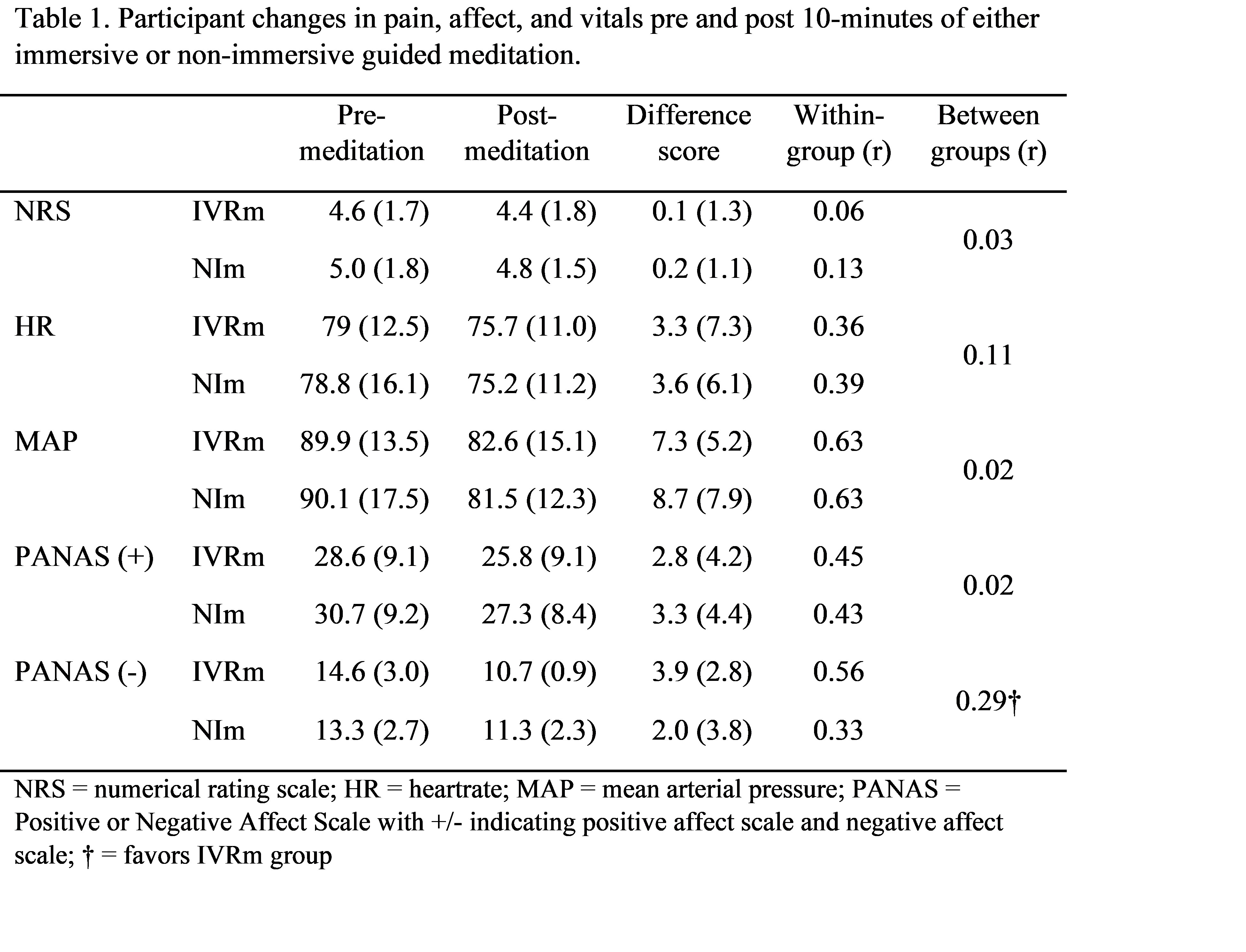
Results: Meditation had negligible effects on pain for both groups. It had moderate positive effects on HR and affect, and large positive effects on blood pressure. Generally, the difference between groups was negligible, however people in the IVRm group demonstrated moderately greater changes in negative affect than those in the NIm group (See Table). For the MEQ people reported moderately fewer distractions while using IVRm, including less mind wandering (r = 0.31), awareness of the body (r = 0.32) and bodily discomfort (r = 0.40)
Conclusion: Meditation in general does not appear to strongly affect pain in people with FM although immersive meditation does reduce awareness of bodily discomfort better than non-immersive meditation. Meditation has positive effects on other important outcomes such as affect and vital signs. IVR appears to provide the most support in reducing negative emotions such as distress, irritability, and fear and may provide a less distracting environment than its non-immersive counterpart.
References
1. Ball EF, et al. Does mindfulness meditation improve chronic pain? A systematic review. Curr Opin Obstet Gyn. 2017;29(6)
2. Hennard J. A protocol and pilot study for managing fibromyalgia with yoga and meditation. Int J Yoga Therap. 2011;(21):109-21.
3. Baker NA, et al. The state of science in the use of virtual reality in the treatment of acute and chronic pain: A systematic scoping review. Clin J Pain. 2022;38(6):424-441.
To cite this abstract in AMA style:
Baker N, Spielman A, Edwards R. Can Immersive Virtual Reality Improve the Effect of Meditation for People with Fibromyalgia? [abstract]. Arthritis Rheumatol. 2024; 76 (suppl 9). https://acrabstracts.org/abstract/can-immersive-virtual-reality-improve-the-effect-of-meditation-for-people-with-fibromyalgia/. Accessed .« Back to ACR Convergence 2024
ACR Meeting Abstracts - https://acrabstracts.org/abstract/can-immersive-virtual-reality-improve-the-effect-of-meditation-for-people-with-fibromyalgia/