
Session Information
Date: Sunday, November 13, 2022
Title: Spondyloarthritis Including PsA – Diagnosis, Manifestations, and Outcomes Poster III
Session Type: Poster Session C
Session Time: 1:00PM-3:00PM
Background/Purpose: Biomechanical stress is a possible trigger of inflammation in psoriatic arthritis (PsA). The influence of physically demanding occupations on this potential association has not yet been investigated.
The aim of this study was to compare PsA patients who perform manual work (blue-collar (BCol) workers) with patients having more sedentary jobs (white-collar (WCol) workers) in terms of work disability, disease activity, and biologic response / retention rate.
Methods: PsA patients from the Swiss Clinical Quality Management cohort were included if they had available information on occupation and work disability, started a new biological treatment, and if baseline and follow-up (12 months ± 90 days) data on disease activity were available. Patients working in jobs associated with transportation, manufacturing or agriculture were classified as BCol, whereas patients working in less physically demanding jobs (office-worker, homemaker, teacher, etc.) were classified as WCol. Baseline characteristics were compared using Fisher’s exact for categorical and Kruskal-Wilcoxon test for continuous variables.
For longitudinal analysis, patients with more than 4 weeks work disability were excluded. Generalized estimating equation (GEE) models were used to examine the proportion of patients who achieved DAS28-CRP remission at 1 year. The retention rate was assessed using Kaplan-Meier survival curves and multiple-adjusted Cox proportional hazard regression. The following potential confounders were included in the models: disease duration, baseline disease activity, sex, BMI, type and line of biologic treatment and csDMARD co-therapy.
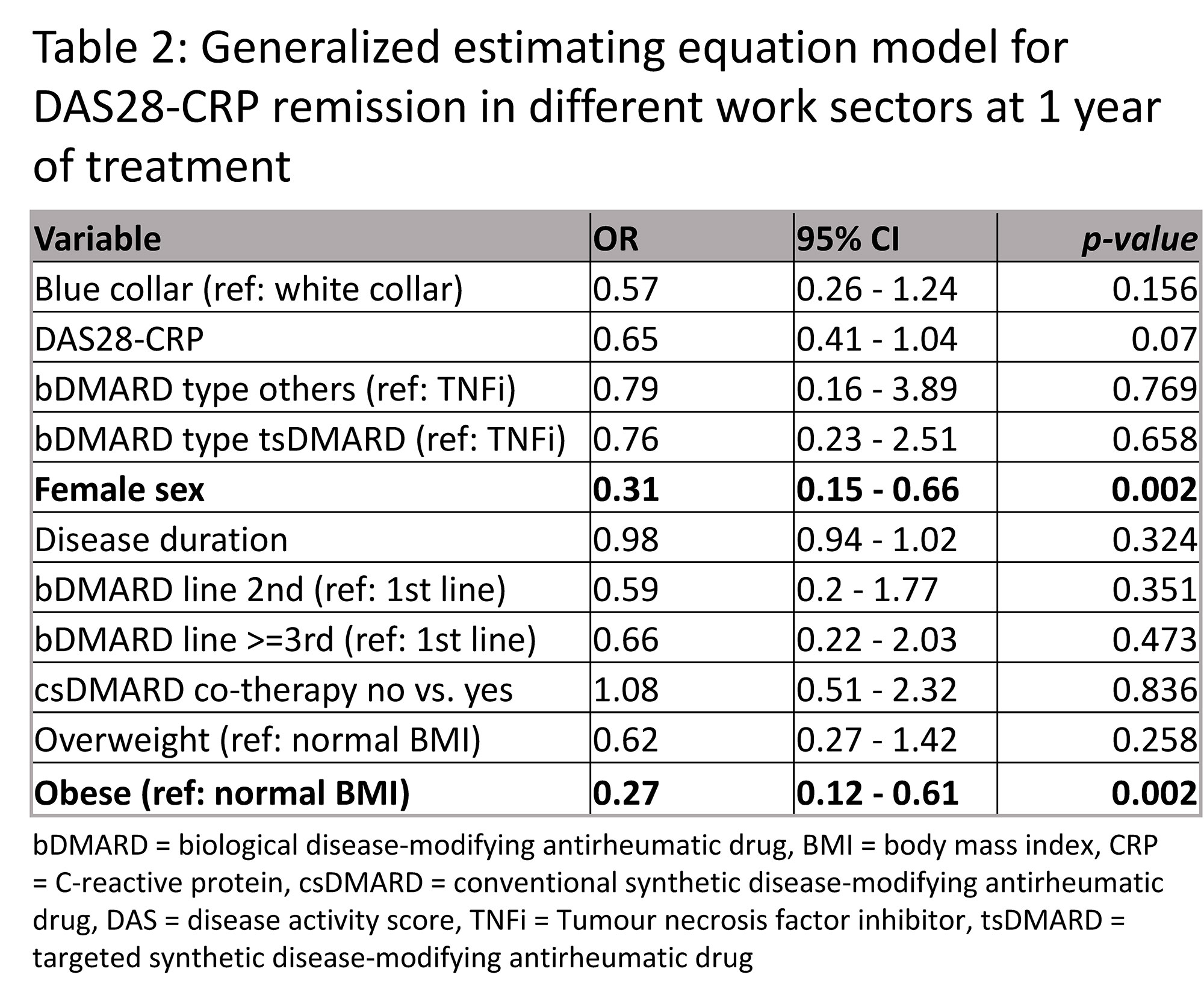
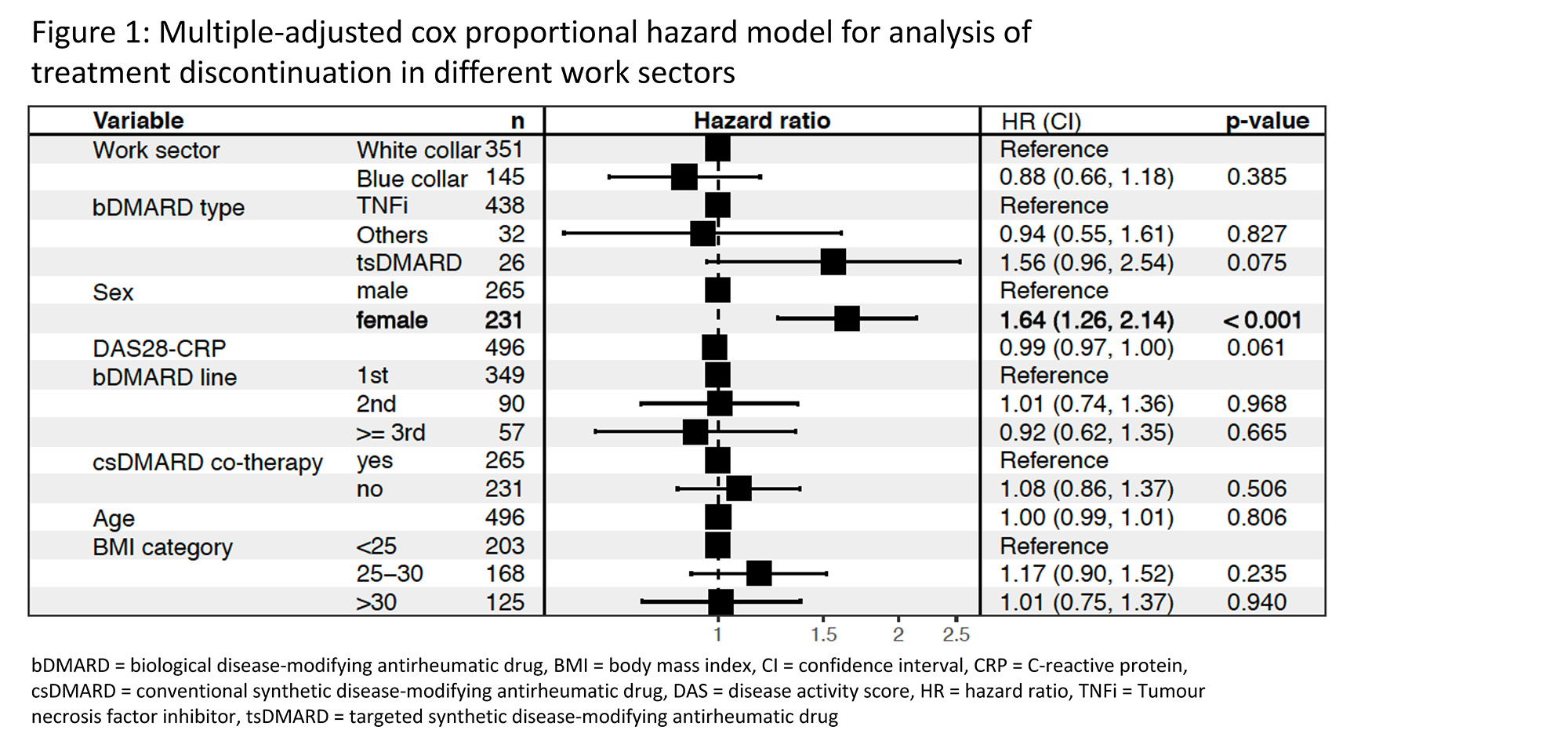
Results: 564 patients were included (29% BCol and 71% WCol worker). Baseline characteristics are shown in Table 1. At baseline, BCol workers were more likely to be male and had a higher rate of any work disability. Disease activity as well as patient reported outcomes were comparable. Occupation showed no effect on the proportion of patients achieving DAS28-CRP remission at one year in the GEE analysis (Table 2). Female sex and BMI > 30 kg/m2 were significantly associated with a lower remission rate in adjusted GEE analysis. Kaplan-Meier plots showed significantly longer biologic retention in BCol (mean retention duration 3.15 vs. 2.14 years in BCol and WCol, respectively). The adjusted retention analysis could not confirm this result, while the association remained for the female sex (Figure 1).
Conclusion: Compared with WCol workers, BCol workers with PsA had similar disease burden and response rates to biologics among those who continued to work. A very high percentage of BCol patients reported any work disability, which influences the true impact of work on PsA. However, work disability must be actively addressed in daily clinical practice, as employment is one of the most fundamental social determinants of health.

To cite this abstract in AMA style:
Colla N, Maul J, Moeller B, Nissen M, Yawalkar N, Papagiannoulis E, Distler O, Ciurea A, Micheroli R. Blue-collar Workers with Psoriatic Arthritis: Disease Activity, Work Disability and Response to Biologics [abstract]. Arthritis Rheumatol. 2022; 74 (suppl 9). https://acrabstracts.org/abstract/blue-collar-workers-with-psoriatic-arthritis-disease-activity-work-disability-and-response-to-biologics/. Accessed .« Back to ACR Convergence 2022
ACR Meeting Abstracts - https://acrabstracts.org/abstract/blue-collar-workers-with-psoriatic-arthritis-disease-activity-work-disability-and-response-to-biologics/