
Background/Purpose: Minorities with systemic lupus erythematosus (SLE) are at high risk of poor disease outcomes and may face challenges in effectively self-managing multiple health problems. The Chronic Disease Self-Management Program (CDSMP) is an evidence-based intervention that improves the health of people with chronic illnesses. We aimed to pilot test the benefits of the Chronic Disease Self-Management Program (CDSMP) for low-income African American women with systemic lupus erythematosus (SLE).
Methods: Four CDSMP 6-week workshops were delivered to 49 low-income African American women with SLE who received medical care for ≥6 months at a public lupus clinic in Atlanta, Georgia. We compared post- minus pre- CDSMP changes (from baseline to 4 months after the start of the intervention) in three general outcomes (health status, self-efficacy and self-management behaviors) using self-reported measures. Additionally, a fourth general outcome (outpatient and inpatient health care utilization) was assessed using electronic administrative records in the 6-month periods before and after the intervention. Paired t-tests or Wilcoxon signed-rank tests were used to compare the post-pre CDSMP change for each outcome measure.
Results: Significant improvements were observed in one of the three measures of health status (physical component summary of the SF-36), in the measure of self-efficacy, and three of the five measures of self-management behaviors outcome (cognitive symptom management, communication with physicians, and medication taking measure).
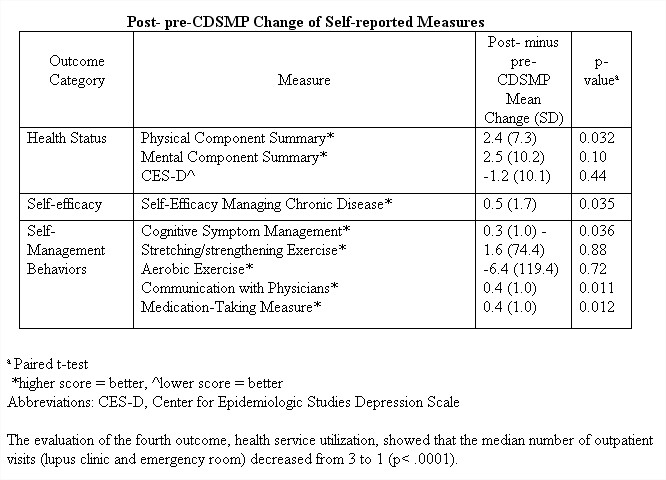
Conclusion: The CDSMP is a promising intervention for low-income African Americans with SLE. It is an inexpensive program with growing availability around the world that should be further evaluated as a resource to improve patient-centered outcomes and decrease health service utilization among SLE patients.
Disclosure:
C. Drenkard,
None;
C. M. Dunlop-Thomas,
None;
K. Easley,
None;
G. Bao,
None;
S. S. Lim,
None;
T. J. Brady,
None.
« Back to 2012 ACR/ARHP Annual Meeting
ACR Meeting Abstracts - https://acrabstracts.org/abstract/benefits-of-the-chronic-disease-self-management-program-in-low-income-african-american-women-with-systemic-lupus-erythematosus-results-of-a-pilot-test/