
Session Information
Session Type: Poster Session (Sunday)
Session Time: 9:00AM-11:00AM
Background/Purpose: To analyze longitudinal data from the Consortium for the Longitudinal Evaluation of African Americans with Early Rheumatoid Arthritis Registry (CLEAR) for the association between biomarkers including the HLA-DRB1 shared epitope (SE), anti-cyclic citrullinated peptide (CCP), and rheumatoid factors IgA and IgM (RFIgA and RFIgM) with changes in radiographic progression from study enrollment (< 2yrs disease duration) to 60-month disease duration. Cross-sectional studies have shown an association between SE, CCP, and RF and disease severity in various cohorts of patients with RA. This study seeks to determine the independent effects of these biomarkers as predictors of radiographic progression among African American patients while controlling for the effects of other comorbidities, socioeconomic factors, age, sex, and RA medication.
Methods: We analyzed data on 194 African American patients with information on biomarkers including SE, CRP, CCP, RFIgA and RFIgM as well as radiographic outcomes including erosion scores and joint space narrowing (JSN) at baseline and after 60 months of disease duration. Radiographic disease progression was determined by increase in disease scores from baseline to 60-month disease duration follow-up, and individuals with severe progression were identified as those in the top worst quintile of disease score increase (Erosion≥1; JSN≥7). Demographics, comorbidities, medications, and measures of SES were also collected at the baseline assessment. Multiple imputation was used to impute missing values. Multivariable multi-level linear and logistic regression models with study site adjusted for as a random effect were used to estimate linear coefficients (β), odds ratios (aOR) and 95% confidence intervals (CI) for disease prevalence and progression in relation to biomarkers at baseline. All models were adjusted for gender, age, BMI, number of comorbidities, cigarette smoking, disease duration at study entry, methotrexate/leflunomide (MTX/LEF) use, education level (< high school [HS] vs ≥ HS), home ownership, professional occupation, as well as simultaneous adjustment for all biomarker predictors.
Results: At baseline the mean age was 51 years, 86% were female, average RA disease duration was 14.05 months, and 64.4% patients were on MTX/LEF (Table 1). Radiographic measures at baseline and 60 months are shown in Table 2. Beta estimates for the cross-sectional association between baseline biomarkers and baseline radiographic measures are shown in Table 3. Also in Table 3 are odds ratios for the association between baseline biomarkers of interest and severe radiographic progression. Results did not indicate an association of CCP, RF, or SE with severe radiographic progression in this cohort.
Conclusion: Our findings show modest associations between biomarkers and radiographic severity in cross-sectional analyses. However, when analyzing biomarker predictors of radiographic progression, CCP, RFIgM, RFIgA, and SE are not significantly associated with disease progression in African Americans over a 60-month disease duration with early RA. Future larger longitudinal studies are needed to confirm our results.
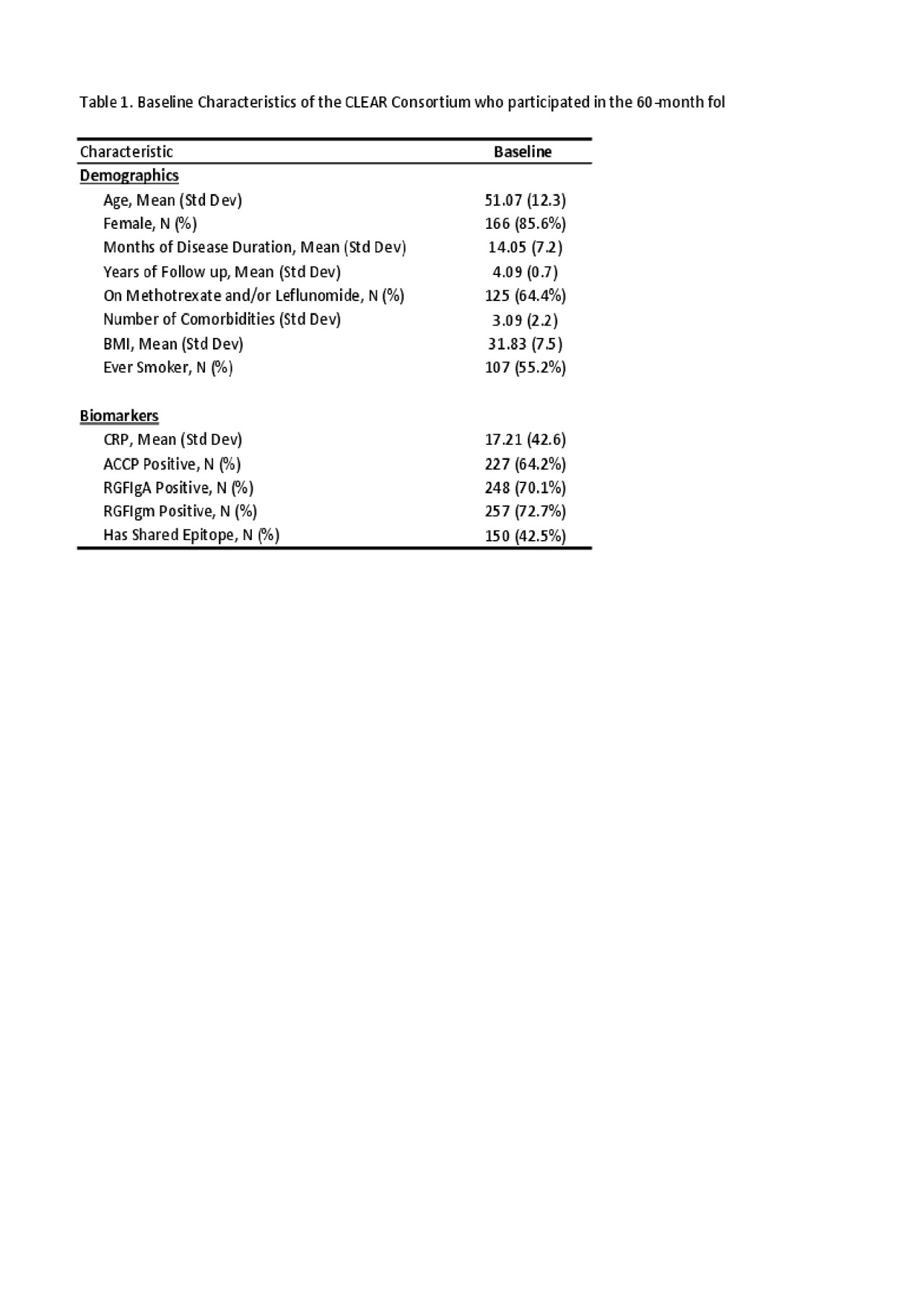
Emma Table 1

Emma Table 2

Emma Table 3
To cite this abstract in AMA style:
Astrike-Davis E, Cleveland R, Jonas B, Callahan L. Associations of Clinical Biomarkers with Radiographic Progression of Rheumatoid Arthritis (RA) in African Americans with Early Disease [abstract]. Arthritis Rheumatol. 2019; 71 (suppl 10). https://acrabstracts.org/abstract/associations-of-clinical-biomarkers-with-radiographic-progression-of-rheumatoid-arthritis-ra-in-african-americans-with-early-disease/. Accessed .« Back to 2019 ACR/ARP Annual Meeting
ACR Meeting Abstracts - https://acrabstracts.org/abstract/associations-of-clinical-biomarkers-with-radiographic-progression-of-rheumatoid-arthritis-ra-in-african-americans-with-early-disease/