
Session Information
Date: Tuesday, November 12, 2019
Title: Epidemiology & Public Health Poster III: OA, Gout, & Other Diseases
Session Type: Poster Session (Tuesday)
Session Time: 9:00AM-11:00AM
Background/Purpose: Traumatic knee joint injuries, such as injuries to the anterior cruciate ligament and menisci, are associated with early onset osteoarthritis (OA), but our understanding of the epidemiology of this association is limited. The effect of knee injury on patient-reported outcomes (PROs) of knee function and symptoms is understudied in military populations, despite their high risk of knee injury and knee OA. This study of a cohort of military officers examined the association of traumatic knee injury with knee function, symptoms, and radiographic OA (rOA).
Methods: Participants were recruited from an existing cohort of 6452 military officers enrolled between 2004 and 2009, at the time of their matriculation as cadets at the United States Air Force Academy, Military Academy, or Naval Academy. Officers with a history of ligament and meniscal injuries prior to, during, or after their 4-year academy career (knee injury subcohort; n=176) were compared to site-matched officers with no history of knee injury (non-injured subcohort; n=261). All participants completed a questionnaire between August 2015 and December 2017 that included PROs assessed with Knee Injury and OA Outcome Score (KOOS) scales (range 0-100=extreme to no deficits) and a single-item measure of knee symptoms (pain, aching, or stiffness in the past 30 days, 4-point Likert scale). Radiographic evidence of knee OA was evaluated using standardized fixed-flexion bilateral knee radiographs (available in n=117 injured, n=143 non-injured). These were read by a single highly-experienced musculoskeletal radiologist for Kellgren-Lawrence grade (KLG), presence of osteophytes (OST), and joint space narrowing (JSN). Data were analyzed using descriptive statistics, contingency table methods (radiographic data), and ANOVA (KOOS).
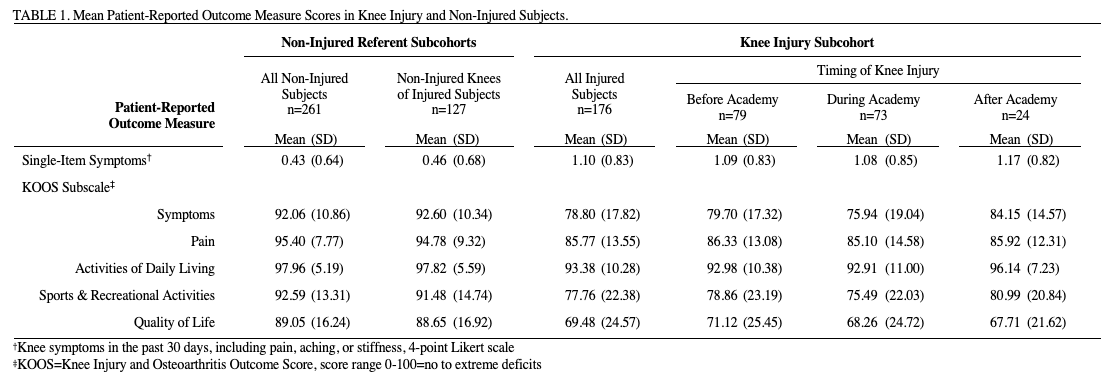
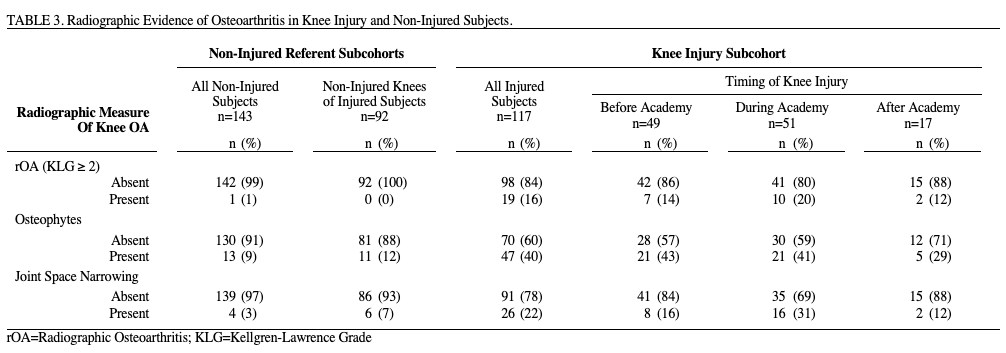
Results: Mean age was 28 years for both injured and non-injured participants; 39% were women (injured: 37%; non-injured: 40%). Mean weight was 78 kg and body mass index was 25 kg/m2. Mean time from first knee injury to follow-up assessment was 8.7 years. Among officers with a history of knee injury, 16% had knee rOA (KLG ≥ 2), 40% had OST, and 22% had JSN, compared to only < 1%, 9%, and 3% of non-injured participants (p< 0.001). Compared with non-injured participants, injured participants also had clinically relevant deficits on KOOS symptoms, KOOS pain, KOOS sports/recreation, and KOOS quality of life scales (mean score differences of -13.3, -9.6, -14.8, -19.6 respectively; all p< 0.001). Deficits on KOOS activities of daily living scale were also statistically significant (mean difference -4.6; p< 0.001) but were smaller and less clinically-relevant. Average scores on the single-item symptom scale were worse in the injured (1.1 vs. 0.4; p< 0.001).
Conclusion: At the midpoint of an anticipated 20-year military career, officers with a history of ACL/meniscal injury have deficits in knee-related symptoms, QOL, and knee function. Approximately 1 in 6 officers with prior knee injury progressed to rOA before mean age 30. This progression rate is highly concerning given the physically-demanding nature of their profession and their young age.

To cite this abstract in AMA style:
Golightly Y, Shiue K, Nocera M, Guermazi A, Cantrell J, Renner J, Padua D, Cameron K, Svoboda S, Jordan J, Loeser R, Kraus V, Lohmander S, Beutler A, Marshall S. Association of Traumatic Knee Injury with Knee Function, Symptoms, and Radiographic Osteoarthritis in Military Officers [abstract]. Arthritis Rheumatol. 2019; 71 (suppl 10). https://acrabstracts.org/abstract/association-of-traumatic-knee-injury-with-knee-function-symptoms-and-radiographic-osteoarthritis-in-military-officers/. Accessed .« Back to 2019 ACR/ARP Annual Meeting
ACR Meeting Abstracts - https://acrabstracts.org/abstract/association-of-traumatic-knee-injury-with-knee-function-symptoms-and-radiographic-osteoarthritis-in-military-officers/