
Session Information
Session Type: Abstract Submissions (ACR)
Background/Purpose: Prior studies suggest that individuals with lower socioeconomic status (SES) both under-utilize joint replacement procedures and present with increased pain and poorer function. Area-level SES is often used as a proxy when individual-level SES is unavailable and may also capture neighborhood-level effects. We examined the relationship between area-level SES and pain and function at presentation for total knee arthroplasty (TKA).
Methods: We examined a cohort of individuals undergoing TKA from 2010-2013 at an academic medical center. We obtained demographic information and measures of pain and functional status (WOMAC) and depression (MHI-5) from baseline surveys. We used the Geographic Information System (GIS) to geocode individual home addresses and linked these to U.S. Census data at the block group level. For P.O. Boxes, we used post office addresses. We constructed a previously validated composite area-level SES index that included occupation, income, wealth, education, and housing-related Census variables. We assessed bivariate associations between age (<65 or ≥65), sex, race (White or non-White), area SES (divided into quartiles, with highest two combined), BMI (<25, 25-30, 30-35, >35) and depression (MHI5>68 or less) and two outcomes –pain and functional status (WOMAC ≤30, 30-55, >55) –using Chi-squared tests. Linear regression models allowed us to identify independent correlates of high pain and low function (WOMAC >55). Covariates included age, sex, BMI, depression and area SES.
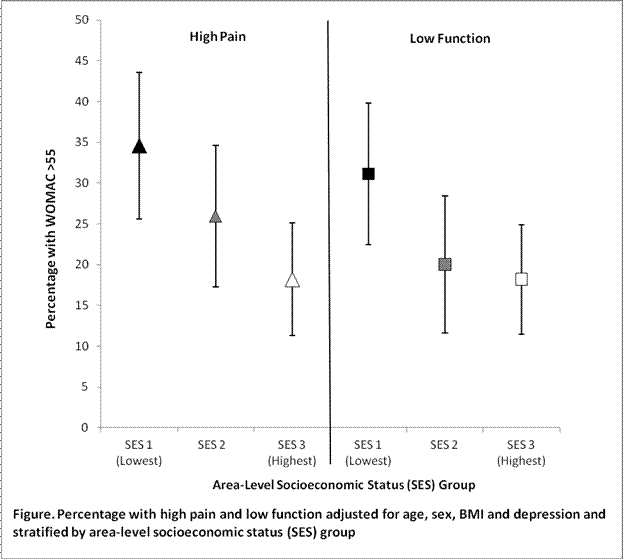
Results: Among 320 individuals, 181 (58%) were female. The mean age was 66 years (SD 10), and 282 (89%) were White. Addresses were geocoded for 297 street addresses and 20 P.O. Boxes. Our mean SES index score was 59 (SD 6, median 59, range 42-78); the U.S. population median SES is 51. In bivariate analyses, younger age, higher BMI, female sex, and higher depression scores were associated with higher pain and lower function (p<0.05). Higher BMI was also associated with lower area SES (p<0.01). Adjusted analyses showed striking associations between SES and baseline pain and functional status: 35% (95% CI 26-44) with the lowest area SES and 18% (95% CI 11-25) with the highest presented with high pain, while 31% (95% CI 22-40) with the lowest area SES and 18% (95% CI 11-25) with the highest presented with low function (Figure).
Conclusion: In this cohort of individuals with, on average, higher area-level SES than the general U.S. population, those from the highest SES areas presented for TKA with lower perceived pain and higher functional status than those from lower SES areas. Further research is needed to confirm these trends and understand why TKA appears to be utilized in higher socioeconomic status patients with relatively mild pain and high function.
Disclosure:
C. H. Feldman,
None;
Y. Dong,
None;
J. N. Katz,
OARSI,
6,
JBJS,
9;
L. Donnell-Fink,
None;
E. Losina,
JBJS,
9.
« Back to 2013 ACR/ARHP Annual Meeting
ACR Meeting Abstracts - https://acrabstracts.org/abstract/association-of-area-level-socioeconomic-status-with-pain-and-function-at-presentation-for-total-knee-arthroplasty/