
Session Information
Session Type: Poster Session (Sunday)
Session Time: 9:00AM-11:00AM
Background/Purpose: Cardiovascular disease is a significant cause of mortality in patients with SLE. High levels of fatigue are also reported in patients with SLE and negatively impact quality of life. Physical activity is associated with improvements in both cardiovascular disease and fatigue, but trials of exercise interventions involve activities that may not be feasible or sustainable outside the formal setting of a study. Our objective is to understand the perceptions, attitudes, barriers and preferences to exercise in patients with SLE.
Methods: Patients ≥18 years old with SLE seen in the Lupus Clinic at McMaster University Medical Centre were invited to complete a short questionnaire during their routine clinic appointments. This questionnaire, adapted from an exercise questionnaire validated in an osteoporosis population, contained four sections: 1) patient characteristics, 2) perceptions and attitudes towards exercise, 3) perceived barriers to exercise, and 4) preferences to performing exercise.
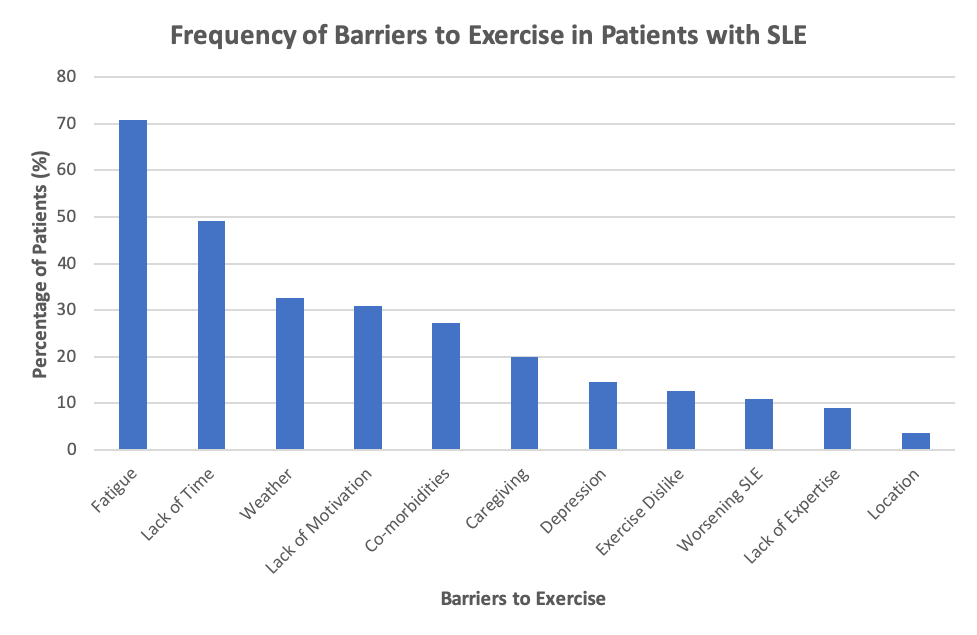
Results: Respondents included 49 females and 6 males (mean (SD) age 39 (12.9) years), of whom 32 worked full-time, 9 worked part-time and 14 were not employed. Almost half (n=25, 45%) reported caring for children or family members. Most patients (89%, n=49) reported having barriers to exercise. Those most frequently reported (Figure 1) included fatigue (n=39, 71%), lack of time (n=27, 49%), weather conditions (n=18, 33%), and lack of motivation (n=17, 31%). About 87% (n=48) of respondents were willing to change their daily routine to include more exercise. Walking was the most preferred exercise (n=43, 78%), followed by strengthening exercises (n=41, 75%) and flexibility exercises (n=28, 51%). After performing vigorous exercise, 49% (n=27) of patients thought they would feel better compared to when they do not exercise while 18% (n=10) thought they would feel the same and 33% (n=18) thought they would feel worse. After performing moderate exercise, 64% (n=35) of patients reported feeling better, 27% (n=15) reported feeling the same, and 9% (n=5) reported feeling worse.
Conclusion: The majority of our patients were female of child-rearing years. Many were employed full-time and were primary caregivers, which may explain fatigue and time being the most commonly reported barriers to exercise. Walking was overwhelmingly the most preferred type of exercise. Most patients found moderate exercise to be beneficial, while a sizeable minority thought vigorous activity would be detrimental. Most patients expressed willingness to incorporate more physical activity into their daily routine. There is a need for a feasible exercise regimen that considers barriers and personal preferences in patients with SLE.
To cite this abstract in AMA style:
Jeyasingham G, Alam A, Steiner N, Legault K, Matsos M, Beattie K. Assessing Perceptions, Barriers, and Preferences to Exercise in Patients with Systemic Lupus Erythematosus [abstract]. Arthritis Rheumatol. 2019; 71 (suppl 10). https://acrabstracts.org/abstract/assessing-perceptions-barriers-and-preferences-to-exercise-in-patients-with-systemic-lupus-erythematosus/. Accessed .« Back to 2019 ACR/ARP Annual Meeting
ACR Meeting Abstracts - https://acrabstracts.org/abstract/assessing-perceptions-barriers-and-preferences-to-exercise-in-patients-with-systemic-lupus-erythematosus/