ACR Meeting Abstracts

ACR Meeting Abstracts

  • Meeting Abstracts
    • All Meetings
    • PRSYM 2026
    • ACR Convergence 2025
    • Download Abstract Supplements
  • Keyword Index
  • Search
  • My Favorites
    • View and print all favorites
    • Clear all favorites

Abstract Number: 1791

Antiphospholipid Antibody Profile Stability over Time: Prospective Results from AntiPhospholipid Syndrome Alliance for Clinical Trials and InternatiOnal Networking (APS ACTION) Clinical Database and Repository (“Registry”)

Elena Gkrouzman1, Ecem Sevim 2, Jackie Finik 3, Danieli Andrade 4, Vittorio Pengo 5, Savino Sciascia 6, Maria Tektonidou 7, Amaia Ugarte 8, Cecilia Chighizola 9, H Michael Belmont 10, Laura Pérez Sánchez 11, Lanlan Ji 12, Paul Fortin 13, Maria Efthymiou 14, Guilherme De Jesus 15, David Branch 16, Cecilia Nalli 17, Michelle Petri 18, Ricard Cervera 19, Esther Rodriguez 20, Jason Knight 21, Tatsuya Atsumi 22, Rohan Willis 23, Maria Laura Bertolaccini 24, Hannah Cohen 14, Jacob Rand 25, Doruk Erkan 1 and On Behalf Of APS ACTION 26, 1Hospital for Special Surgery, New York City, 2Hospital for Special Surgery, New York, NY, 3Hospital for Special Surgery, New York, NY, New York, NY, 4Hospital das Clinicas, Faculdade de Medicina, Universidade de São Paulo, Sao Paulo, Brazil, 5Azienda Ospedaliera of Padova, University of Padova, Padova, Italy, 6Center of Research of Immunopathology and Rare Diseases- Coordinating Center of Piemonte and Valle d’Aosta Network for Rare Diseases, Department of Clinical and Biological Sciences, University of Turin, Torino, Italy, 7First Department of Internal Medicine, National and Kapodistrian University of Athens, Athens, Greece, Athens, Greece, 8Hospital Universitario Cruces, University of the Basque Country Autoimmune Diseases Research Unit, Department of Internal M edicine, BioCruces Health, Biscay, Spain, 9Rheumatology, Istituto Auxologico Italiano, University of Milan, Milan, Italy, 10NYU Langone Health, New York, NY, 11IMIBIC/Reina Sofia Hospital/University of Cordoba, Cordoba, Spain, 12Peking University First Hospital, Beijing, China (People's Republic), 13Division de Rhumatologie, Département de Médecine, CHU de Québec – Université Laval, Axe maladies infectieuses et inflammatoires, Centre de recherche du CHU de Québec – Université Laval, Canada, Quebec, QC, Canada, 14University College London, London, United Kingdom, 15Universidade do Estado do Rio de Janeiro, Rio de Janeiro, Brazil, 16University of Utah Health Sciences Center, Salt Lake City, UT, 17Rheumatology and Clinical Immunology, Spedali Civili, Brescia, Italy, Brescia, Italy, 18Johns Hopkins University School of Medicine, Baltimore, MD, 19Hospital Clinic of Barcelona, Barcelona, Spain, 20Hospital Universitario 12 de Octubre, Madrid, Spain, 21Division of Rheumatology, Department of Internal Medicine, Michigan Medicine, Ann Arbor, MI, 22Hokkaido University, Sapporo, Japan, 23Antiphospholipid Standardization Laboratory, University of Texas Medical Branch, Galveston, TX, 24King's College London, London, United Kingdom, 25Weill Cornell Medicine, New York, 26APS ACTION, New York, NY

Meeting: ACR/ARP Annual Meeting 2019

Keywords: Antiphospholipid antibodies, antiphospholipid syndrome and SLE

  • Tweet
  • Email a link to a friend (Opens in new window) Email
  • Print (Opens in new window) Print
Session Information

Date: Monday, November 11, 2019

Title: 4M087: Antiphospholipid Syndrome (1788–1793)

Session Type: ACR Abstract Session

Session Time: 2:30PM-4:00PM

Background/Purpose: APS ACTION “Registry” was created to study long-term outcomes in persistently antiphospholipid antibody (aPL)-positive patients with and without other systemic autoimmune diseases. Our primary objective was to determine whether clinically significant aPL profiles at baseline remain stable over time.

Methods: A web-based data capture system is used to store patient demographics and aPL-related medical history. Inclusion criteria are positive aPL, based on the Updated Sapporo APS Classification Criteria, tested at least twice within one year prior to enrollment. Patients are followed every 12±3 months with clinical data and blood collection. For this prospective analysis of available follow-up (f/u) aPL tests, clinically significant aPL profile was defined as positive lupus anticoagulant (LA) test and/or aCL/aβ2GPI IgG/M >40U. Stable aPL profile was defined as a clinically significant aPL profile in at least two-thirds of f/u measurements. Univariate and multivariable generalized linear mixed models with logit link were used to assess the effect of time and other variables of interest on odds of clinically significant aPL profile. Wilcoxon rank-sum and Fisher’s exact tests were employed to compare clinical characteristics of patients with stable versus unstable aPL profiles.

Results: As of January 2019, 796 patients were enrolled from 26 centers worldwide, 482 had f/u visits with aPL results, and 472 patients had a clinically significant aPL profile at baseline. Based on aPL profiles at f/u visits (median follow up: 5.1 years [interquartile range [IR]: 4.3, 5.8]; median number of f/u visits with aPL profiles: 2 [interquartile range: 1, 3]), 366/472 (78%) patients had stable aPL profiles over time (54 [11%] unstable; 52 [11%] inconclusive). Time did not affect odds of maintaining a clinically significant aPL profile at f/u (p=0.906). In multivariable analysis, time, age, concomitant systemic autoimmune disease (mainly lupus), smoking history, and hydroxychloroquine use did not affect odds of maintaining a clinically significant aPL profile at f/u. Based on crude unadjusted comparisons, patients with stable aPL profiles, compared to those with unstable profiles, were more likely to have baseline positive LA test, aCL IgM > 40U (positive trend for IgG), aβ2GPI IgG > 40U (positive trend for IgM), two or more positive aPL tests, and history of arterial events and aspirin use (Table).

Conclusion: In approximately 80% of patients with a baseline clinically significant aPL profile (LA test and/or aCL/aβ2GPI IgG/M >40U), aPL profiles remain consistently significant (stable) during five years of follow-up. Further multivariate analysis will investigate predictors of aPL profile stability over time, and guide future validation studies of stored samples through APS ACTION core laboratories.
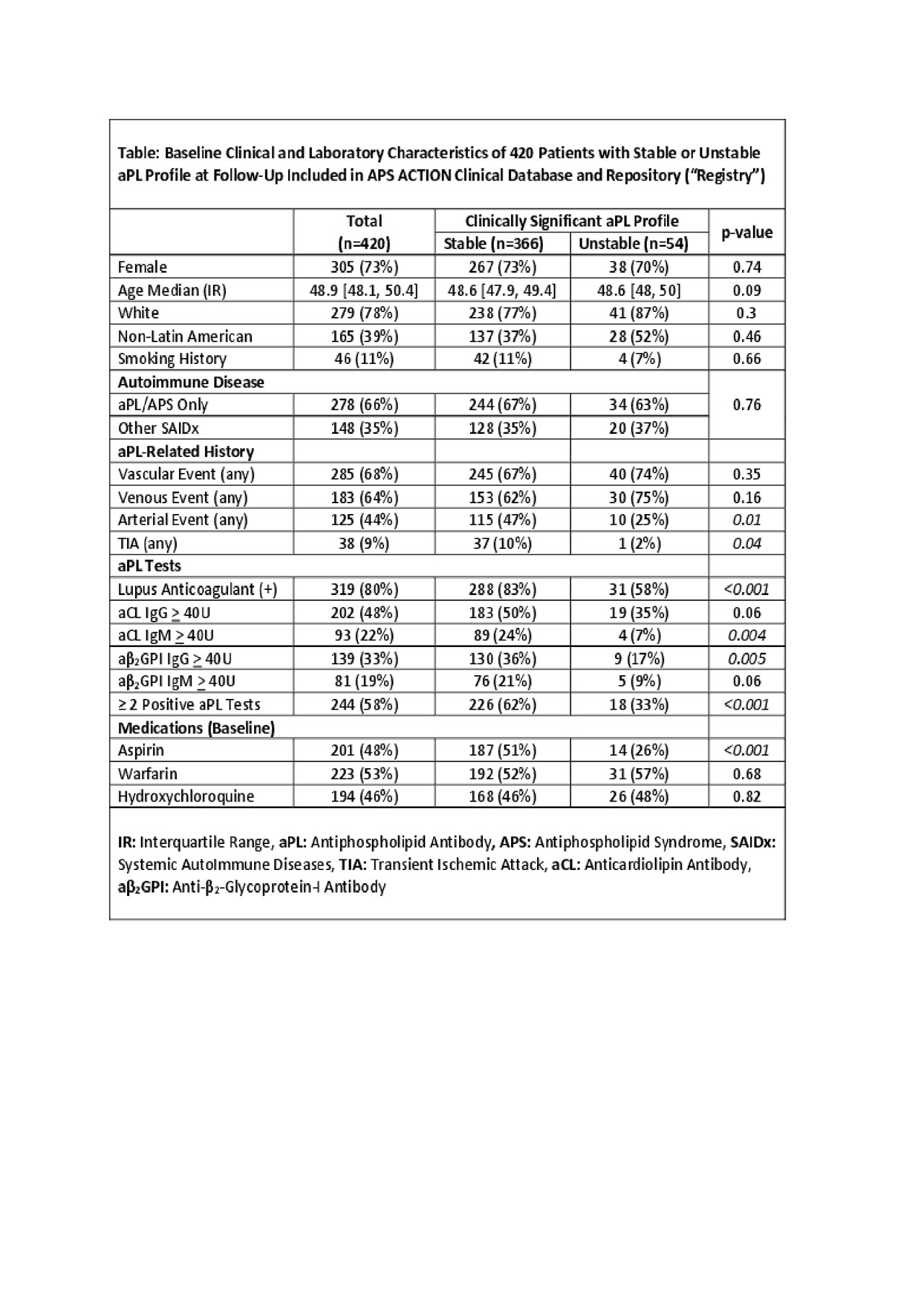

GkrouzmanE_Table


Disclosure: E. Gkrouzman, None; E. Sevim, None; J. Finik, None; D. Andrade, None; V. Pengo, None; S. Sciascia, None; M. Tektonidou, None; A. Ugarte, None; C. Chighizola, None; H. Belmont, None; L. Pérez Sánchez, None; L. Ji, None; P. Fortin, None; M. Efthymiou, None; G. De Jesus, None; D. Branch, None; C. Nalli, None; M. Petri, Eli Lilly and Company, 5, Exagen, 2, 5; R. Cervera, None; E. Rodriguez, None; J. Knight, None; T. Atsumi, AbbVie, 5, 8, Abbvie, 5, 8, Asahi Kasei Pharma Corporation, 8, Astellas Pharma, 8, 9, Astellas Pharma Inc, 8, AstraZeneca, 5, AstraZeneca plc, 5, 8, Bayer Yakuhin, 8, Bayer Yakuhin, Ltd., 8, Bristol-Myers Squibb, 8, 9, Chugai Pharmaceutical Co Ltd, 8, Chugai Pharmaceutical Co., 8, 9, Daiichi Sankyo, 8, 9, Daiichi Sankyo Co Ltd, 8, Eisai Co., Ltd, 8, Eli Lilly and Company, 8, 9, Eli Lilly Japan KK, 8, Elsai Co Ltd, 8, Gilead Sciences, 8, Gilead Sciences, Inc., 8, MEDICAL & BIOLOGICAL LABORATORIES CO., 5, Medical and Biological Laboratories Co Ltd, 5, Mitsubishi Tanabe Pharma, 8, 9, Nippon Shinyaku Co., 8, Novartis, 5, Novartis Pharma KK, 5, Ono Pharmaceutical, 5, ONO Pharmaceutical Co Ltd, 5, Otsuka Pharmaceutical, 8, Pfizer, 5, 9, Pfizer Inc, 5, 8, Sanofi, 9, Takeda Pharmaceutical Company, 8, Takeda Pharmaceuticals, 8; R. Willis, None; M. Bertolaccini, None; H. Cohen, None; J. Rand, None; D. Erkan, None; O. Of APS ACTION, None.

To cite this abstract in AMA style:

Gkrouzman E, Sevim E, Finik J, Andrade D, Pengo V, Sciascia S, Tektonidou M, Ugarte A, Chighizola C, Belmont H, Pérez Sánchez L, Ji L, Fortin P, Efthymiou M, De Jesus G, Branch D, Nalli C, Petri M, Cervera R, Rodriguez E, Knight J, Atsumi T, Willis R, Bertolaccini M, Cohen H, Rand J, Erkan D, Of APS ACTION O. Antiphospholipid Antibody Profile Stability over Time: Prospective Results from AntiPhospholipid Syndrome Alliance for Clinical Trials and InternatiOnal Networking (APS ACTION) Clinical Database and Repository (“Registry”) [abstract]. Arthritis Rheumatol. 2019; 71 (suppl 10). https://acrabstracts.org/abstract/antiphospholipid-antibody-profile-stability-over-time-prospective-results-from-antiphospholipid-syndrome-alliance-for-clinical-trials-and-international-networking-aps-action-clinical-database-and-r/. Accessed .
  • Tweet
  • Email a link to a friend (Opens in new window) Email
  • Print (Opens in new window) Print

« Back to ACR/ARP Annual Meeting 2019

ACR Meeting Abstracts - https://acrabstracts.org/abstract/antiphospholipid-antibody-profile-stability-over-time-prospective-results-from-antiphospholipid-syndrome-alliance-for-clinical-trials-and-international-networking-aps-action-clinical-database-and-r/

Advanced Search

My Favorites

Save and print abstracts during your browser session by clicking the “Favorite” button at the bottom of any abstract (must have cookies enabled in browser). See saved favorites.

Abstract Policies

  • ACR Convergence Abstract Embargo Policies
  • ACR Convergence Abstract Permissions & Reprints
  • PRSYM Abstract Policies

ACR Convergence. Where Rheumatology Meets

ACR Convergence 2026

Join us November 6-11 in Orlando, Florida.
See Registration Information

  • Contact ACR
  • Privacy Policy
  • ACR Policies
  • Cookie Preferences

© Copyright 2026 American College of Rheumatology