
Session Information
Date: Tuesday, October 23, 2018
Title: Pediatric Rheumatology – Clinical Poster III: Juvenile Idiopathic Arthritis and Uveitis
Session Type: ACR Poster Session C
Session Time: 9:00AM-11:00AM
Background/Purpose:
The temperomandibular joint (TMJ) is one of the most commonly affected joints in juvenile idiopathic arthritis (JIA) (up to 45% of cases). There is a discrepancy between clinical signs and presence of arthritis of the TMJ, which makes recognizing TMJ involvement and effective intervention difficult. Currently, combined radiographic and magnetic resonance (MR) imaging studies of the TMJ are necessary for a formal diagnosis. These approaches are time consuming, expensive, restricted to a clinical setting, and may not show involvement until the disease has sufficiently progressed. Thus, the high prevalence and difficulty in identifying the condition justifies the development of a novel approach for quantitatively and objectively diagnosing and monitoring diseases of the TMJ. The common finding of crepitus in an involved TMJ in patients with JIA inspired the current study. This common, but not well understood sign, led to our development of a novel, inexpensive wearable system for rapid measurement of the acoustic emissions produced during jaw movement. Here, we investigate the use of these sounds as a non-invasively measurable physiological biomarker of TMJ involvement in JIA.
Methods:
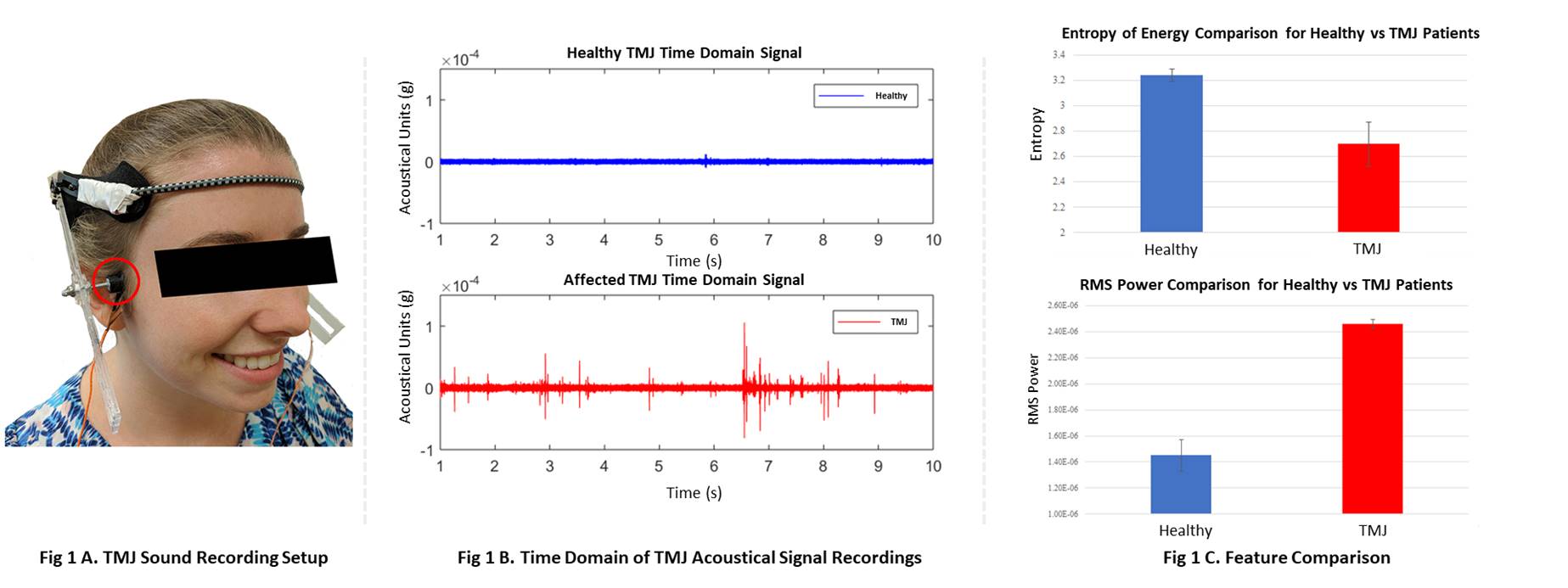
We built a custom system using contact microphones inside a headset to unobtrusively capture the acoustic emissions generated by the articulation of the TMJ (Fig. 1 A, microphone circled in red). Internal friction between articulating structures of the TMJ during movement produce various frequencies of vibrations that can be detected on the surface of the skin above the joint. To determine the possibility of using these vibrations to classify and diagnose TMJ involvement 6 patients have so far been recruited. 2 of the patients have clinically-diagnosed JIA with TMJ involvement, and 4 served as healthy controls. We recorded the unique audio profile produced by each patient opening and closing their jaw at a rate of 1 cycle / 4 seconds. Several features of the joint sounds were then calculated and compared to determine if they could be used to potentially classify and diagnose the condition.
Results:
The time-domain analysis of the signal shows large peaks and a chaotic signal from affected jaws, whereas the healthy jaw produces virtually no sounds with a flat signal (Fig. 1 B). Two of the signal features showing a large difference between the groups are presented (Fig. 1 C).
Conclusion:
The signals recorded with our portable TMJ acoustic emission headset may serve as a novel and convenient way to differentiate between patients with affected and unaffected jaws. In this small sample, two signal features were different between patients with affected TMJs and those without. This promising preliminary finding warrants further study, recruitment, and development to determine if this measurement modality can one day serve as a means of screening patients for jaw conditions.
To cite this abstract in AMA style:
Whittingslow D, Jeong HK, Gergely T, Ponder L, Prahalad S, Inan O, Abramowicz S. Acoustic Emissions Generated By the Temporomandibular Joint of Patients with Juvenile Idiopathic Arthritis and Their Implication on Patient Assessment and Screening: A Pilot Study [abstract]. Arthritis Rheumatol. 2018; 70 (suppl 9). https://acrabstracts.org/abstract/acoustic-emissions-generated-by-the-temporomandibular-joint-of-patients-with-juvenile-idiopathic-arthritis-and-their-implication-on-patient-assessment-and-screening-a-pilot-study/. Accessed .« Back to 2018 ACR/ARHP Annual Meeting
ACR Meeting Abstracts - https://acrabstracts.org/abstract/acoustic-emissions-generated-by-the-temporomandibular-joint-of-patients-with-juvenile-idiopathic-arthritis-and-their-implication-on-patient-assessment-and-screening-a-pilot-study/