
Session Information
Session Type: Poster Session (Monday)
Session Time: 9:00AM-11:00AM
Background/Purpose: ANCA-associated vasculitis (AAV) is associated with end-organ damage, complications of treatment, and excess death. Retrospective studies on the clinical course of AAV, including the evolution of clinical manifestations, comorbidities, and complications before and after the diagnosis are limited to analyses of claims data and case series relying on chart review or coded fields in electronic health records. No study has used automated methods to evaluate the clinical notes documented in the patients’ EHR as a data source to characterize AAV’s natural history.
Methods: The Partners AAV (PAAV) cohort is a consecutive inception cohort established at Partners HealthCare System (PHS), a large hospital system in New England, that has been previously described. All cases are PR3- or MPO-ANCA+. The clinical notes of this study cohort were obtained from PHS Research Patient Data Registry between the inception of the database and 08/23/2018. We then conducted automatic topic modeling to capture the trends of various themes mentioned in care provider notes three years prior to and five years after the initiation of AAV treatment. Each topic was manually labeled independently by two vasculitis experts; differences were resolved through consensus.
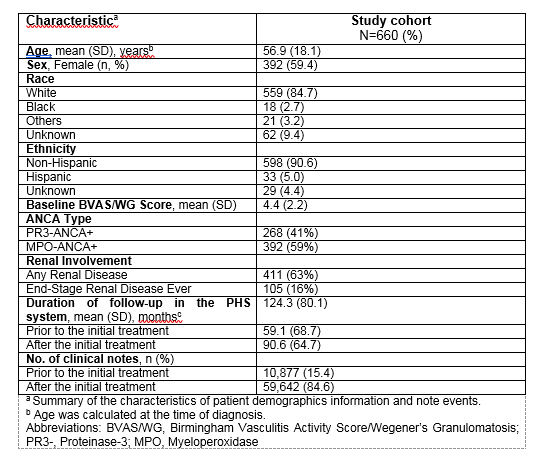
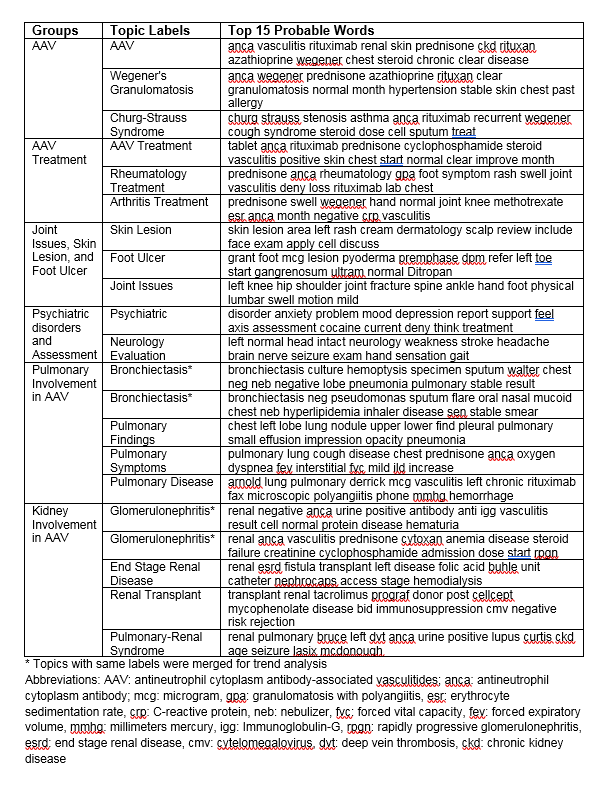
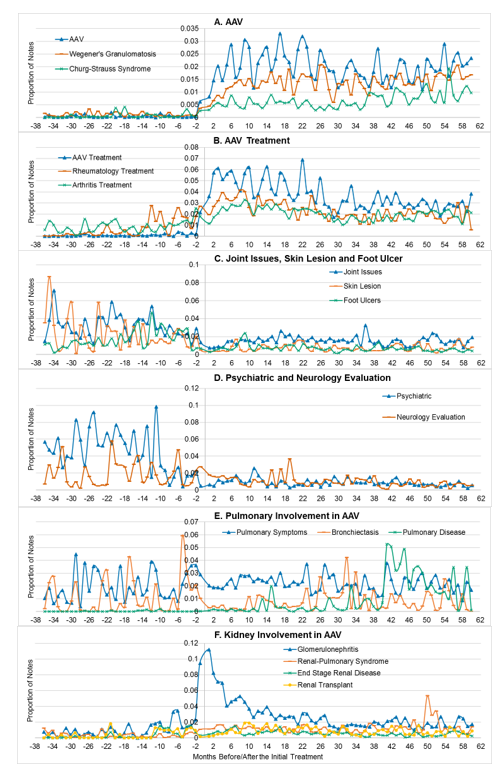
Results: This cohort analysis included 660 patients with AAV, with mean (SD) age of 56.9 (18.1) years and 392 (59.4%) female (Table 1). We generated 89 stable topics from a total of 70,519 notes. We studied the progression of the disease using topics that included AAV and treatment, cutaneous symptoms, psychiatric disorders, joint symptoms, and topics related to AAV complications of the kidneys and lungs like end-stage renal disease, renal transplantation, and bronchiectasis. Examples of topics are shown in Table 2. The temporal trends of selected topics are shown in Figure 1. Generally, AAV follows a prolonged clinical course with treatment mentioned for years following initiation (Figure 1a). Joint issues, skin lesions, and foot ulcers were frequently mentioned in the years preceding AAV, while these conditions appeared to be less commonly discussed following diagnosis and treatment of AAV (Figure 1c). Symptoms, including anxiety and stress, were often mentioned in the year prior to the disease diagnosis but then become less frequent (Figure 1d). Topics related to pulmonary and renal disease were common during the disease course but followed distinct patterns (Figures 1e and 1f). While pulmonary symptoms were common before and after diagnosis, renal disease (e.g., glomerulonephritis) was particularly common at the time of and following diagnosis.
Conclusion: Using the clinical notes of a large AAV cohort, we identified several topics relevant to the diagnosis, treatment, comorbidities, and complications of AAV. The patterns and trends of these topics support the notion that diagnostic delay is common and that some symptoms (e.g., cutaneous) may respond better to treatment than others (e.g., pulmonary). This method can therefore provide unique insights regarding signs and symptoms that are often not documented in EHR structured data fields. Future studies might evaluate the role of automated topic modeling in identifying possible AAV cases prospectively.
To cite this abstract in AMA style:
Wang L, Miloslavsky E, Stone J, Choi H, Zhou L, Wallace Z. A Retrospective Cohort Study Using Clinical Notes and Latent Topic Modeling to Characterize the Natural History of ANCA-Associated Vasculitis [abstract]. Arthritis Rheumatol. 2019; 71 (suppl 10). https://acrabstracts.org/abstract/a-retrospective-cohort-study-using-clinical-notes-and-latent-topic-modeling-to-characterize-the-natural-history-of-anca-associated-vasculitis/. Accessed .« Back to 2019 ACR/ARP Annual Meeting
ACR Meeting Abstracts - https://acrabstracts.org/abstract/a-retrospective-cohort-study-using-clinical-notes-and-latent-topic-modeling-to-characterize-the-natural-history-of-anca-associated-vasculitis/